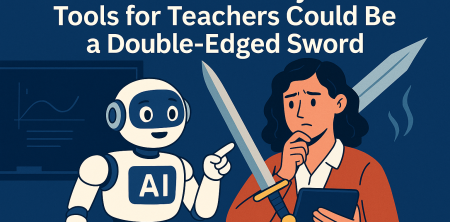
Alright, let's talk about AI in education. It's the buzzword that's either going to save us all or lead to the complete erosion of critical thinking, depending on who you ask. And honestly, both sides have points worth considering. As someone who’s spent years in the classroom, from K-12 to university dean, I’ve seen my share of educational fads and genuine breakthroughs. AI, though, feels different. It's not just another new piece of software; it’s a fundamental shift in how we might approach teaching and learning. But before we dive headfirst into the ‘best AI tools for teachers,’ we need to acknowledge the elephant in the room: the very real, very charged debate happening right now.
Think about it: New York City and Los Angeles, two of the largest school districts in the country, have slapped one-year bans on generative AI for younger students. Why? To protect critical thinking skills. That’s a pretty stark warning, isn’t it? On one hand, you have tech giants like Microsoft, OpenAI, and Anthropic pouring millions into initiatives like the National Academy for AI Instruction, aiming to train hundreds of thousands of educators. They see the promise of personalized learning and efficiency. On the other, parents and child development experts are raising legitimate concerns about student data privacy, the potential for AI to diminish genuine learning, and a glaring lack of evidence supporting its long-term benefits for children. It’s a highly emotional debate, and frankly, we're navigating uncharted territory. So, while I’m going to share some of the most effective AI tools for teachers, I want you to consider each one through a critical lens, always asking: Is this truly enhancing education, or just making things easier without true depth?
1. Grammarly: Beyond Basic Spell Check
Let's start with a tool that many of you probably already use, perhaps without even realizing its AI capabilities. Grammarly isn't just a fancy spell checker; it's a sophisticated AI-powered writing assistant. For teachers, this can be an absolute godsend, especially when you're wading through stacks of student essays. It goes beyond catching typos and grammatical errors, offering suggestions for clarity, conciseness, vocabulary enhancement, and even tone. Imagine being able to provide students with instant feedback on their writing mechanics before you even see the draft. That’s time saved for you, and immediate learning for them.
But here’s the rub: while Grammarly can significantly improve the technical aspects of student writing, it doesn’t teach the underlying principles of effective communication or critical thought. Students can become overly reliant on its suggestions, potentially bypassing the cognitive effort required to genuinely understand sentence structure or nuanced word choice. As educators, our role isn't just to polish the surface; it's to cultivate deep understanding. So, while Grammarly can be an excellent drafting tool and a way to reduce surface-level errors, it must be used as a supplement, not a replacement, for explicit writing instruction and critical feedback from a human teacher.
2. ChatGPT & Google Bard (now Gemini): The Generative Powerhouses
Okay, these are the big players, the ones causing all the commotion. ChatGPT and Google Bard (now Gemini) are generative AI models capable of producing human-like text, translating languages, writing different kinds of creative content, and answering your questions in an informative way. For teachers, the potential applications are vast, almost dizzying. Need a quick lesson plan outline for a new topic? Ask AI. Want to generate multiple-choice questions for a quiz? It can do that. Looking for differentiated reading passages for students at various levels? Absolutely. The ability to rapidly generate content can be a massive time-saver for overworked educators.
However, this is precisely where the controversy comes into sharpest focus. The fear is that students will use these tools not for learning, but for cheating – generating entire essays or completing assignments without any original thought. And honestly, some will. But the deeper concern, the one driving those school district bans, is the potential for these tools to erode critical thinking. If students constantly rely on AI to generate ideas, synthesize information, or even write their thoughts, are they truly developing those essential cognitive muscles? How do we ensure they're engaging with the material, wrestling with complex ideas, and forming their own conclusions, rather than just prompting an AI to do it for them? The pedagogical challenge here isn’t just about detection; it’s about reimagining assignments and teaching strategies to integrate these tools responsibly, turning them into partners for exploration rather than crutches for avoidance. These tools represent some of the most powerful and potentially transformative of the best AI tools for teachers, but they also demand the most careful consideration.
3. Quizlet: Flashcards Evolved
Quizlet has been a staple for many students and teachers for years, primarily known for its digital flashcards. But its integration of AI takes it a step further, making it a more dynamic learning platform. Quizlet’s AI features, such as 'Learn' mode, use spaced repetition and adaptive questioning to help students master material more efficiently. It tracks what students know and don't know, tailoring the learning experience to their individual needs, which is a core promise of personalized learning.
For teachers, Quizlet can be an invaluable resource for vocabulary acquisition, memorization of facts, and even basic concept checking. You can create sets for your students, monitor their progress, and identify areas where the class as a whole might be struggling. This data-driven insight can inform your instruction, allowing you to re-teach or elaborate on specific topics. The concern here is less about critical thinking erosion and more about the type of learning it supports. While excellent for recall and foundational knowledge, Quizlet primarily addresses lower-order thinking skills. It's a fantastic tool for building a knowledge base, but it's crucial that teachers integrate it into a broader curriculum that also challenges students to analyze, evaluate, and create.
4. Canva's Magic Studio: Design with AI Assistance
Canva is already a beloved tool for many educators who aren't graphic designers but need to create visually appealing presentations, worksheets, or classroom posters. Now, with its AI-powered 'Magic Studio,' it's become even more powerful. Imagine being able to describe the image you need for a lesson – say, 'a historical map of ancient Rome with key landmarks highlighted' – and having AI generate it for you. Or transforming a bulleted list into a visually engaging infographic with a few clicks. This isn't just about making things pretty; it's about making complex information more accessible and engaging for students, especially visual learners. (See: CDC on youth health behaviors.)
For teachers, this means less time wrestling with design software and more time focusing on content and pedagogy. It can empower educators to create high-quality, professional-looking materials that might otherwise require significant time or specialized skills. The potential downside, if there is one, lies not in the tool itself but in its misuse. We still need to ensure that the visual aids we create, even with AI assistance, are accurate, unbiased, and genuinely enhance learning, rather than just adding visual clutter. But as far as tools to boost efficiency and engagement, Canva's AI features are a strong contender among the best AI tools for teachers. For more context, see radical new methods in education.
5. Curipod: Interactive Lessons Powered by AI
Curipod is an exciting entrant in the Edtech space, aiming to make lessons more interactive and dynamic using AI. It allows teachers to generate interactive presentations, polls, word clouds, and Q&A sessions on the fly, transforming traditional lectures into engaging, participatory experiences. What's particularly clever about Curipod is its ability to take a topic you input and suggest interactive activities, questions, and even entire lesson flows, all designed to keep students actively involved.
Think about the typical classroom scenario: a teacher delivers content, and students passively receive it. Curipod flips that script by making interaction seamless. Students can respond to prompts from their devices, providing real-time feedback that the teacher can immediately use to adjust instruction. This kind of active engagement is crucial for deeper learning. The challenge, as with any highly interactive tool, is managing the classroom environment and ensuring that the technology genuinely facilitates learning rather than becoming a distraction. But for fostering participation and gathering instant formative assessment, Curipod offers a compelling vision for what AI can do in the classroom.
6. DALL-E 2 / Midjourney: Visualizing Concepts
Similar to Canva's AI image generation, but often more powerful and versatile, DALL-E 2 and Midjourney are text-to-image AI tools. While they might seem like niche creative tools, their application in education, particularly for visual learners or abstract concepts, is significant. Need an image of 'a bustling marketplace in ancient Mesopotamia' for a history lesson? Or 'the molecular structure of DNA depicted as a swirling galaxy'? These tools can generate highly specific, unique visuals based on your textual prompts.
This capability allows teachers to create bespoke visual aids that might be impossible to find through traditional image searches. It can help students visualize abstract ideas, historical events, or scientific processes in a way that stock photos simply can't. The caveat, of course, is the potential for AI-generated images to be inaccurate or to perpetuate biases present in their training data. Teachers need to critically review any AI-generated image for accuracy and appropriateness before using it in the classroom. However, for sparking imagination and providing custom visual support, these are some of the more creative best AI tools for teachers.
7. Speechify: Text-to-Speech for Accessibility
Speechify is an AI-powered text-to-speech reader that can be a game-changer for accessibility and differentiated instruction. It takes any text – an article, a PDF, a web page, even a physical book scanned with its app – and reads it aloud in natural-sounding voices. For students with reading disabilities like dyslexia, visual impairments, or even those who are English language learners, Speechify can significantly reduce barriers to accessing content.
As educators, we're constantly striving to meet the diverse needs of our students. Speechify offers a powerful way to do just that, allowing students to consume information in a format that works best for them. It can help improve reading comprehension by allowing students to hear the words as they read along, reinforcing pronunciation and fluency. The primary concern here is minor: ensuring that students are still developing their own reading skills and not relying solely on the auditory input. But as a tool for inclusion and support, Speechify is an excellent example of AI enhancing, rather than replacing, fundamental learning.
8. Khan Academy's Khanmigo: Personalized Learning & Tutoring
Khan Academy is already a titan in online education, and its AI tutor, Khanmigo, takes its mission of free, world-class education to a new level. Khanmigo isn't just a chatbot; it's designed to act as a personalized tutor and teaching assistant. For students, it provides tailored explanations, hints, and practice problems, guiding them through concepts they're struggling with without simply giving them the answer. It encourages problem-solving and critical thinking by asking probing questions rather than just providing solutions.
For teachers, Khanmigo acts as an assistant, helping generate lesson plans, create engaging activities, and even draft reports. This is a powerful blend of personalized learning for students and efficiency for educators. The ethical considerations here are paramount: how do we ensure the AI is truly fostering understanding and not just rote memorization? How do we monitor student interactions to ensure safety and prevent over-reliance? Khan Academy is known for its pedagogical rigor, and Khanmigo aims to align with that, but the broader debate about AI's role in direct instruction will undoubtedly continue. It’s one of the most ambitious of the best AI tools for teachers, and its development will be worth watching closely.
9. Synthesia: AI Video Creation for Engaging Content
Synthesia allows you to create professional-looking videos with AI-generated avatars speaking your text. While it might sound like something out of a sci-fi movie, its applications for educators are surprisingly practical. Imagine needing to create an introductory video for a new unit, an explanation of a complex concept, or even a 'welcome back' message for your students – but you're camera-shy or lack professional video equipment. Synthesia lets you type your script, choose an avatar, and generate a polished video in minutes. (See: AP News on AI in education.)
This can be incredibly useful for delivering consistent, engaging content, especially for flipped classrooms, online learning modules, or even parent communications. It reduces the barrier to entry for creating high-quality video resources. Of course, the human element of teaching is irreplaceable, and we don't want to replace all human interaction with AI avatars. But for specific instructional videos, announcements, or even creating content in multiple languages with AI translation, Synthesia offers a powerful, efficient solution that many educators might find surprisingly valuable. For more context, see districts facing scrutiny over educational policies.
10. Eduaide.AI: Your Classroom AI Assistant
Eduaide.AI is a relatively newer platform that's quickly gaining traction because it’s built specifically with the needs of K-12 and higher education teachers in mind. Unlike general-purpose AI tools, Eduaide.AI focuses on generating a wide range of educational resources. Think lesson plans, rubrics, quizzes, discussion prompts, and even personalized feedback for student work. It can take a topic, a grade level, and specific learning objectives, and then spit out tailored materials, saving teachers hours of prep time each week.
What makes Eduaide.AI particularly compelling for educators is its emphasis on pedagogical soundness. It's not just generating text; it's designed to create resources that align with common teaching practices and learning theories. This means teachers can spend less time creating the basic framework of a lesson or assignment and more time refining it, differentiating it, and delivering it with their unique teaching style. The primary challenge, as with any generative AI, is ensuring the output perfectly matches the specific nuance or context of a classroom. Teachers still need to review and adapt the generated content, but it provides an incredibly robust starting point, making it one of the most practical best AI tools for teachers focused on daily classroom operations.
11. Turnitin's AI Writing Detection: Addressing Academic Integrity
While most of this list focuses on AI as a creative or assistive tool for teachers, it's equally important to consider AI's role in maintaining academic integrity, especially with the rise of generative AI. Turnitin, a long-standing tool for plagiarism detection, has now integrated AI writing detection capabilities. This isn't a tool for direct instruction or content creation, but it’s a crucial backstop for educators grappling with the ethical implications of AI in student work.
For teachers, Turnitin’s AI detection helps identify instances where students might be submitting AI-generated content as their own original work. This isn't about catching every single instance, but rather about providing data points that can initiate conversations with students about academic honesty, proper citation, and the responsible use of AI. It acknowledges the reality that AI is here, and rather than burying our heads in the sand, we need tools to manage its impact on assessment. While no AI detector is 100% foolproof, it gives teachers a necessary resource to navigate the new landscape of academic integrity, reinforcing the importance of original thought and critical engagement.
The Unseen Peril and the Path Forward
The integration of AI into education is not a question of 'if,' but 'how.' As we’ve explored some of the best AI tools for teachers, it's clear that the potential for enhancing learning and streamlining administrative tasks is immense. From personalized learning paths and instant feedback to content creation and accessibility, AI offers capabilities that were unimaginable just a few years ago. It promises to free up valuable teacher time, allowing educators to focus on the truly human aspects of their profession: mentorship, emotional support, and the cultivation of critical thinking.
However, the skepticism, the bans, and the concerns from parents and child development experts are not without merit. The 'unseen peril' isn't just about cheating; it's about the subtle erosion of cognitive effort, the potential for algorithmic bias, and the unprecedented harvesting of student data. We cannot, and must not, blindly adopt these technologies without rigorous evaluation and a deep understanding of their long-term impact on young minds. Schools need robust policies around data privacy, ethical AI use, and training for educators to truly leverage these tools effectively and responsibly.
Ultimately, the challenge for educators isn't to resist AI, but to master it. It's about developing AI literacy ourselves, understanding its strengths and limitations, and integrating it in ways that genuinely amplify human intelligence, rather than diminish it. We must continue to champion critical thinking, creativity, and human connection as the cornerstones of education, ensuring that AI serves as a powerful assistant, not a replacement for the profound human act of teaching and learning. For more context, see making the internet safe for children. (See: New York Times on AI tools in education.)
Navigating the Ethical Minefield: Data Privacy and Bias in AI
Beyond the immediate concerns of critical thinking and academic integrity, there are deeper ethical considerations that teachers and school administrators absolutely must grapple with when integrating AI tools. One of the most significant is student data privacy. Many AI tools, particularly those offering personalized learning experiences, collect vast amounts of data on student performance, engagement, and even emotional responses. Who owns this data? How is it stored? Is it truly anonymized? And what safeguards are in place to prevent its misuse or sale to third parties? These aren't hypothetical questions; they are real concerns that require transparent policies and robust legal frameworks. Parents have a right to know how their children's digital footprints are being managed, and schools have a responsibility to protect that information as diligently as they protect physical records.
Another critical ethical dimension is algorithmic bias. AI models are trained on massive datasets, and if those datasets reflect existing societal biases – whether racial, gender, or socioeconomic – the AI will perpetuate and even amplify them. This can manifest in subtle ways, like an AI tutor inadvertently reinforcing stereotypes, or in more overt forms, like an assessment tool consistently underestimating the abilities of students from certain backgrounds. As educators, our mission is equity and inclusion. Using AI that carries inherent biases undermines that mission. It's imperative that we demand transparency from AI developers about their training data and actively scrutinize the outputs of these tools for any signs of unfairness. This requires a level of AI literacy that many educators are just beginning to develop, highlighting the urgent need for comprehensive professional development.
Professional Development: Equipping Teachers for the AI Era
It's one thing to list the best AI tools for teachers; it's another entirely to empower educators to use them effectively and ethically. The rapid evolution of AI means that traditional professional development models often fall short. We can't just offer a one-off workshop and expect teachers to become AI experts. Instead, we need ongoing, iterative training that focuses not just on technical proficiency, but on pedagogical integration and critical evaluation. This means helping teachers understand how AI works, what its limitations are, and how to design assignments that leverage AI for learning while still fostering essential human skills.
Effective professional development in the AI era should include hands-on experience with these tools, opportunities for collaborative lesson design, and dedicated time for reflection and discussion about best practices and potential pitfalls. It should also address the ethical dilemmas head-on, providing frameworks for teachers to analyze and mitigate issues like data privacy and bias. Furthermore, it's crucial to foster a culture of experimentation and shared learning within school communities. Teachers are often the most innovative problem-solvers; by empowering them with knowledge and support, we can collectively discover the most effective and responsible ways to harness AI's potential in the classroom.
Looking Ahead: AI as a Partner, Not a Replacement
The conversation around AI in education needs to move beyond a binary debate of good or bad. Instead, we should view AI as a powerful partner that, when used thoughtfully, can augment human capabilities and transform the learning experience. Imagine a future where AI handles the repetitive tasks – grading multiple-choice questions, generating basic lesson outlines, or even providing initial drafts of differentiated materials – freeing teachers to focus on higher-order tasks. This means more time for individualized mentorship, facilitating complex discussions, fostering creativity, and addressing the social-emotional needs of students. AI can personalize learning at scale, something human teachers, despite their best efforts, struggle to achieve in a crowded classroom.
The goal isn't to replace the human teacher but to elevate the role of the teacher. AI can handle the "what" and "how" of content delivery and basic assessment, allowing teachers to deepen their focus on the "why" – the critical thinking, ethical reasoning, and human connection that truly define education. The best AI tools for teachers aren't those that automate teaching entirely, but those that enhance a teacher's ability to inspire, challenge, and connect with their students on a profoundly human level. This future requires careful planning, ethical consideration, and a commitment to continuous learning, but it's a future where education can be more equitable, more engaging, and ultimately, more human.
Trending Now
- This Game-Changing EU Kids Act Could Finally Make the Internet Safe for Your Children
- read the full story
- this guide on schools don’t have to tell parents about student gender identity — unless they ask, judge rules – la times
- our breakdown of this elite private school’s radical new method will leave you speechless
Frequently Asked Questions
What are the risks of using AI tools in education?
AI tools in education can pose risks such as diminishing critical thinking skills and raising concerns about student data privacy. Critics argue that reliance on AI may undermine genuine learning, while proponents highlight the potential for personalized learning experiences.
How can AI tools benefit teachers?
AI tools can benefit teachers by enhancing efficiency and providing personalized learning experiences for students. They can assist in tasks like grading, lesson planning, and offering tailored feedback, allowing educators to focus more on teaching.
Why have some school districts banned AI for younger students?
School districts like New York City and Los Angeles have banned AI for younger students for a year to protect critical thinking skills. This decision reflects concerns over the potential negative impact of AI on genuine learning and cognitive development.
What is the debate surrounding AI in education?
The debate surrounding AI in education centers on its potential benefits versus risks. Proponents emphasize personalized learning and efficiency, while opponents worry about data privacy, erosion of critical thinking, and lack of evidence supporting long-term benefits for students.
What is Grammarly and how does it use AI?
Grammarly is an AI-powered writing assistant that goes beyond basic spell checking. It analyzes text for grammar, punctuation, style, and tone, providing users with real-time feedback to improve their writing skills, making it a valuable tool for both teachers and students.
What's your take on this? Share your thoughts in the comments below — we read every one.


0 Responses