```html
Black holes have long fascinated scientists and enthusiasts alike, and recent research suggests that these enigmatic cosmic phenomena may play a pivotal role in shaping the evolution of galaxies. A startling revelation indicates that powerful black hole winds could suppress star formation in some of the universe's largest galaxies, offering an explanation for their unexpectedly low star count. In this article, we’ll explore the implications of this finding, focusing particularly on the research surrounding the galaxy NGC 4151.
Understanding Black Hole Winds
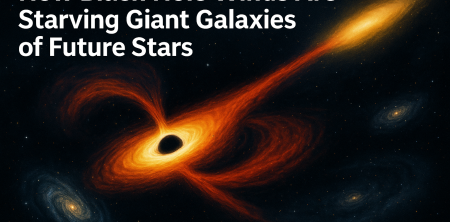
So, what exactly are black hole winds? These winds occur when supermassive black holes at the centers of galaxies exert immense gravitational forces. As matter spirals into the black hole, it heats up and can emit powerful jets and winds. These winds are composed of gas and particles that can travel at incredible speeds, sometimes close to the speed of light. As they escape the black hole's grasp, these winds can interact with the surrounding gas in the galaxy, which is crucial for star formation.
The energy and momentum carried by black hole winds can have profound effects on the interstellar medium, the gas and dust that fill galaxies. This interaction often leads to turbulence and shock waves, disrupting the gas that would otherwise coalesce into new stars. The feedback mechanism between black holes and their host galaxies thus becomes a critical area of study, especially for understanding the lifecycle of galaxies.
The Case of NGC 4151
The research highlighting these effects was centered on the galaxy NGC 4151, a well-known Seyfert galaxy located about 40 million light-years away in the constellation Canes Venatici. NGC 4151 is notable not only for its active supermassive black hole but also for its vibrant star-forming regions. However, astronomers have puzzled over why this galaxy has fewer stars than expected, given its apparent resources. The new findings suggest that the powerful winds from its central black hole might be a key factor in this discrepancy.
Using observations from multiple wavelengths, researchers measured the X-ray emissions from NGC 4151. They detected that during certain periods, the X-rays emitted by the black hole were hard but faint, correlating with the strongest signs of black hole winds. This revelation adds another layer to our understanding of how black holes interact with their environments.
Winds and Star Formation: The Connection
A critical aspect of the research was the timing of the observed phenomena. The study found that the black hole winds appeared approximately 10,000 seconds after changes in the X-ray emissions. This delay aligns with theoretical models that suggest the influence of black hole activity can propagate outward, disrupting the surrounding gas necessary for forming new stars.
The implications of this timing are significant. It indicates that the relationship between a black hole and its host galaxy is not instantaneous. Instead, there’s a complex feedback loop that governs the dynamics of star formation. A sudden surge in X-ray emissions can trigger winds that, in turn, limit the available gas for star formation, ultimately leading to a more barren galaxy. (mysterious neutrino discovery)
The Impact of Black Hole Winds on Galaxy Evolution
This study presents compelling evidence that black hole winds could be pivotal in determining the evolutionary pathways of massive galaxies. While previous studies have acknowledged black holes' roles in regulating star formation, this new research provides a more nuanced understanding. It reveals that the timing and strength of black hole activity can systematically influence the star formation rates in galaxies. (See: Wikipedia article on black holes.)
It’s crucial to note that this process is not uniform across all galaxies. The intensity of black hole winds can vary widely based on factors like the mass of the black hole, the amount of matter it consumes, and the properties of the interstellar medium within the galaxy. This variability means that while some galaxies may suffer from star formation suppression due to their black holes, others may experience a different dynamic altogether.
Comparative Studies: What Other Galaxies Reveal
To further contextualize the findings from NGC 4151, researchers are looking at other galaxies with active supermassive black holes. For instance, studies of the Milky Way's own central black hole, Sagittarius A*, have provided insights into how similar processes might play out in our own galaxy. While Sagittarius A* is relatively quiescent compared to other black holes, understanding its influence on galactic dynamics could offer parallels to more energetic systems like NGC 4151.
Additionally, examining the star formation histories of different types of galaxies — such as elliptical galaxies versus spiral galaxies — can shed light on the broader implications of black hole winds. Elliptical galaxies, which typically harbor massive black holes, often appear redder and more devoid of new stars compared to their spiral counterparts. This observation bolsters the hypothesis that black hole winds could be a driving force behind the observed differences in star formation across galaxy types.
The Role of X-rays in Understanding Black Hole Winds
X-ray emissions are a key indicator of the processes occurring around black holes. In NGC 4151, the correlation between X-ray brightness and wind strength has provided researchers with valuable data. When the X-rays are hard yet faint, this could signal that the black hole is actively consuming material but not producing as much energy as one might expect during an active phase. This points to a more complex picture where black holes can modulate their influence over time.
Future observations of X-ray emissions from other active galaxies will be essential in refining our understanding of how black hole winds operate. By correlating X-ray data with star formation rates, astronomers can better gauge the extent to which black holes influence their host galaxies. This research will likely lead to more nuanced models of galaxy formation and evolution.
Future Research Directions
The findings from NGC 4151 open up several avenues for future research. Scientists are eager to explore how black hole winds affect not just star formation, but the overall evolution of galaxies over cosmic time. One long-term goal is to determine whether black holes are simply passive observers of galactic evolution or active participants that can steer the trajectory of star formation.
One exciting prospect is the use of advanced observational techniques, such as gravitational wave astronomy and high-resolution imaging. These methods could help capture more detailed interactions between black holes and their host galaxies, allowing for a deeper understanding of the phenomena at play. As telescope technology continues to advance, we can expect groundbreaking discoveries that may reshape our understanding of the universe.
The Emotional and Philosophical Implications
The notion that black hole winds could be “starving” galaxies is not just a scientific revelation; it also carries emotional and philosophical weight. For centuries, humanity has gazed at the stars, dreaming of what lies beyond our terrestrial confines. The idea that these massive structures can wield such power over the formation of stars — the very building blocks of life — is both awe-inspiring and humbling.
Reflecting on these findings invites us to consider our place within the universe. If black holes can dictate the fate of galaxies, what does that say about the forces that govern our own existence? It’s a reminder that the universe is a dynamic and interconnected system, where one phenomenon can dramatically influence another, echoing the interconnectedness we often observe in nature. (See: NASA's overview of black holes.)
Frequently Asked Questions about Black Hole Winds
What are black hole winds made of?
Black hole winds consist of high-energy particles and gases ejected from the accretion disk of a supermassive black hole. These winds can carry significant momentum and energy, affecting the surrounding interstellar medium.
How do black hole winds affect star formation?
Black hole winds can suppress star formation by creating turbulence and shock waves in the interstellar medium. This disruption prevents gas from coalescing into new stars, leading to a lower star formation rate in the galaxy.
Can all galaxies experience black hole winds?
Not all galaxies will experience black hole winds in the same way. The influence of these winds depends on the mass of the black hole, the rate of material accretion, and the properties of the surrounding gas. Galaxies with more massive black holes or those actively consuming larger amounts of matter are more likely to exhibit significant wind effects.
What future observations will help us understand black hole winds better?
Future observations using next-generation telescopes will focus on capturing X-ray emissions and other wavelengths from a variety of active galaxies. Instruments designed for gravitational wave detection may also provide insights into the dynamics associated with black hole winds, enhancing our understanding of their role in galaxy evolution.
How do black hole winds relate to galaxy shapes?
There’s a relationship between black hole winds and the morphology of galaxies. For instance, elliptical galaxies, which generally have more massive black holes, tend to show lower star formation rates and redder colors, suggesting that black hole winds may be suppressing star formation in these systems compared to spiral galaxies.
Case Studies: Insights from Other Galaxies
Research has shown that other notable galaxies, like M87, which is famous for its massive black hole, display signs of black hole winds. M87 serves as an excellent case study for understanding the impact of these winds, as it hosts one of the most well-observed black holes. Astronomers have documented jets emanating from M87, which are thought to be related to the activities of its black hole. These jets, much like winds, can affect star formation in the surrounding environment, supporting the notion that black holes and their emissions significantly shape their host galaxies.
Statistics: The Scale of Black Hole Influence
A recent study indicated that about 90% of galaxies contain a supermassive black hole at their centers. Among these, the majority exhibit some form of black hole activity, such as quasar activity or jet emissions. Statistically, this means that black hole winds could influence a vast number of galaxies across the universe, shaping cosmic evolution on a grand scale. The active winds from these supermassive black holes can generate energy output exceeding that of entire galaxies, illustrating their powerful role in the cosmos.
Further Implications of Black Hole Winds
The influence of black hole winds extends beyond mere star formation rates; they may also play a role in the development of massive structures, like galaxy clusters. As black holes expel winds, they can drive gas out of galaxies, which affects not only the individual galaxy but the larger cosmic web structure. The expulsion of gas can lead to a more significant number of galactic mergers and interactions, which in turn might lead to new star formation in different regions, creating a complex network of stellar birth across the universe. (See: Nature article on black hole winds.)
The Role of Feedback Loops in Galactic Dynamics
Understanding black hole winds involves delving into feedback loops that govern both star formation and black hole activity. When a black hole consumes a large amount of gas, it can lead to a sudden increase in energy output, which in turn creates a powerful wind that can blow away nearby gas. This not only hinders new star formation but can also influence the growth of the black hole itself. This feedback loop creates a cyclical relationship that is critical to the evolution of galaxies.
Technological Advances and Observational Strategies
The study of black hole winds is being propelled forward by cutting-edge technologies in observational astronomy. The deployment of advanced space telescopes, like the James Webb Space Telescope, allows astronomers to capture detailed images and spectra of distant galaxies and black holes. These observations can help in understanding the intricate relationships between black holes and their host galaxies. In particular, high-resolution imaging can reveal the structure of the gas being expelled and the effects it has on star formation.
Case Study: The Andromeda Galaxy
The Andromeda Galaxy (M31) can provide deeper insights into the role of black hole winds. It is the nearest spiral galaxy to the Milky Way and is home to a supermassive black hole, similar to Sagittarius A*. Studies of Andromeda's star formation patterns reveal areas where black hole activity may have suppressed star formation, making it a robust case for analyzing how black hole winds influence galactic evolution. Researchers continue to monitor Andromeda to see how its black hole may interact with the surrounding medium, especially as it begins to merge with the Milky Way in billions of years.
Conclusion: The Future of Galactic Studies
The implications of black hole winds on galactic evolution are profound. They challenge existing paradigms and encourage a reevaluation of how we understand the cosmos. As researchers continue to investigate the effects of black holes on their host galaxies, we can anticipate a rich tapestry of discoveries that will deepen our understanding of the universe.
In a way, the study of black hole winds is not just about understanding distant galaxies. It’s about unraveling the mysteries of cosmic evolution and our role within it. As we gather more data and refine our theories, we move one step closer to comprehending the intricate dance between black holes and the galaxies that they both create and destroy.
```
Trending Now
Frequently Asked Questions
What are black hole winds?
Black hole winds are powerful jets and winds emitted when matter spirals into a supermassive black hole. These winds, composed of gas and particles, can travel at incredible speeds and interact with the surrounding interstellar medium, influencing star formation within galaxies.
How do black holes affect star formation?
Supermassive black holes can suppress star formation in their host galaxies through their winds. These winds create turbulence and shock waves in the interstellar medium, disrupting the gas that would otherwise coalesce into new stars, thus affecting the galaxy's star count.
What is the significance of the galaxy NGC 4151?
NGC 4151 is a Seyfert galaxy that is notable for its active supermassive black hole and vibrant star-forming regions. Recent research has revealed that despite its resources, NGC 4151 has fewer stars than expected, likely due to the effects of black hole winds.
Why do some galaxies have fewer stars than expected?
Some galaxies, like NGC 4151, have unexpectedly low star counts due to the influence of black hole winds. These winds disrupt the gas necessary for star formation, leading to a suppression of new stars in these massive galaxies.
What role do black holes play in galaxy evolution?
Black holes play a crucial role in galaxy evolution by regulating star formation through their winds. The feedback mechanism between black holes and their host galaxies affects the interstellar medium, influencing the lifecycle and development of galaxies over time.
Have you experienced this yourself? We'd love to hear your story in the comments.

