```html
Understanding Bloom's Taxonomy
Bloom's Taxonomy is a framework that educators worldwide have utilized for decades to foster learning and assess student outcomes. Initially introduced in 1956 by Benjamin Bloom and his colleagues, the taxonomy serves as a systematic classification of educational objectives. It offers a hierarchy that guides educators in formulating educational goals and assessments. The original taxonomy comprised six cognitive levels, from 'Knowledge' to 'Evaluation', which educators could use to structure curricula and assess student learning.
As educational paradigms shifted over time, it became evident that the original taxonomy needed revisions to remain relevant. This led to the development of a revised taxonomy in the early 2000s, aimed at addressing the evolving needs of learners and the education landscape. Understanding the Bloom's Taxonomy differences between the original and revised versions reveals not just what changed but also why these changes matter in contemporary education.
A Historical Perspective: The Birth of Bloom's Taxonomy
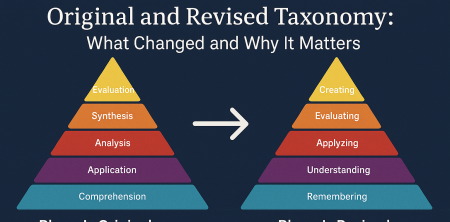
The original Bloom's Taxonomy emerged in a post-World War II educational landscape characterized by an emphasis on higher-order thinking. The focus was to cultivate students' cognitive abilities in a structured manner. The taxonomy included six hierarchical levels: Knowledge, Comprehension, Application, Analysis, Synthesis, and Evaluation. Each level represented a step in the cognitive processes, intended to help educators create assessments that aligned with their instructional goals.
As education progressed, it became apparent that the original taxonomy, while useful, had limitations. Critics argued that it was too rigid and failed to capture the complexity of learning processes. As such, in 2001, a group of cognitive psychologists, curriculum theorists, and instructional researchers, led by Lorin Anderson, a former student of Bloom, embarked on a project to revise the taxonomy to better reflect contemporary understandings of learning.
The Key Differences Between Original and Revised Taxonomy
The revised Bloom's Taxonomy introduced several changes that significantly impacted how educators approach teaching and assessment. The most notable changes included:
- Renaming of Categories: The revised taxonomy changed the names of the levels from nouns to verbs, reflecting a shift in focus from static knowledge to dynamic processes. For instance, 'Synthesis' became 'Creating', and 'Evaluation' transitioned to 'Evaluating'.
- Reordering of Levels: The original order was altered. The revised taxonomy places 'Creating' at the top, emphasizing the importance of creativity in learning processes.
- Inclusion of Knowledge Dimensions: The revised taxonomy added a second dimension to the framework, known as knowledge dimensions, which categorize knowledge into four types: factual knowledge, conceptual knowledge, procedural knowledge, and metacognitive knowledge.
Details on the Revisions: Cognitive Process Dimension
One of the most significant alterations in the revised taxonomy is the emphasis on cognitive processes. The cognitive process dimension now includes six categories, which are:
- Remembering: Retrieving relevant knowledge from long-term memory.
- Understanding: Constructing meaning from different types of functions, including written and graphic information.
- Applying: Carrying out or using a procedure in a given situation.
- Analyzing: Breaking material into its constituent parts and detecting how the parts relate to one another.
- Evaluating: Making judgments based on criteria and standards.
- Creating: Putting elements together to form a coherent or functional whole; reorganizing elements into a new pattern or structure.
This reordering reflects a significant shift in educational priorities, placing a higher value on creative and evaluative thinking.
The Knowledge Dimension: New Insights
In addition to the cognitive process dimension, the revised taxonomy introduces a knowledge dimension, offering a more nuanced understanding of what learners need to grasp. This dimension divides knowledge into four categories:
- Factual Knowledge: This refers to the basic elements students must know to be acquainted with a discipline or solve problems. Examples include terminology and specific details.
- Conceptual Knowledge: This encompasses the interrelationships among the basic elements within a larger structure that enables them to function together. For instance, understanding theories or models falls under this category.
- Procedural Knowledge: This involves the skills and processes necessary to perform tasks. It includes methodologies, algorithms, or techniques.
- Metacognitive Knowledge: This pertains to knowledge of cognition in general as well as awareness and control of one’s own learning processes. It includes strategies for learning and self-regulation.
By incorporating the knowledge dimension, the revised framework acknowledges that different types of knowledge play distinct roles in the learning process.
Practical Implications for Educators
The changes outlined in the revised Bloom's Taxonomy have practical implications for educators. Understanding these Bloom's Taxonomy differences can enhance instructional design, assessment strategies, and classroom practices. Here are some key takeaways:
- Encourage Higher-Order Thinking: The revised taxonomy emphasizes the importance of higher-order thinking skills, such as evaluating and creating. Educators can design lessons and assessments that challenge students to engage in critical thinking and problem-solving.
- Align Assessments with Learning Objectives: By using the revised framework, educators can ensure that assessments align more closely with learning objectives. For instance, if an objective is to foster creativity, assessments should require students to create something new, not just recall information.
- Differentiate Instruction: Understanding the different types of knowledge can help educators tailor instruction to meet diverse learning needs. For instance, students may require different approaches depending on whether they are acquiring factual knowledge or developing metacognitive skills.
Bloom's Taxonomy in Action: Real-World Examples
To fully appreciate the impact of Bloom's Taxonomy differences, it's helpful to look at real-world examples of how the revised taxonomy has been applied in educational settings. Consider the following: (See: Bloom's Taxonomy overview.)
- Project-Based Learning: In a history class, instead of merely memorizing dates and events, students might work on a project that requires them to create a documentary about a significant historical period. This project allows them to engage with the material creatively and critically.
- STEM Education: In a science classroom, teachers can use the revised taxonomy to design experiments that require analysis and evaluation. For instance, students might conduct an experiment and then create a presentation discussing their findings and evaluating the experiment's effectiveness.
- Literary Analysis: In English classes, students can apply the revised taxonomy by analyzing texts, discussing themes, and ultimately creating their interpretations through creative assignments, like rewriting a story from a different character's perspective.
Challenges and Considerations
While the revised Bloom's Taxonomy offers several advantages, it is not without its challenges. Educators must consider the following:
- Training and Support: Many educators remain unfamiliar with the revisions, necessitating professional development to help them effectively implement the new framework.
- Curriculum Constraints: Existing curricula may not readily accommodate the changes outlined in the revised taxonomy. Adapting current materials and assessments can be daunting.
- Assessment Quality: Not all assessments can easily align with the revised taxonomy's emphasis on higher-order thinking, which can present challenges in standardized testing environments.
The Relevance of Bloom's Taxonomy Today
In an age where information is readily available and the ability to think critically is paramount, Bloom's Taxonomy remains relevant. The transition from the original to the revised taxonomy reflects a deeper understanding of how learning occurs. It highlights the need for educational approaches that foster creativity and critical thinking, which are essential skills in today’s world.
As we look to the future of education, embracing the Bloom's Taxonomy differences can guide educators in preparing students for a complex, interconnected world. The revised framework encourages not just rote memorization but a holistic approach to learning that values the development of higher-order thinking skills.
Conclusion: Embracing the Evolution of Learning
The journey from Bloom's original taxonomy to its revised version signifies more than just a change in terminology. It represents a shift in our understanding of how students learn, emphasizing the importance of higher-order thinking, creativity, and adaptability. In a rapidly changing educational landscape, educators must embrace these Bloom's Taxonomy differences to better prepare students for an uncertain future.
In summary, the evolution of Bloom's Taxonomy serves as a guide for educators seeking to enhance their teaching practices and engage students in meaningful learning experiences. By understanding and applying these differences, educational professionals can create a dynamic classroom environment that nurtures critical thinkers and innovators.
Frequently Asked Questions About Bloom's Taxonomy
1. What are the main differences between the original and revised Bloom's Taxonomy?
The original Bloom's Taxonomy focused on cognitive levels that were labeled with nouns, while the revised version emphasizes cognitive processes with active verbs. Additionally, the revised taxonomy reorders these levels and introduces a knowledge dimension that categorizes knowledge types into four categories.
2. How can educators use Bloom's Taxonomy in lesson planning?
Educators can use Bloom's Taxonomy to create clear learning objectives by identifying which levels of cognition they want students to achieve. By aligning assessments with these objectives, teachers can ensure they are fostering a range of skills from basic recall to higher-order thinking.
3. Can Bloom's Taxonomy be applied across different subjects?
Absolutely! Bloom's Taxonomy is versatile and can be applied in various subjects, from mathematics and science to arts and humanities. Each subject can utilize the taxonomy's levels and dimensions to create engaging and effective learning experiences.
4. What role does assessment play in Bloom's Taxonomy?
Assessment is crucial in Bloom's Taxonomy as it allows educators to evaluate whether students have achieved the desired cognitive levels. By designing assessments that target higher-order thinking, educators can better understand student mastery and areas needing improvement.
5. How can technology be integrated with Bloom's Taxonomy?
Technology can enhance Bloom's Taxonomy by providing tools that facilitate creative and analytical thinking. For example, using digital platforms for collaborative projects allows students to engage in creating and evaluating their work, aligning with the higher levels of the taxonomy.
6. Are there any criticisms of Bloom's Taxonomy?
Some educators argue that the rigid structure of Bloom's Taxonomy may not fully encompass the complexities of how people learn. Others suggest that it might oversimplify the learning process, as learning often occurs in a more fluid and interconnected manner. However, many still find it a valuable tool for educational planning.
7. How does Bloom's Taxonomy relate to modern educational practices?
Bloom's Taxonomy aligns closely with contemporary educational practices that emphasize critical thinking, creativity, and problem-solving. It supports instructional strategies like project-based learning and inquiry-based learning, which are prevalent in today’s classrooms. (See: Research on Bloom's Taxonomy.)
8. What is the significance of the knowledge dimension in the revised taxonomy?
The knowledge dimension adds depth to the revised taxonomy by acknowledging that different types of knowledge require different teaching strategies. Understanding these categories helps educators tailor their instruction to meet diverse student needs, fostering a more comprehensive learning experience.
9. How can educators assess higher-order thinking skills effectively?
To assess higher-order thinking skills, educators can use a variety of assessment types, such as open-ended questions, projects, and presentations that require synthesis and evaluation. Rubrics that include criteria for higher-order skills can also support fair and comprehensive assessment.
10. What future developments might we see in Bloom's Taxonomy?
As educational research continues to evolve, we may see further adaptations of Bloom's Taxonomy that incorporate new findings about how learning works. Trends in personalized learning, social-emotional learning, and integrated curricula may influence future iterations of the taxonomy.
Expanded Applications of Bloom’s Taxonomy in Diverse Learning Environments
Bloom's Taxonomy has been adapted and utilized in various learning environments, including online education, adult learning, and corporate training. Each setting offers unique challenges and opportunities for applying the taxonomy effectively.
Online Learning Environments
With the rise of online education, educators have begun to adapt Bloom's Taxonomy for digital platforms. For example, in online courses, instructors can create interactive quizzes that assess remembering and understanding through multiple-choice questions. They can then design discussion forums where students analyze topics or evaluate case studies, encouraging higher-order thinking. Online collaborative tools allow students to create presentations or projects together, embodying the 'Creating' level of the taxonomy.
Statistics show that integrating Bloom’s framework into online courses can significantly enhance student engagement. A study revealed that courses employing Bloom’s Taxonomy had a 20% higher completion rate compared to traditional methods, highlighting its effectiveness in online learning contexts.
Adult Learning and Professional Development
In adult learning, especially in professional development settings, Bloom's Taxonomy proves valuable in structuring training sessions. Adults often bring a wealth of experience, making it crucial to relate new information to their existing knowledge. Trainers can use the taxonomy to establish learning objectives that target specific cognitive levels. For instance, they can facilitate workshops that encourage participants to apply new skills practically, analyze case studies relevant to their professions, and ultimately create action plans for implementing learned strategies at work.
Consequently, many organizations have embraced Bloom's framework for continuous professional development, ensuring that training programs foster not just knowledge acquisition but also critical thinking and creativity essential for problem-solving in the workplace.
Corporate Training and Development
In the corporate world, Bloom's Taxonomy can enhance employee training programs by providing a clear framework for skill development. Companies can design training modules that guide employees from basic understanding to advanced application of skills. For instance, foundational training on software might start with remembering functions, move to understanding features, and then apply these skills in real-world scenarios.
Experts in corporate training have noted that incorporating Bloom’s Taxonomy results in more effective training outcomes. Organizations that adopted this structured approach reported improved employee performance and satisfaction rates, thanks to targeted learning objectives that align with job requirements.
Incorporating Differentiation in Bloom’s Taxonomy
One of the strengths of Bloom's Taxonomy is its flexibility, allowing educators to differentiate instruction based on students' diverse needs. Differentiation can be achieved by adjusting the cognitive level of tasks or providing various learning pathways to access the same content.
For example, in a mixed-ability classroom, a teacher could assign a simple recall task for students who are just beginning to grasp a concept while offering a project-based assignment for advanced learners. This approach acknowledges the continuum of learning and helps all students progress through the taxonomy.
Research indicates that differentiated instruction based on Bloom’s framework improves not only student engagement but also academic performance. In a recent study, classrooms that implemented differentiated strategies showed a 15% improvement in standardized test scores, underscoring the effectiveness of this tailored approach.
Tips for Effectively Implementing Bloom's Taxonomy
When looking to implement Bloom's Taxonomy in classroom settings, here are some tips for educators:
- Develop Clear Learning Objectives: Start by defining what you want students to achieve. Make your objectives specific, measurable, and aligned with the levels of Bloom's Taxonomy.
- Design Diverse Assessments: Create assessments that require students to demonstrate knowledge at various cognitive levels. This could include quizzes, essays, projects, and presentations that allow for creativity and critical thinking.
- Foster a Growth Mindset: Encourage students to view challenges as opportunities for growth. Using language that promotes resilience and adaptability can help students embrace higher-order thinking tasks.
- Use Collaborative Learning: Implement group activities that require students to work together in analyzing or creating. Collaboration can deepen understanding and spark creativity.
- Reflect on Practice: Regularly assess your teaching strategies and student outcomes. Adjust your approach based on what works, ensuring continuous improvement in teaching practices.
The Future of Bloom's Taxonomy
As education evolves, so too will the applications and interpretations of Bloom's Taxonomy. There may be a shift toward integrating social-emotional learning with the cognitive frameworks, recognizing that emotional intelligence is as vital as cognitive skills.
Furthermore, as technology continues to influence education, we might see new dimensions added to the taxonomy that reflect digital literacy and technological proficiency. For instance, how students utilize technology for creating and sharing knowledge could become a significant focus area.
Educational researchers and practitioners will likely continue to explore how Bloom's Taxonomy can be adapted to fit the changing landscape of learning, ensuring it remains a relevant and powerful tool for educators.
```
Trending Now
Frequently Asked Questions
What is Bloom's Taxonomy?
Bloom's Taxonomy is a framework established in 1956 by Benjamin Bloom and colleagues to classify educational objectives. It provides a hierarchy of cognitive levels, ranging from 'Knowledge' to 'Evaluation,' helping educators design curricula and assess student learning outcomes effectively.
What are the main differences between the original and revised Bloom's Taxonomy?
The original Bloom's Taxonomy featured six cognitive levels in a fixed hierarchy, while the revised version, developed in the early 2000s, introduced changes such as renaming levels and reordering them. The revised taxonomy emphasizes a more flexible approach to learning, addressing the complexity of cognitive processes.
Why was Bloom's Taxonomy revised?
Bloom's Taxonomy was revised to adapt to the evolving educational landscape and address criticisms of the original framework's rigidity. The revision aimed to better reflect contemporary learning needs and incorporate insights from cognitive psychology to promote higher-order thinking.
How does Bloom's Taxonomy help educators?
Bloom's Taxonomy helps educators by providing a structured framework for formulating educational goals and assessments. It guides them in designing curricula that promote critical thinking and aligns assessments with learning objectives, ultimately enhancing student outcomes.
What are the cognitive levels in the revised Bloom's Taxonomy?
The revised Bloom's Taxonomy includes six cognitive levels: Remember, Understand, Apply, Analyze, Evaluate, and Create. This reordering reflects a more dynamic and interconnected approach to learning, promoting a deeper understanding of cognitive processes.
What's your take on this? Share your thoughts in the comments below — we read every one.

