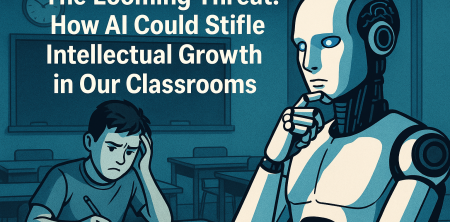
Alright, let's talk about AI in education. It's everywhere, isn't it? From helping students draft essays to personalizing learning paths, artificial intelligence is rapidly becoming an integral part of our academic landscape. But as a long-time educator, former dean, and someone deeply invested in genuine learning, I can tell you this isn't just about shiny new tools. We're staring down a pretty significant crossroads, one where the promise of efficiency clashes head-on with the fundamental goal of intellectual development. The discussion has been absolutely buzzing – sometimes furiously so – among educators, parents, and even students, and for good reason. What exactly does this mean for the future of learning?
For far too long, the conversation around AI in our schools and universities has been stuck in a narrow alleyway, fixating almost exclusively on things like assessment security and academic integrity. And sure, those are important. Nobody wants students cheating their way through college with AI bots. But focusing solely on preventing misuse is like trying to fix a leaky faucet while the whole house is on fire. We're missing the bigger, more existential question: how does AI truly impact the intellectual development of our students? This isn't just about detecting plagiarism; it's about fostering authentic learning, critical thinking, and the very essence of what it means to be an educated individual. The stakes couldn't be higher when we consider the delicate balance between AI ethics vs intellectual development in education.
1. The Narrow Focus on Cheating: A Symptom, Not the Disease
It's an easy trap to fall into, isn't it? When a new technology emerges that can help students bypass traditional academic hurdles, our immediate, almost instinctual, reaction is to put up barriers. We saw it with calculators, then with the internet, and now with AI. The initial panic often revolves around academic integrity – how do we stop students from using ChatGPT to write their papers, or from having an AI solve complex math problems for them? This concern, while valid on its surface, has unfortunately dominated the discourse around AI in education, particularly in higher education circles.
But here's the rub: this focus on assessment security, on preventing misuse, is a reactive stance. It treats AI as an adversary rather than a tool, and it misses the profound implications for how we actually teach and how students genuinely learn. By prioritizing policing over pedagogy, we risk squandering the real potential of AI to revolutionize learning, all while failing to address the deeper challenge of cultivating intellectual curiosity and robust critical thinking skills in an AI-saturated world. We need to shift our gaze from simply detecting AI-generated content to understanding how AI can either enhance or, frankly, hinder the very process of intellectual development.
2. Redefining Intellectual Development in the AI Era
So, what does intellectual development even mean when an AI can generate perfectly coherent text or solve complex equations in seconds? For generations, a significant part of education involved acquiring and recalling information, and then synthesizing it into arguments or solutions. AI changes that game entirely. Now, the emphasis must fundamentally shift from rote memorization or even basic information synthesis to higher-order thinking skills. We're talking about critical analysis, creative problem-solving, ethical reasoning, and the ability to ask the right questions – questions that AI itself can't formulate without human input.
True intellectual development in this new era isn't about competing with AI; it's about leveraging it. It's about students learning how to prompt AI effectively, how to critically evaluate the information it provides, and how to use it as a powerful assistant in their own creative and analytical processes. This demands a complete overhaul of our curriculum and teaching methodologies, moving away from tasks that AI can easily automate and towards those that require uniquely human cognitive capabilities. This is where the core of the AI ethics vs intellectual development in education debate truly lies.
3. The Peril of Over-Reliance: Stifling Cognitive Effort
One of my biggest concerns, and frankly, it keeps me up at night, is the potential for AI to foster over-reliance and, in doing so, stunt genuine cognitive effort. Think about it: if a student can simply ask an AI to summarize a complex text, generate essay outlines, or even draft entire paragraphs, where is the struggle? Where is the mental wrestling with ideas, the grappling with ambiguity, the laborious process of forming one's own thoughts and articulating them coherently?
That struggle, that effort, is precisely where intellectual muscles are built. It's where deep learning happens. When AI automates these processes, it risks creating a generation of students who are adept at outsourcing their thinking, rather than developing their own robust cognitive frameworks. Our role as educators isn't just to impart knowledge; it's to cultivate the capacity for independent thought. We need to actively design learning experiences that require students to engage deeply, to wrestle with challenges, and to understand that true intellectual growth often comes from the friction of difficulty, not the ease of an AI-generated solution.
4. Ethical AI Use: Transparency and Bias Awareness
The ethical considerations surrounding AI in education extend far beyond just academic integrity. We need to talk about transparency. How are these AI algorithms making decisions? What data are they trained on, and what inherent biases might that data carry? If an AI system is used to personalize learning, for example, are we sure it's not inadvertently reinforcing existing inequalities or limiting a student's exposure to diverse perspectives?
Educators and students alike need to be acutely aware of these underlying mechanisms. We must teach digital literacy that includes AI literacy – understanding how these tools work, their limitations, and the potential for embedded biases. Institutions have an ethical imperative to select and implement AI tools that are as transparent as possible, and to provide ongoing training for both staff and students on how to critically engage with AI outputs. Ignoring this aspect of AI ethics vs intellectual development in education would be a grave mistake. (See: AI's impact on education.)
5. The Equity Divide: Amplifying or Mitigating Disparities?
Another pressing ethical concern is the potential for AI to exacerbate existing educational inequities. While AI promises personalized learning for all, the reality might be more complex. Access to the most sophisticated AI tools, reliable internet, and devices often correlates with socioeconomic status. Will students in under-resourced schools have the same opportunities to benefit from cutting-edge AI as their wealthier counterparts?
Furthermore, the data used to train AI models can reflect societal biases, potentially leading to less effective or even discriminatory outcomes for certain student populations. Institutions must proactively work to ensure that AI implementation is equitable, providing universal access and carefully scrutinizing tools for bias. The goal should be to use AI to bridge achievement gaps, not widen them. This means investing in infrastructure, providing training, and advocating for ethical AI development that considers all learners, not just the privileged few. For more context, see The Troubling Truth About AI in Education.
6. Data Privacy and Student Surveillance: A Moral Minefield
Let's not forget about data. AI systems thrive on data, and in an educational context, that means student data. Everything from academic performance and learning styles to behavioral patterns can be collected, analyzed, and used to 'optimize' the learning experience. While the promise of hyper-personalized education is appealing, it raises serious questions about student privacy and potential surveillance.
Who owns this data? How is it stored and protected? What are the long-term implications of AI systems having such intimate knowledge of a student's intellectual journey, their strengths, and their weaknesses? Institutions have a moral and legal obligation to establish robust data governance policies, ensure full transparency with students and parents about data collection and usage, and prioritize privacy above all else. The convenience of AI should never come at the cost of compromising student trust or their fundamental right to privacy. This is a non-negotiable aspect of AI ethics vs intellectual development in education.
7. Cultivating Human-Centric Skills: Empathy and Collaboration
As AI handles more of the analytical and repetitive tasks, the value of uniquely human skills only grows. Empathy, emotional intelligence, collaborative problem-solving, interpersonal communication – these are the competencies that AI cannot replicate, at least not yet. If we are truly focused on intellectual development, then our education systems must lean into fostering these 'soft skills' with renewed vigor.
We need to design curricula that prioritize group projects, debates, discussions, and real-world problem-solving that requires human connection and understanding. AI can be a tool in these scenarios, perhaps assisting with research or organizing ideas, but the core work of human interaction, negotiation, and shared understanding remains paramount. The future workforce will demand individuals who can work effectively with AI, but also with other humans, bringing a level of nuance and emotional intelligence that technology simply can't provide.
8. Faculty Development: Empowering Educators, Not Replacing Them
Implementing AI effectively and ethically in education isn't just about the students; it's profoundly about the educators. Many faculty members, understandably, feel overwhelmed or even threatened by AI. There's a fear of being replaced, or of not knowing how to integrate these complex tools into their teaching practice without compromising their pedagogical principles. This is where institutions absolutely must step up.
We need comprehensive, ongoing professional development that doesn't just teach teachers how to use AI tools, but how to think about AI. This includes understanding the ethical implications, recognizing biases, and reimagining their roles as facilitators of learning in an AI-powered environment. Educators need to be empowered to experiment, to share best practices, and to be at the forefront of this transformation, rather than simply being told to adapt. Their expertise and guidance are more crucial than ever in navigating the complex interplay of AI ethics vs intellectual development in education.
9. The Imperative of Continuous Dialogue and Adaptation
Finally, we need to acknowledge that this isn't a one-time fix. The landscape of AI is changing at a breathtaking pace. What's cutting-edge today will be obsolete tomorrow. This means that our approach to AI in education, particularly concerning AI ethics vs intellectual development in education, must be one of continuous dialogue, reflection, and adaptation. Universities and schools need to establish ongoing forums for discussion involving faculty, students, administrators, and even AI developers.
Policies and guidelines around AI use must be living documents, regularly reviewed and updated to reflect new technological capabilities and emerging ethical challenges. We can't afford to set static rules and expect them to hold for years. Instead, we need to cultivate a culture of thoughtful experimentation, critical inquiry, and collective responsibility, ensuring that as AI evolves, so too does our understanding of how to harness its power for genuine intellectual growth, while steadfastly upholding our ethical obligations. It's a challenging road, but one we must walk with open eyes and committed hearts.
10. The Role of AI in Personalized Learning: A Double-Edged Sword
When we talk about personalized learning, AI seems like the ultimate solution, right? Imagine an AI tutor that understands each student's unique pace, learning style, and areas of struggle, then tailors content and exercises perfectly to them. This isn't science fiction; it's already happening in various forms. For a long time, educators have dreamt of truly individualized instruction, and AI could be the key to making that scalable.
However, this personalization is a double-edged sword. While it can address individual needs, there's a risk of creating intellectual echo chambers. If an AI constantly feeds a student information aligned with their existing understanding or preferences, does it challenge them to confront new ideas, different perspectives, or uncomfortable truths? Intellectual development isn't just about mastering what you know; it's about expanding your horizons and grappling with the unknown. We need to ensure AI-driven personalization doesn't inadvertently narrow a student's intellectual diet. The algorithms must be designed to introduce cognitive dissonance and encourage exploration beyond comfort zones, ensuring that the student is exposed to a broad spectrum of knowledge, not just what the AI predicts they'll respond positively to. (See: U.S. Department of Education on AI.)
11. Fostering Digital Citizenship in an AI World
Beyond simply understanding how AI works, students need to become responsible digital citizens in an AI-driven society. This means teaching them not just about the ethical implications of using AI, but also about the societal impact of AI at large. How does AI influence news consumption, social interactions, or even economic opportunities? These are questions that directly bear on a student's ability to navigate the modern world intelligently.
Digital citizenship in the AI era should include modules on media literacy (specifically AI-generated media), understanding algorithmic decision-making in everyday life, and recognizing the potential for AI to be used for manipulation or misinformation. Our education system must equip students with the discernment to question AI outputs, verify sources, and understand their own role in contributing to a responsible digital ecosystem. This isn't a separate subject; it needs to be woven into the fabric of every discipline, ensuring students develop a holistic understanding of AI ethics vs intellectual development in education. For more context, see The Unseen Peril of AI Tools for Teachers.
12. AI and the Future of Assessment: Beyond Standardized Tests
The traditional model of assessment, often reliant on standardized tests and written essays, is ripe for disruption by AI. On one hand, AI can offer more sophisticated, continuous, and formative assessments, providing real-time feedback and identifying learning gaps much faster than a human teacher ever could. Imagine AI analyzing a student's problem-solving process in math, not just the final answer, or evaluating the coherence of an argument in an essay draft.
On the other hand, we run into the same intellectual development concerns. If AI can perfectly grade an essay for grammar and structure, are we still teaching students to meticulously self-edit and refine their own work? If AI identifies every single mistake, does it remove the valuable learning experience of making errors and independently correcting them? The key here is to use AI assessment tools to *support* learning, not replace the human judgment and the student's own cognitive effort in the assessment process. We should aim for AI to provide insights that allow educators to design better learning opportunities, and for students to receive targeted feedback that still requires them to engage their brains to improve. This requires a thoughtful balance to maintain the integrity of AI ethics vs intellectual development in education.
13. Addressing the "Black Box" Problem: Explainable AI in Education
A significant ethical challenge with many advanced AI systems is their "black box" nature. We can see the inputs and outputs, but the internal decision-making process is often opaque, even to the developers. In education, this opacity is particularly problematic. If an AI recommends a specific learning path for a student, or flags a student for intervention, we need to understand *why*.
For educators and students to trust and effectively leverage AI tools, these systems need to be more explainable. We need AI that can articulate its reasoning, highlight the data points it used to arrive at a conclusion, and ideally, allow for human oversight and modification. Without this transparency, we risk blindly following algorithmic recommendations without understanding their pedagogical basis or potential biases. Advocating for and developing explainable AI (XAI) is crucial for ensuring that these tools genuinely support intellectual development rather than becoming unquestioned authorities in the learning process.
14. The Need for Interdisciplinary AI Ethics Education
The conversation around AI ethics and intellectual development isn't just for computer science departments or education faculties. It's an inherently interdisciplinary challenge that requires input from philosophy, sociology, law, psychology, and more. Our institutions need to foster this cross-pollination of ideas.
Imagine courses where future engineers learn about the psychological impact of AI on learning, or where education majors study the ethical frameworks for algorithmic design. This kind of interdisciplinary education will produce graduates who are not only technically proficient in AI but also ethically informed and socially aware. It's about creating a generation of professionals who can build, implement, and critically engage with AI in a way that benefits humanity, ensuring that the dialogue around AI ethics vs intellectual development in education is robust and comprehensive.
Frequently Asked Questions About AI Ethics vs. Intellectual Development in Education
Q1: Is AI in education inherently good or bad for intellectual development?
Neither inherently good nor bad. AI is a tool, and like any powerful tool, its impact depends entirely on how we design it, implement it, and teach students to use it. If used thoughtlessly, it can hinder intellectual development by fostering over-reliance and stifling critical thinking. If used strategically, it can enhance learning by personalizing instruction, providing immediate feedback, and freeing up educators to focus on higher-order teaching. The key is intentional, ethical integration.
Q2: How can educators prevent students from over-relying on AI?
This is a critical challenge. Educators can prevent over-reliance by designing assignments that require uniquely human skills – critical analysis of AI outputs, creative problem-solving that AI can't automate, ethical reasoning, and collaborative work. It also means teaching students *when* and *how* to use AI as an assistant, not a replacement for their own thinking. Emphasizing the process of learning and the value of struggle, rather than just the final answer, is also vital. For more context, see The Billion-Dollar Battle Over AI in Education. (See: Research on AI in learning environments.)
Q3: What are the biggest ethical concerns regarding AI in schools today?
Beyond academic integrity, major concerns include data privacy (how student data is collected, stored, and used), algorithmic bias (AI models perpetuating or exacerbating existing inequalities), lack of transparency (the "black box" problem of AI decision-making), and the potential to widen the equity divide for students in under-resourced areas. Each of these can profoundly impact a student's intellectual journey and overall well-being.
Q4: How can schools ensure AI tools are equitable for all students?
Ensuring equity requires several steps: providing universal access to necessary devices and internet, investing in robust infrastructure for all schools, carefully vetting AI tools for inherent biases and conducting pilot programs with diverse student populations. It also involves training educators on how to mitigate biases and use AI in culturally responsive ways. The goal is to use AI to bridge achievement gaps, not create new ones.
Q5: What skills should students focus on developing in an AI-driven world?
Students should focus on developing higher-order thinking skills that AI struggles with: critical analysis, creative problem-solving, ethical reasoning, complex communication, collaboration, and emotional intelligence. They also need strong AI literacy – understanding how AI works, its limitations, potential biases, and how to critically evaluate its outputs. Basically, skills that make them uniquely human and effective partners with AI, rather than competitors.
Q6: Should AI be used for grading and assessment?
AI can certainly assist with grading and assessment, particularly for repetitive tasks or providing immediate, formative feedback. However, it shouldn't be the sole arbiter. AI can flag patterns, identify common errors, and even suggest areas for improvement. But human educators are essential for nuanced understanding of student progress, evaluating complex reasoning, and providing qualitative feedback that fosters deeper intellectual growth. A hybrid approach, where AI supports human assessment, is generally the most beneficial.
Q7: How can faculty stay current with AI developments and integrate them ethically?
Institutions need to provide ongoing, comprehensive professional development that goes beyond basic tool usage. This training should cover AI literacy, ethical frameworks for AI in education, understanding algorithmic bias, and pedagogical strategies for integrating AI effectively. Creating communities of practice where faculty can share experiences and best practices is also invaluable. The goal is to empower educators to be leaders in this transformation, not just passive adopters.
Q8: What is the "black box" problem of AI and why is it important in education?
The "black box" problem refers to AI systems where the internal decision-making process is opaque and difficult to understand, even for experts. In education, this is important because if an AI makes recommendations about a student's learning path or flags a student for intervention, we need to know *why* to ensure fairness, identify potential biases, and provide appropriate human oversight. We need explainable AI (XAI) that can articulate its reasoning.
Q9: How do we balance the benefits of personalized learning with the need for diverse exposure?
This is a delicate balance. While AI can tailor content, it must also be programmed to introduce students to diverse perspectives, challenging ideas, and topics outside their immediate comfort zone. Personalized learning should expand a student's intellectual world, not narrow it into an echo chamber. AI algorithms should be designed with an 'exploration' component, ensuring exposure to a broad curriculum and critical engagement with different viewpoints.
Trending Now
Frequently Asked Questions
How is AI affecting education?
AI is transforming education by personalizing learning experiences and assisting with tasks like essay drafting. However, this technological advancement raises concerns about its impact on intellectual growth and critical thinking among students, as the focus often shifts toward efficiency rather than genuine learning.
What are the risks of using AI in classrooms?
The primary risks include undermining academic integrity and fostering dependency on technology, which may stifle critical thinking and authentic learning. Educators must navigate these challenges to ensure that AI enhances rather than replaces traditional educational values.
Is AI in education a threat to intellectual development?
Yes, there is a concern that reliance on AI may hinder intellectual development by promoting superficial learning and reducing students' engagement in critical thinking. The challenge lies in balancing the use of AI tools with fostering a deep understanding of subjects.
What should educators focus on regarding AI in schools?
Educators should prioritize fostering authentic learning experiences and critical thinking skills while integrating AI. It's essential to address the ethical implications of AI and ensure that its use aligns with the fundamental goals of education.
How can AI be used responsibly in education?
Responsible use of AI in education involves setting clear guidelines to prevent misuse while promoting its benefits. This includes encouraging students to engage actively with learning materials and using AI as a supportive tool rather than a crutch.
Agree or disagree? Drop a comment and tell us what you think.

