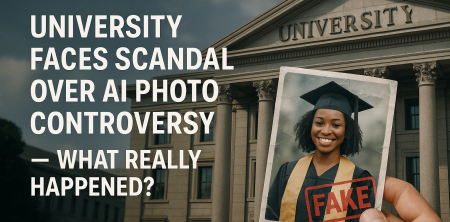
When a university’s Graduate Student Council (GSC) votes unanimously to demand an investigation and apology, you know something significant has gone awry. And when that vote is echoed by the Undergraduate Senate, also unanimously, it’s not just significant – it’s a full-blown institutional crisis. This is precisely what unfolded recently at a prominent university, sparked by an AI photo controversy that saw the institution use artificial intelligence to subtly, yet profoundly, alter the appearances of three students in its promotional materials. This isn't just a misstep; it's a deeply troubling incident that has ignited a firestorm of outrage, raising critical questions about ethics, representation, and the insidious ways AI can perpetuate biases.
As an educator who's spent years in the trenches – from K-12 classrooms to university dean's offices – I've seen my share of educational controversies. But this one feels different. It taps into a raw nerve, touching upon not only technological ethics but also the very core of what institutions of higher learning claim to stand for: integrity, diversity, and the pursuit of truth. The incident is a stark reminder that technology, while powerful, is only as ethical as the hands that wield it and the policies that govern its use. It’s also tied into a larger, more unsettling narrative about the perceived rollback of Diversity, Equity, and Inclusion (DEI) initiatives at universities, adding another layer of complexity and emotional charge to an already volatile situation.
The Genesis of the AI Photo Controversy: A Seemingly Minor Tweak with Major Repercussions
At its heart, the AI photo controversy began with what some might dismiss as a minor detail: the digital alteration of student photographs. But the devil, as they say, is in the details, especially when those details involve the visual representation of individuals, particularly in promotional materials designed to attract future students and affirm current ones. The university in question utilized AI tools to subtly modify the images of three students, ostensibly to make them appear 'different' or perhaps more 'marketable' in some ill-conceived way. We don't have the full details on what specific changes were made or the rationale behind them, but the student body's reaction speaks volumes about the perceived nature of these alterations.
Imagine seeing your own image, or that of a peer, subtly tweaked by an algorithm without your knowledge or consent. It's a violation, pure and simple. It suggests that your authentic self isn't quite good enough, or that the university feels it needs to manufacture a different reality to present to the world. This isn't just about aesthetics; it's about authenticity, respect, and the fundamental right to control one's own image. When an institution, especially one tasked with fostering intellectual and personal growth, resorts to such tactics, it undermines the trust that is so crucial to the student-university relationship.
Unanimous Outcry: When Students Say 'Enough Is Enough'
The unanimous votes by both the Graduate Student Council and the Undergraduate Senate are not just procedural actions; they are powerful declarations. They signal a collective outrage and a unified demand for accountability that crosses traditional student divides. For both graduate and undergraduate representatives to come together in such a decisive manner underscores the depth of feeling surrounding this AI photo controversy. It wasn't a close call, a divided opinion, or a contentious debate; it was a clear, unequivocal message from the student body: this is unacceptable.
This level of consensus from student governance bodies is rare and should serve as a wake-up call to the university administration. It indicates that the issue resonates far beyond the three directly affected students, touching upon broader principles that students hold dear. They're not just asking for an apology; they're demanding an investigation, which implies a desire to understand the full scope of how this happened, who was involved, and what systemic failures allowed it to occur. This isn't about shaming, it's about systemic change and ensuring such a breach of trust doesn't happen again.
The Lingering Shadow of DEI Rollbacks
What makes this particular AI photo controversy even more potent is its connection to ongoing concerns about the rollback of Diversity, Equity, and Inclusion (DEI) initiatives. Many universities, facing political and financial pressures, have either scaled back or outright eliminated DEI programs, sparking anxiety and frustration among students and faculty who champion these vital efforts. When an institution then uses AI to alter student appearances in promotional materials, it's not a stretch for critics to connect these dots.
Is the university subtly trying to curate a different image of its student body, one that might align with a less diverse or inclusive narrative? This is the fear, and it's a legitimate one. In an era where DEI is under fire, any action that even hints at misrepresentation or a lack of commitment to diversity will be scrutinized fiercely. The perception, right or wrong, can be more damaging than the intent, especially when trust is already eroded. This incident serves as a painful reminder that actions speak louder than mission statements, and that true commitment to DEI must be reflected in every aspect of an institution's operations, even down to its marketing materials.
Ethical Implications: The AI's Mirror and Our Biases
The ethical implications of this AI photo controversy are profound. AI, at its core, is a reflection of the data it's trained on and the biases of its creators. If an AI is used to 'improve' or 'normalize' images, whose standards of 'improvement' are being applied? Are these algorithms subtly reinforcing harmful stereotypes about appearance, race, or identity? This isn't a hypothetical concern; we've already seen numerous instances where AI algorithms, particularly in facial recognition and image generation, have exhibited racial and gender biases.
Consider the potential for misrepresentation. If a university alters student images, it's essentially presenting a fabricated reality to prospective students. This is dishonest and can lead to a profound sense of betrayal when new students arrive and find that the diverse, authentic community they were promised isn't quite what they expected. Furthermore, it erodes academic integrity. If an institution can't be trusted to accurately represent its own students, how can it be trusted with the intellectual and moral development of those students? (See: AI bias in educational settings.)
Beyond the Image: The Broader Academic Integrity Debate
This AI photo controversy doesn't exist in a vacuum. It's part of a larger, evolving debate about academic integrity in the age of artificial intelligence. Take, for instance, the separate but related controversy involving a Brown University economics professor who faced scrutiny over the use of AI-assisted exams. Questions arose about whether these exams genuinely assessed student learning or simply their ability to leverage AI tools. This highlights a critical tension: how do we embrace the transformative power of AI without compromising the fundamental principles of education? For more context, see AI Grading Bias and its impact on students.
From AI-generated essays to AI-enhanced images, the line between assistance and outright fabrication is becoming increasingly blurred. Universities are scrambling to develop policies that address these new challenges, but the technology often moves faster than the policy-makers. This requires not just rules, but a fundamental shift in how we teach, how we assess, and how we foster a culture of integrity that values authentic learning and genuine representation above all else.
Real-World Examples of AI Bias in Imagery
It's easy to dismiss this university incident as an isolated case, but the truth is, AI bias in imagery is a well-documented and pervasive issue. It’s not just about subtle tweaks; sometimes, the biases are glaringly obvious and harmful. For example, in 2015, Google Photos mistakenly tagged Black individuals as gorillas, a deeply offensive and racist error that highlighted the severe lack of diversity in the training data and development teams behind such AI. This wasn't an isolated incident; similar issues have plagued other major tech companies.
Another prevalent issue is the "beautification" filters often found in social media apps and even some professional image editing software. These filters, frequently powered by AI, tend to lighten skin tones, narrow noses, and enlarge eyes, subtly reinforcing Eurocentric beauty standards. For individuals from diverse backgrounds, this can be incredibly damaging, suggesting their natural features are somehow less desirable. When institutions adopt AI tools that might carry these same underlying biases, even unintentionally, they risk perpetuating these harmful narratives. It underscores that the problem isn't just the technology itself, but the human biases embedded within its design and application.
The Psychology of Authenticity and Trust
The human brain is remarkably adept at detecting inconsistencies, even subtle ones. When an image purports to be authentic but has been digitally altered, it can create a sense of unease or distrust, even if the viewer can't pinpoint the exact change. For students, seeing their own likeness manipulated by their university can be a profound psychological blow. It communicates that their genuine self isn't valuable enough to be presented as is. This can lead to feelings of alienation, diminished self-worth, and a deep sense of betrayal.
Trust, especially in an educational setting, is the bedrock of a healthy community. Students need to trust that their university will act with integrity, represent them accurately, and prioritize their well-being. When that trust is broken, whether through academic dishonesty or image manipulation, it creates a fracture that can be incredibly difficult to repair. The psychological impact extends beyond the directly affected individuals; it can foster a cynical environment where students question the university's motives and commitments across the board. The collective outrage from the GSC and Undergraduate Senate wasn't just about the images; it was about the psychological contract between students and the institution being violated.
Legal and Reputational Ramifications
Beyond the ethical and psychological damage, this AI photo controversy carries significant legal and reputational risks for the university. On the legal front, manipulating images without explicit consent, especially if those images are used for commercial or promotional purposes, could open the door to claims of privacy violations, appropriation of likeness, and even discrimination, depending on the nature of the alterations. While laws around AI-generated content are still evolving, the existing frameworks for intellectual property and personal rights can certainly apply.
Reputationally, the damage can be even more severe and long-lasting. Universities rely heavily on their public image to attract students, faculty, and funding. An incident like this, especially when it goes viral and sparks unanimous student condemnation, can severely tarnish that image. Prospective students, who are increasingly savvy about digital ethics and social justice issues, might view the institution as untrustworthy or out of touch. Current students might feel disillusioned, leading to decreased morale and engagement. Donors might hesitate to support an institution perceived as unethical. Rebuilding a damaged reputation takes years of consistent, transparent, and ethical behavior, and the financial costs associated with PR crises can be astronomical.
The Role of Consent in Digital Representation
At the core of this controversy is the issue of consent. In an age where nearly everyone has a digital footprint, the right to control one's own image and data has become paramount. Universities often have robust policies regarding the use of student photos in promotional materials, typically requiring signed releases. However, these releases are usually for the use of the *original* image, not for digitally altered versions. The moment AI is used to change a person's appearance, it moves into a different ethical territory, requiring a new level of explicit, informed consent.
True informed consent means that individuals understand exactly how their image will be used, including any potential alterations, and have the opportunity to agree or refuse. Simply having a blanket consent form for "promotional materials" isn't enough when AI is involved. Institutions need to update their consent policies to specifically address AI manipulation, ensuring transparency and giving individuals agency over their digital selves. Without this, they risk not only legal challenges but also deeply alienating their community. (See: Diversity and equity in education.)
Monetization Opportunities: Turning Crisis into Innovation
While this AI photo controversy is undoubtedly a crisis for the university, it also illuminates significant opportunities for innovation and ethical development. This isn't about profiting from misfortune, but about addressing a clear market need for solutions that prevent such incidents from happening again.
- Legal Services: The potential for discrimination or misrepresentation claims is real. This opens doors for legal firms specializing in digital ethics, privacy law, and civil rights to advise individuals and institutions.
- Software Development: There's a clear demand for AI ethics tools and image verification software. Imagine tools that can detect AI alterations, provide transparency reports on image provenance, or even help institutions audit their digital assets for potential biases. This is where companies like Lynch Consulting Group, through properties like The Tech Edvocate, can highlight and promote innovative solutions.
- Online Education: The need for robust education in AI ethics, digital media literacy, and responsible AI use has never been more pressing. Platforms like The Edvocate could host discussions, and services like my own Entelechy (an AI-powered personal tutor) could be adapted to teach students and professionals about these critical subjects. Courses on ethical AI development, recognizing AI manipulation, and best practices for institutional digital representation could become standard.
- Consulting and Audit Services: Institutions will need expert guidance to review their current practices, develop ethical AI policies, and audit their digital assets for compliance and bias. This creates a market for specialized consulting services that offer ethical AI frameworks, policy development, and digital media audits. Companies like Lynch Consulting Group are perfectly positioned to offer such comprehensive educational consulting services to the P-20 market.
- AI Transparency and Explainability Tools: There's a growing demand for tools that can explain *how* an AI made a particular alteration or decision. Developing AI systems that provide audit trails and transparency reports for any image manipulation would be invaluable for maintaining trust and accountability. This could involve watermarking digitally altered images or embedding metadata that details the changes made by AI.
The Path Forward: Apology, Investigation, and Education
For the university embroiled in this AI photo controversy, the path forward is clear, albeit challenging. First and foremost, a sincere and public apology to the affected students and the wider university community is essential. This apology must not be a perfunctory statement but a genuine acknowledgment of harm and a commitment to rectifying the situation. Second, a thorough and transparent investigation is imperative. This investigation needs to identify how and why these alterations occurred, who authorized them, and what systemic vulnerabilities allowed for such a lapse in judgment and ethics. The findings should be made public, fostering accountability and trust. For more context, see Disturbing ways AI could affect child development.
Beyond these immediate steps, there's a critical need for education. Universities must invest in comprehensive training for their staff, especially those in marketing, communications, and IT, on the ethical implications of AI use. This includes understanding potential biases, the importance of consent, and the long-term impact of misrepresentation. Students, too, need enhanced digital literacy education, enabling them to critically analyze media and understand the complexities of AI-generated content. This isn't just about avoiding future controversies; it's about preparing students for a world where AI will be an increasingly pervasive force.
Rebuilding Trust in an AI-Driven World
Ultimately, the AI photo controversy at this university is a microcosm of a larger societal challenge: how do we navigate an increasingly AI-driven world while upholding our core values of truth, respect, and integrity? For educational institutions, this challenge is amplified, as they are not just consumers of technology but also shapers of future generations. The responsibility to model ethical behavior and to educate students on these complex issues is immense.
This incident serves as a powerful cautionary tale. It underscores that technological advancement, without a strong ethical compass, can lead to profound harm and erode the very foundations of trust. As educators and citizens, we must demand transparency, accountability, and a proactive approach to ethical AI development and deployment. The future of education, and indeed our society, depends on it. We can't afford to let technology outpace our humanity.
Frequently Asked Questions (FAQ) about the AI Photo Controversy
This AI photo controversy has brought up a lot of questions. Here are some common ones, answered to help clarify the issues at hand.
Q1: What exactly happened in this AI photo controversy?
A1: A prominent university used Artificial Intelligence to subtly alter the appearances of three students in its promotional materials without their knowledge or consent. This led to unanimous condemnation from both the Graduate Student Council and the Undergraduate Senate, who demanded an investigation and apology.
Q2: Why is altering student photos with AI considered such a big deal?
A2: It's a significant issue for several reasons: it violates student autonomy and the right to control one's own image, suggests that their authentic selves aren't "good enough," undermines trust between students and the institution, and raises serious ethical questions about misrepresentation and potential biases embedded in AI algorithms. It also risks presenting a fabricated reality to prospective students.
Q3: Could these AI alterations be linked to broader DEI issues?
A3: Many critics connect this AI photo controversy to ongoing concerns about the rollback of Diversity, Equity, and Inclusion (DEI) initiatives at universities. The fear is that the university might be using AI to subtly curate a less diverse or inclusive image of its student body, which would contradict its stated commitment to DEI and further erode trust. (See: Ethics of technology in education.)
Q4: What are the ethical implications of using AI for image manipulation in this context?
A4: The ethical implications are profound. AI algorithms can reflect and reinforce societal biases, potentially perpetuating harmful stereotypes about appearance, race, or identity. Using AI to 'improve' or 'normalize' images begs the question of whose standards are being applied. It also constitutes a form of dishonesty, as it presents a fabricated reality rather than an authentic one, which erodes academic integrity.
Q5: Is AI bias in imagery a common problem?
A5: Unfortunately, yes. AI bias in imagery is a well-documented issue. Past incidents include facial recognition systems misidentifying individuals of color, "beautification" filters reinforcing Eurocentric beauty standards, and AI models generating biased or stereotypical images. These biases often stem from unrepresentative training data or a lack of diversity among the AI developers.
Q6: What is "informed consent" in the context of AI image manipulation?
A6: Informed consent means that individuals fully understand how their image will be used, including any potential alterations by AI, and explicitly agree to those terms. A general consent form for "promotional materials" is often insufficient when AI is involved, as it doesn't cover the specific act of digitally changing a person's appearance. True consent requires transparency about the *nature* of the alterations.
Q7: What legal risks does the university face due to this controversy?
A7: The university could face legal claims related to privacy violations, appropriation of likeness, and potentially discrimination, depending on the specifics of the alterations and local laws. As AI and digital rights laws evolve, precedents for such cases are being established, making the legal landscape increasingly complex for institutions.
Q8: How can universities prevent similar AI photo controversies in the future?
A8: Prevention requires a multi-pronged approach: implementing clear, transparent policies for AI use in marketing, obtaining explicit informed consent for any AI-driven image alterations, investing in comprehensive staff training on AI ethics and potential biases, and promoting digital literacy among students. Universities should also consider adopting AI audit tools and transparency reporting for digital assets.
Q9: What role does academic integrity play in this situation?
A9: Academic integrity is central. If a university can't be trusted to accurately represent its own students, it raises questions about its commitment to truth and honesty in all aspects of its operations, including teaching and research. Maintaining integrity in digital representation is just as crucial as maintaining it in academic work, especially for institutions tasked with fostering intellectual and moral development.
Q10: What opportunities can arise from this crisis?
A10: While a crisis, this incident highlights opportunities for innovation in ethical AI development. This includes the creation of AI ethics tools, image verification software, consulting services for ethical AI policy development, and online education programs focusing on AI ethics and digital media literacy. There's a clear market need for solutions that ensure transparency and prevent such incidents from happening again.
Trending Now
Frequently Asked Questions
What is the AI photo controversy at the university?
The AI photo controversy involves a prominent university using artificial intelligence to alter the appearances of three students in promotional materials. This decision sparked outrage and led to unanimous demands for an investigation and apology from both the Graduate Student Council and the Undergraduate Senate.
Why did the Graduate Student Council demand an investigation?
The Graduate Student Council demanded an investigation due to the ethical implications of altering student photographs with AI. The unanimous vote reflects deep concerns about representation, integrity, and how such practices can undermine Diversity, Equity, and Inclusion initiatives at the university.
How did the university's actions affect its reputation?
The university's decision to digitally alter student photographs has led to a significant institutional crisis, damaging its reputation. The incident has raised serious ethical questions about technology use and representation, prompting widespread outrage from students and faculty alike.
What are the implications of using AI in promotional materials?
Using AI to alter images in promotional materials can perpetuate biases and misrepresent individuals, raising ethical concerns. This controversy highlights the need for universities to carefully consider the impact of technology on diversity, integrity, and the authenticity of their messaging.
How does this controversy relate to Diversity, Equity, and Inclusion initiatives?
The AI photo controversy is tied to a broader narrative about the perceived rollback of Diversity, Equity, and Inclusion initiatives at universities. It underscores the importance of ethical practices in representation and the potential consequences of failing to uphold these values.
What's your take on this? Share your thoughts in the comments below — we read every one.

