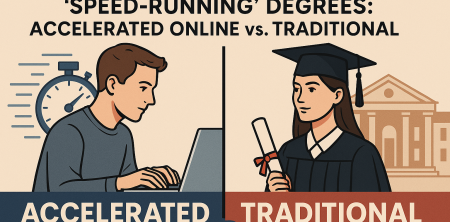
Alright, let's talk about something that's got the academic world buzzing, and honestly, a little freaked out. We're living in an era where the traditional four-year degree, heck, even a two-year master's, is being challenged by something completely different: the accelerated online degree. Specifically, we're seeing a rise in what some are calling 'speed-running' degrees – where students are blowing through entire bachelor's and master's programs in a matter of weeks or months. Seriously, weeks. It sounds wild, right? And it's sparking a heated debate about the true value of an education, especially when we pit accelerated online degrees vs traditional degrees.
Now, I've spent years in education, from K-12 classrooms to being a Dean at Virginia Union University, and let me tell you, the idea of getting a degree in eight weeks for a few thousand bucks would have been unthinkable not too long ago. But it's happening. And it's forcing us to ask some tough questions about academic rigor, employer perception, and what a degree actually signifies in today's job market. Is this a groundbreaking path to accessible education, or a dangerous erosion of academic standards? Let's dive into the core differences and controversies surrounding accelerated online degrees vs traditional degrees.
1. The 'Speed-Running' Phenomenon: A New Frontier or a Shortcut Too Far?
Imagine this: someone completes two degrees, a bachelor's and a master's, in just eight weeks, all for a total cost of a little over $4,000. Sounds like a sci-fi movie, doesn't it? But it's a real story making waves, and this individual is now reportedly coaching others on how to replicate their accelerated path. This isn't just about fast-tracking; it's about optimizing specific online college structures that allow for unlimited, self-paced courses, essentially letting students cram years of study into mere months.
This approach leverages the flexibility of certain online programs, often those structured around competency-based learning or allowing for extensive transfer credits and prior learning assessments. Students who are highly motivated, disciplined, and perhaps already possess a good deal of knowledge in their field can, in theory, demonstrate mastery quickly and move at an unprecedented pace. It's a testament to the idea that time-in-seat doesn't always equal learning, but it also raises significant eyebrows when we consider the depth of understanding that typically comes with a more extended academic journey.
2. Time Investment: Weeks vs. Years in Accelerated Online Degrees vs Traditional Degrees
The most glaring difference between accelerated online degrees vs traditional degrees is, without a doubt, the time commitment. Traditional degrees operate on a semester or quarter system, typically stretching a bachelor's degree over four years and a master's over one to two years. This structure is designed to allow for deep immersion in subjects, critical thinking development, research, and often, practical experiences like internships.
Accelerated online programs, particularly the 'speed-running' variety, condense this significantly. We're talking about completing a full degree in weeks or months. For adult learners with significant work experience, or those who simply need a credential quickly to advance in their careers, this speed can be incredibly appealing. However, it begs the question: how much genuine learning and intellectual development can truly happen in such a compressed timeframe? Is it about acquiring knowledge, or simply checking a box?
3. Cost Implications: Drastically Different Price Tags
Another major draw of these ultra-fast online programs is the cost. When you can complete a degree in weeks, you're not paying for years of tuition, fees, and living expenses. The example of two degrees for just over $4,000 is a stark contrast to the tens, or even hundreds, of thousands of dollars a traditional degree can cost. This financial accessibility is a powerful motivator for many prospective students, especially those burdened by existing debt or facing economic constraints.
However, it's crucial to look beyond the sticker price. While the direct tuition might be lower for some accelerated models, traditional degrees often come with more robust financial aid options, scholarships, and institutional support. Moreover, the long-term return on investment (ROI) needs careful consideration. Is a quickly acquired, cheaper degree perceived equally by employers as one from a more traditional, higher-cost institution? That's a debate we're still very much in the middle of.
4. Academic Rigor and Integrity: The Elephant in the Room
This is where the rubber meets the road, and where educators like myself start to get a bit uneasy. Institutions like Purdue Global, which offers online programs, are already implementing restrictions on their self-paced courses due to concerns over "academic integrity and the value of a Purdue Global degree." When students can complete courses at an astonishing pace, questions arise about whether they're truly engaging with the material, performing original work, and developing critical thinking skills.
Traditional degrees, by their very nature, are designed with a certain level of academic rigor. They incorporate extensive reading, research papers, collaborative projects, and opportunities for in-depth discussion and debate. While accelerated programs aim to cover the same content, the sheer speed can make it challenging to internalize complex concepts, conduct thorough research, or develop the nuanced understanding that often comes with a more extended learning period. It's a balance between efficiency and genuine educational depth.
5. Employer Perception: Do Companies Value Accelerated Online Degrees vs Traditional Degrees Equally?
This might be the most critical factor for many students. You're getting a degree to advance your career, right? So, how do employers view these lightning-fast credentials compared to traditional ones? The answer, unfortunately, isn't always clear-cut and can vary significantly by industry, company, and the specific institution issuing the degree. (See: Associated Press on education trends.)
Some employers, particularly in fast-paced tech sectors or those focused heavily on demonstrable skills, might value the credential itself, or even the initiative shown by completing a degree quickly. They might prioritize what you can do over how long it took you to get a piece of paper. However, in more traditional fields, or with companies that have strong ties to established universities, a degree from a 'speed-run' program might be met with skepticism. There's a lingering perception that a shorter path might equate to less comprehensive learning, and that's something graduates of accelerated programs need to be prepared to address and overcome.
6. Learning Preferences and Lifestyle Fit: Who Benefits Most?
When considering accelerated online degrees vs traditional degrees, it's vital to think about your own learning style and lifestyle. Traditional degrees often suit younger students transitioning directly from high school, those who thrive in structured environments, or individuals seeking a comprehensive college experience that includes campus life, extracurriculars, and direct faculty mentorship. For more context, see Is Your Degree Worth Less Than You Think?.
Accelerated online programs, on the other hand, are often ideal for working professionals, parents, or individuals with significant life commitments who need maximum flexibility. They require a high degree of self-discipline, time management skills, and often, a comfort with independent study. If you're someone who learns best through self-directed exploration and can maintain motivation without external pacing, an accelerated online degree might be a perfect fit. If you need more hand-holding, regular check-ins, and the social aspect of a campus, traditional might be better.
7. Networking and Experiential Learning: A Key Differentiator
One area where traditional degrees often have a distinct advantage is in networking and experiential learning opportunities. Being on campus, engaging with professors and peers in person, participating in student organizations, and accessing career services can build invaluable professional networks. Many traditional programs also integrate internships, co-ops, or study abroad experiences that provide real-world application of knowledge.
While many online programs are improving their networking features, it's generally harder to replicate the organic connections formed in a physical environment. Similarly, while some accelerated programs might offer practical components, the compressed timeline can limit the depth and breadth of these experiences. This isn't to say online students can't build networks or gain experience, but it often requires more proactive effort on their part outside of the structured curriculum.
8. Accreditation and Reputation: More Important Than Ever
In the world of accelerated online degrees vs traditional degrees, accreditation becomes absolutely paramount. With the rise of 'speed-running' and less conventional pathways, ensuring your chosen program is regionally or nationally accredited by a recognized agency is non-negotiable. Without proper accreditation, your degree might not be recognized by employers, licensing boards, or other educational institutions if you decide to pursue further study.
Beyond basic accreditation, the reputation of the issuing institution still carries weight. A degree from a well-regarded, albeit accelerated, online program from a reputable university will likely be viewed more favorably than one from an unknown entity that promises instant degrees. Always research the institution's history, faculty credentials, and how their graduates fare in the job market.
9. The Future of Higher Education: A Blended Landscape?
This debate about accelerated online degrees vs traditional degrees isn't going away. In fact, it's accelerating (pun intended). What we're witnessing is a fundamental shift in how people view and access higher education. The traditional model, while still highly valued, is no longer the only game in town. The demand for flexible, affordable, and time-efficient pathways is growing, driven by a workforce that needs continuous upskilling and reskilling.
I believe the future likely holds a more blended landscape. Universities, even traditional ones, are learning from the success of online and accelerated models, integrating more flexibility and competency-based elements into their offerings. Simultaneously, purely accelerated programs will likely face increased scrutiny and pressure to demonstrate genuine academic rigor and value. Ultimately, the 'right' choice will depend entirely on individual circumstances, career goals, and a careful, informed assessment of the educational value truly being offered.
Choosing between an accelerated online degree and a traditional path is a significant decision, and it's not one to take lightly. While the appeal of quickly earned, inexpensive credentials is undeniable, it's crucial to weigh those benefits against potential concerns about academic depth and employer perception. Do your homework, understand your own learning needs, and always, always prioritize accredited programs that genuinely prepare you for your future, not just hand you a piece of paper.
10. The Psychological Impact: Motivation, Burnout, and Self-Efficacy
Beyond the logistical and academic differences, there's a significant psychological aspect to consider when comparing accelerated online degrees vs traditional degrees. The compressed timeline of an accelerated program demands an incredibly high level of sustained motivation and discipline. You're essentially running a marathon at a sprint pace, day in and day out. This can lead to what we call "academic burnout" if not managed carefully. The constant pressure to absorb vast amounts of information, complete assignments, and demonstrate mastery in a short window can be mentally and emotionally exhausting.
Traditional degrees, with their more extended timelines, often allow for periods of less intensity, opportunities for breaks, and a slower, more reflective pace of learning. This can contribute to a stronger sense of self-efficacy as students gradually build confidence through consistent, manageable progress. For accelerated learners, the rapid pace means celebrating successes quickly, but also potentially facing setbacks that feel amplified due to the limited time for recovery. It's a high-stakes, high-reward mental game that isn't for everyone. Before jumping into a speed-run degree, it's crucial to honestly assess your mental resilience and capacity for sustained, intense effort. (See: CDC on educational impacts.)
11. Specific Disciplines and Their Suitability for Acceleration
It's important to recognize that not all academic disciplines are equally suited for accelerated learning models. When we talk about accelerated online degrees vs traditional degrees, the subject matter plays a huge role. For instance, fields that rely heavily on rote memorization, practical application of clearly defined rules, or require a credential for entry-level positions often lend themselves better to accelerated paths.
Think about certifications in IT, some business administration programs, or even certain health sciences where the goal is to quickly acquire a specific skill set or knowledge base. Here, competency-based models can shine. However, disciplines that demand extensive critical analysis, deep theoretical understanding, complex problem-solving, creative exploration, or hands-on laboratory work might suffer in a compressed format. Humanities, advanced sciences, engineering, and many creative arts degrees typically benefit from the extended time traditional programs offer, allowing for iterative projects, mentorship, and a nuanced development of thought. Trying to "speed-run" a philosophy degree or a complex research-based science program might leave a student with a piece of paper, but without the deep intellectual toolkit they truly need. For more context, see Is College Worth It in 2025?.
12. The Role of Technology in Facilitating Acceleration
The rise of accelerated online degrees wouldn't be possible without significant advancements in educational technology. Learning Management Systems (LMS) like Canvas or Blackboard have become incredibly sophisticated, allowing for streamlined course delivery, automated grading for certain assignments, and robust online discussion forums. AI-powered tools are also starting to play a role, offering personalized learning paths and instant feedback, which can further enable students to move at their own pace.
These technologies are a double-edged sword. On one hand, they empower individuals to access education regardless of geographical barriers or scheduling conflicts, making accelerated programs genuinely feasible. On the other hand, the reliance on technology can sometimes reduce the human element of education—the spontaneous discussions, the direct mentorship, the nuanced feedback that often comes from a live interaction with an instructor. While technology certainly facilitates speed, it's essential to ensure it doesn't inadvertently diminish the richness of the learning experience itself. The balance between tech-driven efficiency and human-centered pedagogy is a delicate one.
13. Regulatory Scrutiny and Quality Control
As accelerated online degrees gain prominence, so does the scrutiny from regulatory bodies and educational watchdogs. Concerns about quality control, especially in the most aggressively fast programs, are prompting discussions among accrediting agencies and government entities. The goal is to ensure that these rapid pathways still uphold a minimum standard of educational quality and that the degrees awarded represent genuine learning outcomes.
We've already seen institutions like Purdue Global adjust their policies. This kind of self-correction, or external pressure, is vital for the long-term credibility of accelerated online education. Without robust oversight, there's a risk of institutions prioritizing speed and profit over educational integrity, which could devalue all online degrees. This means that when you're looking at accelerated online degrees vs traditional degrees, you need to pay even closer attention to the institutional commitment to quality assurance, transparent assessment methods, and how they define and measure student competency, especially in compressed timelines. Always look for institutions that openly discuss their quality control measures and student success rates.
14. The Argument for Lifelong Learning and Reskilling
One of the strongest arguments for the expansion of accelerated online degrees lies in the imperative for lifelong learning and continuous reskilling in today's rapidly evolving job market. Traditional four-year degrees, while foundational, often can't keep pace with the swift changes in industry demands. Workers need to acquire new skills and credentials quickly to remain competitive or transition to new careers.
Here, accelerated online programs offer a distinct advantage. They provide a flexible and efficient way for adult learners to gain specialized knowledge or new qualifications without putting their careers on hold for years. This isn't about replacing the traditional university experience for an 18-year-old; it's about serving a different demographic with different needs. For a mid-career professional needing a specific master's credential to move up, or someone changing industries requiring a new bachelor's in a different field, the ability to complete a degree in a year or less can be a game-changer for their career trajectory and economic mobility. It speaks to a model of education that is agile and responsive to the real-time demands of the economy.
Frequently Asked Questions About Accelerated Online Degrees vs Traditional Degrees
Q1: Are accelerated online degrees respected by employers?
This is probably the most common question, and the answer isn't a simple yes or no. Employer perception varies significantly based on the industry, the specific company, and the reputation of the institution granting the degree. In tech and some business sectors, where demonstrable skills and quick adaptation are valued, they might be well-received. In more traditional fields, or with companies that have strong ties to established universities, there might be some initial skepticism. The key is that the degree should be from an accredited, reputable institution, and you, as the graduate, should be prepared to articulate the depth of your learning and how it applies to the job.
Q2: How quickly can I realistically complete an accelerated online degree?
While some extreme examples of "speed-running" exist (like degrees in weeks), most legitimate accelerated online bachelor's programs aim for completion in 1-2 years, and master's programs often take 6-18 months. The actual time depends on several factors: your prior knowledge, how many transfer credits you have, your personal study discipline, and the specific program's structure. Be wary of programs promising degrees in an impossibly short timeframe without clear, rigorous academic requirements. For more context, see Ditching the MBA for Game-Changing Alternatives. (See: New York Times education articles.)
Q3: Are accelerated online degrees cheaper than traditional degrees?
Generally, yes, they tend to be more cost-effective. This is primarily because you're paying for fewer terms of tuition, and you often avoid the ancillary costs associated with on-campus living (housing, meal plans, transportation). However, "cheaper" doesn't mean "free." You'll still pay tuition per credit or per competency unit. Always compare the total program cost, including fees, for both accelerated and traditional options, and don't forget to factor in potential financial aid for both.
Q4: What kind of student is best suited for an accelerated online degree?
Accelerated online degrees are ideal for highly motivated, self-disciplined individuals who are comfortable with independent study. They often suit working professionals, parents, or adult learners with significant life commitments who need flexibility and speed. You'll need excellent time management skills and a strong internal drive to succeed without the constant external pacing of a traditional classroom environment. If you thrive on social interaction in learning or need a lot of hand-holding, a traditional path might be a better fit.
Q5: Is accreditation important for accelerated online degrees?
Absolutely, it's non-negotiable. Accreditation ensures that a program meets certain quality standards. For an accelerated online degree, ensure the institution is regionally or nationally accredited by an agency recognized by the U.S. Department of Education or the Council for Higher Education Accreditation (CHEA). Without proper accreditation, your degree might not be recognized by employers, licensing boards, or other academic institutions if you decide to pursue further education. Always verify accreditation before enrolling.
Q6: Do accelerated online degrees offer the same networking opportunities?
This is one area where traditional, on-campus degrees often have an advantage. The organic, in-person networking that happens on a physical campus—through classes, clubs, and campus events—is harder to replicate online. However, many reputable online programs are improving their virtual networking opportunities through online forums, professional organizations, virtual career fairs, and alumni networks. You'll likely need to be more proactive in seeking out and leveraging these connections in an online setting.
Q7: Can I transfer credits to an accelerated online degree program?
Many accelerated online programs are designed to accept a significant number of transfer credits, especially from previously attended accredited institutions. This is a common way students speed up their degree completion. Some programs also offer prior learning assessments (PLA), where your professional experience or non-collegiate learning can be evaluated for college credit. Always check the specific program's transfer credit policy before applying.
Q8: What are the potential downsides of an accelerated online degree?
Beyond potential employer skepticism (which can be overcome), the main downsides include the intense pace which can lead to burnout, potentially less in-depth learning due to compressed timelines, and fewer opportunities for spontaneous, in-person interaction with faculty and peers. It requires a significant personal commitment and a learning style that thrives under pressure. You might also miss out on the broader "college experience" if that's something you value.
Q9: How do I choose between an accelerated online degree and a traditional degree?
The "right" choice depends entirely on your individual circumstances, learning style, career goals, and financial situation. Ask yourself: What's my budget? How quickly do I need this credential? How do I learn best (independently or with more structure)? What are my career aspirations and how will this degree help me achieve them? Research specific programs thoroughly, check accreditation, and talk to alumni from both types of programs if possible. Don't rush the decision; it's a significant investment in your future.
Trending Now
- our breakdown of the staggering truth: is your degree worth less than you think? 7 best online degree alternatives 2025
- the complete explanation
- The AI Revolution: 7 Ways Higher Ed Admin Is Shrinking
- our breakdown of 7 unbelievable online certifications that will catapult your career in 2026
Frequently Asked Questions
What is a speed-running degree?
A speed-running degree refers to an accelerated online program that allows students to complete a bachelor's or master's degree in a significantly shorter time frame, often in just weeks or months, by utilizing self-paced courses and optimized online structures.
Are accelerated online degrees worth it?
The worth of accelerated online degrees depends on various factors, including employer perception, academic rigor, and the individual's learning style. While they offer quick completion and lower costs, potential employers may question the depth of knowledge acquired compared to traditional degrees.
How do accelerated degrees compare to traditional degrees?
Accelerated degrees typically focus on self-paced learning and can be completed much quicker than traditional degrees, which usually take several years. However, the debate continues over their academic rigor and the value they hold in the job market.
What are the pros and cons of online degrees?
Pros of online degrees include flexibility, lower costs, and faster completion times. However, cons may involve concerns over academic standards, limited interaction with instructors, and potential skepticism from employers regarding the quality of education.
Can you really earn two degrees in eight weeks?
Yes, some individuals have reportedly completed two degrees, such as a bachelor's and a master's, in as little as eight weeks through accelerated online programs. This is made possible by enrolling in self-paced courses that allow for intensive study.
Have you experienced this yourself? We'd love to hear your story in the comments.

