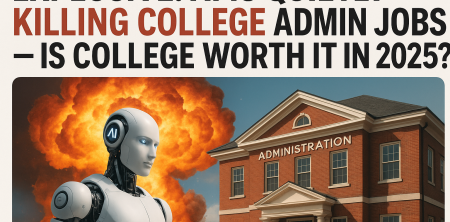
For decades, the trajectory of higher education costs has been a one-way street: steadily, relentlessly upward. We've seen tuition climb, fees balloon, and student loan debt become a national crisis. Underlying much of this was the often-cited growth in administrative staff. Universities, it seemed, were becoming top-heavy, with non-teaching personnel expanding at a faster clip than faculty. But what if I told you that trend is not just slowing down, but actually reversing course? And what if this seismic shift is making us all ask a crucial question: is college worth it 2025?
It's a question that’s gaining serious traction, and for good reason. A recent survey from the College and University Professional Association for Human Resources (CUPA-HR) dropped a bombshell: a significant decrease in administrative positions across higher education. Specifically, they reported a 6.6% reduction in full-time non-teaching staff and a staggering 23.9% cut in part-time non-teaching staff for 2025 compared to the previous year. Now, think about that for a moment. This isn't just a minor adjustment; it's a dramatic pivot, and the culprit, or perhaps the catalyst, is artificial intelligence.
This isn't just an internal university HR issue. This administrative streamlining, largely driven by AI, has profound implications for the cost of higher education and, by extension, for every student and family grappling with the decision of whether to invest in a degree. As institutions look to trim budgets and operate more efficiently, these changes *should* translate into a deceleration, or even a reduction, in tuition hikes. The big question, however, is whether they actually will, and what that means for the perceived value of a college degree in the coming years.
The Unseen Growth: How Admin Bloat Fueled Rising Costs
Before we dive into how AI is shaking things up, it’s important to understand the landscape it's disrupting. For years, critics of rising college costs often pointed to the proliferation of non-teaching staff as a major contributing factor. While faculty numbers remained relatively stable or grew incrementally, the ranks of administrators, support staff, and various specialized personnel swelled considerably. We saw new departments emerge, new roles created, and a general expansion of the bureaucratic infrastructure within universities.
This growth wasn't always malicious or wasteful. Many new positions were created to handle increasing regulatory compliance, support burgeoning student services, manage complex technological systems, or expand fundraising efforts. However, the sheer volume of this expansion inevitably added to institutions' operational overhead. Salaries, benefits, office space, and IT infrastructure for these roles all contributed to the overall cost base, which, as you might guess, was then passed on to students in the form of higher tuition and fees.
Economists and education policy experts have debated the exact impact of this administrative bloat for years. Some argued it was a necessary evil to provide a comprehensive student experience and manage increasingly complex institutions. Others contended it was an unsustainable model that diverted resources away from the core mission of teaching and research. Regardless of where you stood on that debate, the reality was that administrative growth became a significant line item in university budgets, directly influencing the answer to 'is college worth it?' for many families.
AI's Scalpel: Trimming the Administrative Fat
Now, enter artificial intelligence. AI isn't just a fancy new tool; it's a fundamental shift in how tasks can be accomplished. In the administrative realm, this means automating routine, repetitive, and data-intensive processes that previously required human intervention. Think about tasks like managing student records, processing applications, answering common queries, scheduling, or even basic IT support.
Generative AI, in particular, can draft emails, summarize documents, create reports, and even personalize communications at scale. Predictive AI can help optimize resource allocation, identify at-risk students, or forecast enrollment trends. These capabilities directly impact the need for human staff in roles that are primarily transactional or data-entry focused. The CUPA-HR findings—a 6.6% drop in full-time and a 23.9% drop in part-time non-teaching staff in 2025—are a clear indication that universities are beginning to leverage AI to achieve efficiencies.
This isn't just about reducing headcount; it's about reallocating human talent to higher-value activities. Instead of spending hours on data entry, staff can focus on complex problem-solving, personalized student support that AI can't replicate, or strategic planning. The promise here is not just cost savings but also an improvement in service delivery, as AI systems can often process information faster and with greater accuracy than humans, especially for routine tasks. It's a pragmatic response to financial pressures, and it's happening much faster than many anticipated.
The Public's Shifting Perception: Is College Worth It in 2025?
Amidst these internal shifts in university operations, there's a parallel, and perhaps more concerning, trend unfolding among the general public. A recent survey revealed a record low 31% of adults describing a college education as 'very important.' Let that sink in. For generations, a college degree was almost universally seen as the golden ticket—a non-negotiable step toward a stable career and a better life. Now, less than a third of adults view it as 'very important.'
Why this dramatic shift? It's multifaceted, but the most prominent factors are the relentless rise in tuition costs and the crushing weight of student loan debt. When you combine these financial burdens with a job market that increasingly values skills and experience over a traditional degree, the equation starts to look different. People are seeing friends, family members, or even themselves graduating with five- or six-figure debt, only to struggle to find a job commensurate with their investment. The return on investment (ROI) simply isn't what it used to be for everyone. (See: CDC Youth Risk Behavior Survey.)
This growing skepticism isn't just anecdotal; it's reflected in enrollment numbers and public discourse. You hear more and more conversations about trade schools, coding bootcamps, and direct-to-work pathways. The narrative that 'everyone needs a college degree' is eroding, replaced by a more nuanced understanding that different paths suit different individuals. This public sentiment is a powerful force, and universities that ignore it do so at their peril. They need to demonstrate tangible value, especially as the financial commitment continues to be so substantial, particularly when asking, 'is college worth it 2025?'
The Student Loan Debt Crisis: A Lingering Shadow
You can't talk about the value of college without confronting the elephant in the room: student loan debt. We're talking trillions of dollars nationally, spread across millions of borrowers. This isn't just an abstract economic problem; it's a very real burden on individuals, delaying homeownership, family formation, and other significant life milestones. The sheer scale of this debt has made many prospective students and their families think twice about taking on additional loans, even for what was once considered a prerequisite for success. For more context, see student loan forgiveness battle.
Even with AI-driven administrative efficiencies, the legacy of this debt crisis continues to cast a long shadow. Universities might be able to slow tuition increases, but they can't magically erase the debt that already exists. This means that for a significant portion of the population, the decision of whether to pursue higher education isn't just about future costs; it's about an already existing financial albatross. The psychological and economic impact of this debt is a major driver of the public's waning confidence in the 'very important' status of a college degree.
It also fuels the search for alternatives. If a four-year degree comes with a price tag that requires decades of repayment, many are actively seeking shorter, more affordable, and more directly career-focused credentials. This pressure from the debt crisis is forcing universities to re-evaluate their pricing models and demonstrate clearer pathways to financial solvency for their graduates. Without addressing the debt issue, the question of 'is college worth it 2025' will continue to be met with a resounding 'maybe not' for far too many.
Personal Finance in the Age of AI and High Tuition
So, with all these swirling factors—AI automation, administrative cuts, skepticism, and debt—how do students and families navigate the financial landscape of higher education? It’s more critical than ever to approach college funding with a strategic, personal finance mindset. Blindly accepting loans or picking the most prestigious (and expensive) school without a clear financial plan is a recipe for regret.
First, always start by maximizing scholarships and grants. These are funds you don't have to pay back. Don't just rely on what the university offers; aggressively seek out external scholarships from community organizations, corporations, and foundations. There are countless opportunities out there, but they require diligent searching and application writing. Every dollar in grant money is a dollar you won't have to borrow.
Second, seriously consider community college or dual enrollment programs for the first year or two. Completing general education requirements at a significantly lower cost can save tens of thousands of dollars. Then, transfer those credits to a four-year institution. It’s a smart financial move that doesn’t compromise the quality of your degree, and many state universities have seamless transfer agreements. This strategy directly addresses the 'is college worth it 2025' question by making the initial investment much smaller.
Third, understand the true cost of attendance, not just tuition. Factor in living expenses, books, transportation, and personal costs. Create a realistic budget. If you're taking out loans, borrow only what you absolutely need, not the maximum amount offered. Every dollar borrowed accrues interest, compounding your debt burden. Explore part-time jobs or work-study programs to offset some costs while studying.
Finally, and critically, research the earning potential of your chosen field. While passion is important, a harsh financial reality awaits if your degree leads to a job that can't support your loan payments. Use resources like the Bureau of Labor Statistics and salary aggregators to get a realistic picture of post-graduation income for various professions. This isn't about choosing a major solely for money, but about making an informed decision that balances your interests with financial viability.
The Promise of Efficiency: Will Cost Savings Reach Students?
Now for the million-dollar question: if AI is making universities more efficient and reducing administrative overhead, will these cost savings actually be passed on to students in the form of lower tuition or slower tuition increases? History suggests caution here. Universities, like any large organizations, are adept at finding new ways to spend money. Savings from one area might be redirected to other priorities, such as faculty salaries, research initiatives, facility upgrades, or marketing efforts.
However, the unprecedented public scrutiny and declining perception of college value might force their hand. If institutions want to reverse the trend of decreasing enrollment and rebuild public trust, they will need to demonstrate tangible efforts to control costs and make education more affordable. This could mean more modest tuition hikes, increased financial aid budgets, or even, in some cases, actual tuition reductions. The pressure to answer 'is college worth it 2025' affirmatively will be immense.
Furthermore, the competitive landscape is changing. As more online programs, micro-credentials, and alternative education providers emerge, traditional universities face greater pressure to justify their price point. If they can’t offer a significantly better value proposition, students will increasingly look elsewhere. AI-driven efficiency gains, therefore, represent a crucial opportunity for universities to become more competitive and relevant in a rapidly evolving educational ecosystem. (See: Associated Press News.)
A New Era for University Staffing and Skill Sets
The administrative shifts driven by AI aren't just about job losses; they're also about job transformation. The roles that remain, or the new roles that emerge, will require different skill sets. There will be a greater demand for individuals who can work alongside AI, manage AI systems, interpret AI-generated data, and develop AI strategies. This means a shift from purely transactional tasks to more analytical, strategic, and human-centric roles.
For current university staff, this necessitates upskilling and reskilling. Institutions will need to invest in training programs to help their existing workforce adapt to this new environment. For prospective employees, it means understanding which skills are becoming obsolete and which are gaining importance. Proficiency in data analysis, AI literacy, change management, and advanced problem-solving will be highly valued. For more context, see student loan borrowers final notices.
This also has implications for university curricula. If universities are going to prepare students for a workforce increasingly shaped by AI, their own internal staffing transformations should serve as a practical lesson. They need to integrate AI literacy and future-proof skills into their programs, ensuring that graduates are equipped not just for today's job market, but for the one that AI is rapidly creating. This internal and external alignment is critical for maintaining the relevance of higher education.
The Broader Impact on Education Innovation
Beyond administrative efficiencies, AI has the potential to fundamentally transform the learning experience itself. Imagine personalized learning paths tailored to each student's needs, AI tutors providing instant feedback, or adaptive assessments that identify knowledge gaps in real-time. These innovations could make education more effective, more engaging, and ultimately, more valuable.
However, integrating AI into the pedagogical core of universities requires significant investment and thoughtful implementation. It's not just about slapping AI tools onto existing courses; it's about reimagining how learning happens. The administrative cost savings from AI could, in theory, free up resources to fund these educational innovations, creating a virtuous cycle where efficiency drives pedagogical advancement.
This is where the debate around 'is college worth it 2025' gets even more interesting. If universities can leverage AI not just to cut costs but also to dramatically improve the quality and personalization of education, then the value proposition becomes much stronger. The challenge will be to ensure these technological advancements are equitably accessible to all students, and that they genuinely enhance learning outcomes rather than just becoming another layer of complexity.
Rethinking the Value Proposition: Beyond the Degree
Ultimately, the discussion around 'is college worth it 2025' forces a critical re-evaluation of what higher education truly offers. For decades, the degree itself was the primary currency. But in an AI-driven world, where skills can be acquired through diverse pathways and knowledge is instantly accessible, the value proposition needs to extend beyond a piece of paper.
Universities need to emphasize the development of critical thinking, creativity, complex problem-solving, ethical reasoning, and interpersonal skills—abilities that AI can augment but not replicate. They need to foster environments that promote deep learning, collaboration, and the ability to adapt to rapid change. The college experience should be about holistic development, networking opportunities, mentorship, and exposure to diverse ideas that shape individuals into well-rounded, adaptable citizens.
If universities can effectively articulate and deliver on this broader value proposition, integrating the best of AI for efficiency and innovation while focusing human effort on truly transformative educational experiences, then the answer to 'is college worth it 2025' might shift back towards a resounding 'yes.' But it won't be the same 'yes' as in generations past. It will be a 'yes' that acknowledges a different kind of investment, a different set of outcomes, and a fundamentally reimagined role for higher education in society.
The Role of Accreditation in a Changing Landscape
As the conversation around the value of higher education evolves, so does the significance of accreditation. Historically, accreditation has been the gold standard, a stamp of approval guaranteeing a certain level of quality and rigor for an institution and its programs. It ensures that degrees are recognized, credits are transferable, and students are eligible for federal financial aid. But in an era where alternative credentials and AI-driven learning platforms are gaining traction, how does accreditation adapt? (See: New York Times Education Section.)
For 2025 and beyond, accreditation bodies face the challenge of evaluating innovative educational models that don't fit the traditional mold. How do you accredit a program that relies heavily on AI tutors, offers micro-credentials, or is entirely skills-based rather than credit-hour based? The answer lies in shifting the focus from inputs (like faculty-to-student ratios or library holdings) to outcomes. What skills do students actually acquire? Are they prepared for the workforce? Do they achieve their personal and professional goals?
This shift will be crucial for maintaining public trust and ensuring that even non-traditional educational pathways offer genuine value. Students need assurance that their investment, whether it's in a four-year degree or a specialized bootcamp, will lead to recognized credentials and career opportunities. Accreditation will play a vital role in validating these diverse learning experiences, helping prospective students confidently answer 'is college worth it 2025' for their specific aspirations, regardless of the format of their education.
Comparing Traditional Degrees to Alternative Credentials
The rise of AI and the increasing skepticism about traditional college costs have also fueled a serious comparison between four-year degrees and alternative credentials. We're talking about things like coding bootcamps, industry certifications, apprenticeships, and specialized online courses. For many, these alternatives offer a faster, cheaper, and more direct path to employment in high-demand fields.
Consider the cost: a coding bootcamp might run you $10,000 to $20,000 for a few months of intensive training, potentially leading to a well-paying tech job. Compare that to upwards of $100,000 or more for a four-year degree, often with less direct career preparation. The ROI calculation for alternative credentials can look incredibly appealing, especially for those who already have a clear career path in mind.
However, it's not a simple either/or. Traditional degrees still offer a breadth of knowledge, critical thinking skills, and networking opportunities that many alternative credentials don't. They can be particularly valuable for leadership roles, professions requiring extensive theoretical backgrounds (like law or medicine), or for those who haven't yet settled on a specific career. The key for students in 2025 is to understand which path aligns best with their individual goals, financial situation, and desired career trajectory. It's about informed choice, not a blanket rejection of one path over another. The question isn't just "is college worth it 2025," but "is *this type of education* worth it for *my goals* in 2025?"
The Future of Faculty: AI as a Colleague, Not a Replacement
While much of the AI discussion has focused on administrative staff, it's natural to wonder about the impact on faculty. Will AI eventually replace professors? The consensus among education experts is a resounding no, but it will certainly change the faculty role. Instead of replacement, think of AI as an incredibly powerful teaching assistant or research partner.
AI can handle many of the time-consuming, administrative aspects of teaching: grading objective quizzes, providing basic feedback on drafts, answering frequently asked questions, and curating learning resources. This frees up professors to focus on what they do best: fostering critical thinking, facilitating deep discussions, mentoring students, conducting groundbreaking research, and designing innovative learning experiences that AI alone cannot replicate.
For faculty in 2025, embracing AI will be less about fearing obsolescence and more about leveraging these tools to enhance their teaching and research. It means developing new pedagogical approaches that integrate AI, teaching students how to ethically and effectively use AI in their own work, and focusing on the uniquely human aspects of education. The value of a professor will increasingly be measured not just by their knowledge, but by their ability to guide students through a complex, AI-infused world, making their contribution to the college experience undeniably worth it.
Trending Now
Frequently Asked Questions
Is college still worth it in 2025?
As administrative positions in colleges decrease due to AI, the cost of higher education may stabilize or even decline. This shift raises critical questions about the value of a college degree in 2025, especially as students and families weigh the financial implications of pursuing higher education.
How is AI affecting college administrative jobs?
AI is leading to a significant reduction in college administrative staff, with reports indicating a 6.6% decrease in full-time positions and a 23.9% cut in part-time roles. This trend is reshaping the landscape of higher education and could impact operational costs.
What are the implications of reduced college admin staff?
The reduction in administrative staff, driven by AI, could lead to lower operational costs for universities. This may result in slower tuition increases or even potential decreases, directly affecting students' decisions about the value of their college education.
Why are college costs rising?
For decades, rising college costs have been attributed to an increase in administrative staff. However, with recent cuts in non-teaching positions due to AI, this trend may be reversing, potentially impacting future tuition rates and overall college affordability.
What does the future of higher education look like with AI?
The integration of AI in higher education is expected to streamline operations and reduce administrative bloat, which may lead to a more efficient system. This transformation could influence tuition rates and the overall perceived value of a college degree in the coming years.
What did we miss? Let us know in the comments and join the conversation.


0 Responses