```html
Understanding Dyscalculia: A Brief Overview
Dyscalculia, often referred to as 'math dyslexia,' is a specific learning disability that affects an individual's ability to understand numbers and perform mathematical calculations. Symptoms can manifest in various ways, ranging from difficulty recognizing numerical symbols to struggles with learning math facts and concepts. Unlike typical math struggles, dyscalculia is not a result of a lack of intelligence or motivation. Instead, it stems from a variety of cognitive processing issues that make mathematical tasks particularly challenging. For more on this, see essential insights for educators.
Research indicates that dyscalculia affects approximately 5% to 7% of the population, meaning that many students enter classrooms facing significant barriers when it comes to math. For teachers and parents, recognizing the signs of dyscalculia is the first step toward providing effective support. Understanding how to implement multisensory math activities for dyscalculia can profoundly impact a student's ability to engage with math in a meaningful way.
The Importance of Multisensory Learning
Multisensory learning is an educational approach that integrates multiple senses—sight, sound, touch, and movement—to enhance the learning experience. For students with dyscalculia, this approach can be particularly beneficial. By engaging multiple senses, these activities help solidify mathematical concepts and skills, making them more accessible and easier to grasp.
There is substantial evidence that reinforces the efficacy of multisensory techniques in education. According to a study published in the journal Learning Disabilities Research & Practice, students who participated in multisensory interventions showed significant improvements in their math ability compared to those who received traditional instruction. This suggests that incorporating multisensory math activities for dyscalculia is not just helpful, but essential for fostering understanding and mastery in mathematics.
1. Number Line Hopscotch
Hopscotch is a classic game that can be easily transformed into a number line activity. To set up, create a number line on the ground using chalk or tape, extending from 0 to a predetermined number, such as 20. Students can take turns hopping along the number line, calling out the numbers they land on.
This activity helps reinforce number recognition and sequencing while also incorporating physical movement, which is essential for many students with dyscalculia. You can enhance the complexity by asking students to perform simple addition or subtraction as they land on specific numbers. For instance, if they land on 5, they might need to hop two spaces forward and say the new number aloud.
2. Hands-On Manipulatives
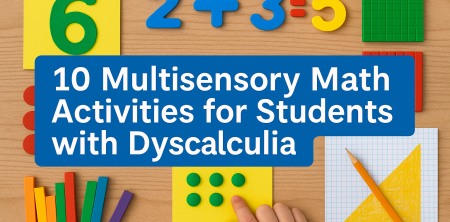
Using manipulatives such as counting blocks, beads, or even everyday items like buttons and coins can significantly aid in understanding mathematical concepts. These physical objects allow students to visualize and physically interact with numbers, making abstract concepts more tangible.
For example, when introducing addition or subtraction, students can group manipulatives together to represent problems visually. If they are learning about fractions, they can use pie charts made from paper plates divided into sections to better understand parts of a whole. This hands-on approach fosters engagement and comprehension while allowing students to explore mathematical concepts at their own pace.
3. Math Stories and Word Problems
Incorporating storytelling into math lessons can motivate students to engage with numbers in a more relatable way. Create math stories or word problems that link mathematical concepts to real-life scenarios. For instance, you can design a narrative about a character who needs to buy apples at the market, encouraging students to solve for how many they would need based on the price and their budget.
This approach not only makes math more enjoyable but also encourages critical thinking. By discussing the story and its context, students can better comprehend the mathematical operations involved. Furthermore, adding illustrations can appeal to visual learners, further enhancing the multisensory aspect of the activity.
4. Colored Number Cards
Using colored number cards can help students with dyscalculia differentiate between numbers and operations. Create a set of cards in various colors, each representing different numerical values or mathematical operations (addition, subtraction, etc.).
To use these cards, students can draw and arrange them to solve problems. For example, if given a problem like “5 + 3,” they could select the appropriate colored cards and arrange them on their desk or board. This visual and tactile interaction will reinforce their understanding of numerical relationships and operation sequences, making the learning process more engaging. (See: Understanding dyscalculia from NIH.)
5. Math Games with Technology
In this digital age, incorporating technology into learning can be extremely beneficial. There are myriad educational apps and online games designed specifically for students with dyscalculia. These platforms often utilize gamification techniques to make math learning fun and engaging.
Apps like Prodigy Math or Mathway offer tailored experiences where students can practice math skills through interactive gameplay. By providing instant feedback and adjusting the difficulty based on the student's performance, these tools can cater to diverse learning needs, creating a personalized learning experience that is both multisensory and effective.
6. Sensory Bins for Hands-On Learning
Sensory bins filled with rice, beans, or sand can serve as excellent tools for teaching math concepts. You can hide number cards, counting bears, or even shapes within the bin, allowing students to dig through and discover them. This tactile element not only helps with number recognition but also fine motor skills.
For instance, you can create a bin that includes various objects representing different numbers, and students can practice counting, sorting, or even basic operations by manipulating the items they find. This approach encourages exploration and creativity, making math feel less intimidating for students struggling with dyscalculia.
7. Visual Math Journals
Encouraging students to keep visual math journals can be a powerful way to reinforce concepts. In these journals, students can draw representations of problems, write explanations in their own words, and reflect on their learning processes. This practice taps into several learning modalities, enabling students to express their understanding creatively.
Additionally, visual journals can serve as a valuable reference for students when they encounter similar math problems in the future. They can look back at their drawings and explanations, reinforcing their learning while building confidence in their mathematical abilities.
8. Real-Life Math Applications
Integrating real-life scenarios into math lessons can help demonstrate the relevance of mathematical concepts. Engage students in activities like budgeting for a class party, measuring ingredients for a recipe, or planning a small project. These experiences allow students to apply their math skills in practical situations, reinforcing the idea that math is not just confined to textbooks.
These types of projects encourage students to work collaboratively, discussing approaches and solutions among peers. Engaging with real-world applications can motivate students to see math as an essential skill rather than just an academic requirement, fostering a more positive attitude toward the subject.
9. Collaborative Group Work
Group work can provide a supportive environment for students with dyscalculia, allowing them to learn from their peers. In small groups, students can collaborate on math tasks, share strategies, and build upon each other's understanding. This social aspect of learning can be particularly beneficial for students who may feel isolated or discouraged by their struggles.
In a collaborative setting, students can take on different roles based on their strengths, whether it’s leading a discussion, providing support, or generating ideas. This not only facilitates deeper comprehension of mathematical concepts but also promotes social skills and teamwork, essential life skills that extend beyond the classroom.
10. Regular Feedback and Encouragement
Finally, providing regular feedback and encouragement is crucial for students with dyscalculia. Celebrate small victories, no matter how minor they may seem. Positive reinforcement can enhance self-esteem and motivate students to continue working through challenges.
Incorporating constructive feedback helps students understand their progress while identifying areas for improvement. This supportive approach creates an environment where students feel safe to take risks, ask questions, and express their uncertainties without fear of judgment.
Expanding on Multisensory Math Activities
While the activities mentioned above provide a solid foundation for teaching math to students with dyscalculia, there is a wealth of other multisensory methods that can further enhance learning. Engaging students through various forms of sensory input can vary the learning experience and keep it fresh and exciting. (See: Dyscalculia overview by CDC.)
11. Interactive Whiteboard Activities
Using interactive whiteboards in the classroom can transform the way math is taught. Teachers can use digital tools to create interactive lessons that engage students visually and kinesthetically. For instance, students can draw shapes, solve equations, or manipulate data using touch-sensitive screens. The immediate feedback provided by these tools helps solidify understanding and encourages exploration.
12. Use of Music and Rhythm
Music can be a powerful medium for learning. Incorporating songs that describe mathematical concepts or procedures can help students remember important facts. For example, creating a catchy tune for multiplication tables can make memorization easier. Rhythm and music can enhance memory retention, making learning more enjoyable and effective.
Statistics and Evidence Supporting Multisensory Approaches
According to research conducted by the National Center for Learning Disabilities, students who engage in multisensory learning can improve their retention rates by up to 70%. The study highlights that when students use touch, sight, and sound simultaneously, they are more likely to understand and recall information. This is particularly true for students with learning disabilities like dyscalculia.
Additionally, a survey conducted by the International Dyslexia Association found that 85% of teachers reported increased student engagement when utilizing multisensory strategies in math instruction. This shows just how impactful these methods can be in fostering a positive learning environment and encouraging student participation.
Expert Perspectives on Multisensory Math Learning
Experts in educational psychology frequently endorse multisensory approaches for students with learning disabilities. Dr. Richard Wagner, a leading researcher in the field, states that "multisensory learning not only aids in concept retention but also helps build a student's confidence over time." This confidence can be especially crucial for students with dyscalculia, who may often feel discouraged by traditional teaching methods.
Similarly, Dr. Sarah Ward, an educational therapist, emphasizes the importance of individualized learning experiences. "Every child learns differently, and multisensory activities allow educators to tailor their teaching to fit the needs of each student," she explains. This flexibility is key to reaching students who may struggle with conventional approaches.
Creative Ideas for Incorporating Multisensory Math Activities
Here are some innovative ways to incorporate multisensory activities into math lessons:
- Math Scavenger Hunts: Create a scavenger hunt where students find items that correspond to math problems. For example, "Find three objects that can represent the number 7" or "Locate five items that can be grouped by twos." This promotes physical activity and critical thinking.
- DIY Math Games: Invite students to create their own board games that incorporate math problems. They can design the game board, rules, and challenges, providing a platform for creativity while reinforcing math concepts.
- Cooking Projects: Utilize cooking to teach measurements and fractions. Have students follow a recipe, measuring ingredients and dividing them into portions. This real-world application makes math relevant and engaging.
Frequently Asked Questions (FAQ)
1. What are multisensory math activities?
Multisensory math activities involve teaching methods that engage multiple senses—sight, sound, touch, and movement. These activities aim to enhance understanding and retention of mathematical concepts by making learning more interactive and engaging. This builds on top-rated dyscalculia apps.
2. How can I identify if my child has dyscalculia?
Signs of dyscalculia include difficulty with number recognition, trouble understanding math concepts, struggles with memorizing math facts, and challenges in completing math-related tasks. If you suspect your child may have dyscalculia, it's essential to consult with a professional for an accurate assessment.
3. Are multisensory activities effective for all students?
Yes, while particularly beneficial for students with learning disabilities such as dyscalculia, multisensory activities can enhance learning for all students. These approaches cater to different learning styles and can make math more enjoyable for everyone.
4. Can technology aid in multisensory learning?
Absolutely! There are numerous educational apps and digital tools designed to provide multisensory experiences. They often include interactive elements that engage students through visuals, sound, and tactile interactions, making math learning more dynamic.
5. How often should multisensory math activities be used in lessons?
It's ideal to integrate multisensory activities regularly within your math curriculum. Consistent use helps reinforce concepts and allows students to engage with the material in various ways, promoting deeper understanding over time.
Adapting Multisensory Activities for Different Learning Levels
When implementing multisensory math activities, it's essential to recognize that students with dyscalculia may have varying levels of ability and understanding. Adapting activities for different learning levels can help ensure that all students benefit from the multisensory approach.
For instance, younger students or those just beginning their mathematical journey might benefit from simpler activities, such as counting with physical objects. In contrast, older students may engage more effectively with technology-based games that incorporate higher-level math concepts. It’s all about tailoring the experience to each student’s needs.
The Role of Parents in Supporting Multisensory Learning
Parents play a crucial role in supporting their children with dyscalculia. Encouraging the use of multisensory math activities at home can reinforce classroom learning while providing additional practice in a comfortable setting. Simple activities, such as cooking together or playing math-based board games, can effectively integrate math practice into everyday life.
Moreover, parents can help by creating a positive math environment at home. This means celebrating successes, no matter how small, and maintaining an open dialogue about any struggles their child may face. Building a strong support system can significantly enhance a child's confidence and willingness to tackle challenging math concepts.
Ready-to-Use Resources and Materials for Educators
Teachers looking to implement multisensory math activities can benefit from various resources and materials available online and in educational stores. Here are some examples:
- Math Manipulatives Kits: Many companies offer kits specifically designed for teaching math concepts, including counting cubes, fraction circles, and base ten blocks.
- Interactive Games: Websites like Teachers Pay Teachers provide downloadable resources, including interactive games and worksheets aimed at reinforcing math concepts through multisensory learning.
- Educational Apps: As mentioned earlier, apps like Prodigy Math offer tailored experiences that can be easily integrated into lessons, making math practice fun and engaging.
Conclusion: An Inclusive Approach to Math Education
Addressing the needs of students with dyscalculia requires a thoughtful and inclusive approach. By implementing multisensory math activities for dyscalculia, educators and parents can create a more accessible learning environment that fosters understanding and enthusiasm for mathematics. The strategies outlined here are not only effective but also enjoyable, encouraging students to engage with math in ways that resonate with them personally.
With the right tools and support, students with dyscalculia can thrive, transforming their relationship with math from one of frustration to one of confidence and success. So, whether you're a teacher looking to innovate your lessons or a parent seeking ways to support your child, consider integrating these multisensory strategies into your math teaching toolkit.
```
Trending Now
Frequently Asked Questions
What are some multisensory activities for students with dyscalculia?
Multisensory activities for students with dyscalculia include using physical objects for counting, incorporating music to teach math facts, and employing visual aids like charts and diagrams. These activities engage multiple senses, making math concepts more accessible and easier to understand.
How can teachers support students with dyscalculia?
Teachers can support students with dyscalculia by implementing multisensory learning strategies, providing individualized instruction, and using tools like manipulatives and visual aids. Recognizing the signs of dyscalculia and adapting teaching methods to meet diverse needs are crucial for effective support.
What is dyscalculia and how does it affect learning?
Dyscalculia, often called 'math dyslexia,' is a specific learning disability that impairs an individual's ability to understand numbers and perform calculations. It can lead to difficulties in recognizing numerical symbols and learning math concepts, affecting overall academic performance in mathematics.
Why is multisensory learning important for students with dyscalculia?
Multisensory learning is important for students with dyscalculia because it engages multiple senses—sight, sound, touch, and movement—making math concepts more relatable. This approach helps solidify understanding and retention, leading to better academic outcomes compared to traditional teaching methods.
What percentage of the population is affected by dyscalculia?
Research indicates that dyscalculia affects approximately 5% to 7% of the population. This means many students face significant challenges in math, making it essential for educators and parents to recognize the signs and implement effective support strategies.
What's your take on this? Share your thoughts in the comments below — we read every one.


0 Responses