```html
As education continues to evolve, the methods and frameworks used to prepare students for higher learning are of paramount importance. One of the most influential frameworks in education is Bloom's Taxonomy. This system categorizes levels of learning, which can significantly enhance the way students engage with material, especially in Advanced Placement (AP) courses. The interrelationship between Bloom's Taxonomy and AP courses plays a crucial role in fostering college-level thinking, equipping students with the skills they need to succeed in both academia and beyond.
Understanding Bloom's Taxonomy
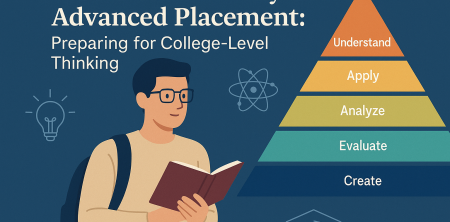
Developed by Benjamin Bloom in 1956, Bloom's Taxonomy in education provides a structured approach to educational objectives. It classifies cognitive skills into six levels, ranging from basic to advanced:
- Knowledge: Recalling facts and basic concepts
- Comprehension: Understanding information
- Application: Using information in new situations
- Analysis: Breaking down information into parts
- Synthesis: Combining elements to form a new whole
- Evaluation: Making judgments based on criteria
This hierarchical model not only aids educators in designing curricula but also helps students understand the complexity of their learning processes. Each level builds upon the previous one, encouraging deeper thought and more sophisticated engagement with subjects.
The Role of Advanced Placement in Education
Advanced Placement courses are rigorous, college-level classes offered in high schools, allowing students to earn college credits while still in secondary education. These courses are designed to challenge students, pushing them to develop higher-order thinking skills. The AP program includes a variety of subjects ranging from calculus and biology to humanities and foreign languages, each demanding critical thinking and analytical abilities.
In recent years, the AP program has gained traction as a pathway for students not only to gain college credit but also to prepare more effectively for the academic challenges of university life. With over 2.8 million students participating in AP courses annually, the significance of integrating frameworks like Bloom's Taxonomy into these classes cannot be understated.
Bloom’s Taxonomy and Its Impact on AP Learning Objectives
Integrating Bloom's Taxonomy in education into AP curricula allows educators to craft objectives that guide both teaching and assessment. By utilizing the taxonomy, teachers can create specific, measurable goals that align with the cognitive demands of each unit. For instance:
- In a history AP course, students might start with recalling dates and events (Knowledge), then advance to comparing historical events (Analysis), and finally, to evaluating the significance of those events on contemporary society (Evaluation).
- In a science AP course, students may begin by learning scientific facts (Knowledge), progress to applying scientific methods in experiments (Application), and culminate in designing their own experiments to test hypotheses (Synthesis).
This structured approach not only clarifies expectations for students but also informs assessment practices, ensuring that all levels of cognition are tested.
Practical Applications of Bloom's Taxonomy in AP Courses
Educators are uniquely positioned to leverage Bloom's Taxonomy to enhance their teaching strategies within AP courses. Here are several practical applications:
1. Curriculum Development
When developing a curriculum, teachers can map out learning objectives using the taxonomy levels. For example, an AP Literature teacher could create assignments that focus first on comprehension of themes (Comprehension), then move toward analyzing character motivations (Analysis), and finally, encourage students to create their own narratives inspired by studied works (Synthesis). (See: Bloom's Taxonomy overview.)
2. Assessments
Standardized tests often focus heavily on basic recall, but by including various types of questions that span the levels of Bloom's Taxonomy, teachers can better assess student understanding. For instance, multiple-choice questions might test Knowledge, while essay prompts could require students to analyze and evaluate texts.
3. Classroom Activities
Engaging activities can be designed around the different levels of the taxonomy. Group projects can facilitate collaboration and deeper thinking, allowing students to analyze problems collectively and synthesize their ideas into presentations or reports.
Current Relevance and Future Directions
In today’s educational landscape, the relevance of Bloom's Taxonomy in education continues to grow. As schools increasingly focus on preparing students for college and career readiness, the integration of this taxonomy into AP courses becomes vital. With the rise of remote learning and hybrid education models, educators face the challenge of maintaining rigorous academic standards.
Teachers can utilize digital tools to create interactive lessons that adhere to Bloom's levels, ensuring that students engage in higher-order thinking even in a virtual classroom. For instance, online discussion boards can prompt students to evaluate arguments in literature or scientific theories, mirroring the Analytical and Evaluative stages of the taxonomy.
Challenges in Implementation
While integrating Bloom's Taxonomy into AP courses is beneficial, there are challenges educators face. One significant hurdle is the varying levels of student preparedness. Not all students enter AP courses with the same foundational knowledge, leading to disparities in their ability to engage with higher-order thinking tasks.
Furthermore, the pressure of standardized testing can lead teachers to prioritize content coverage over deep learning. Balancing the demands of preparing students for AP exams while fostering critical thinking skills requires creativity and flexibility in teaching strategies.
Expert Perspectives on Bloom’s Taxonomy
Educators and scholars have long recognized the value of Bloom's Taxonomy in shaping effective learning environments. Dr. Lorin Anderson, one of the contributors to the revision of Bloom's original framework, emphasized the importance of aligning educational goals with real-world applications. He noted, "When students understand the purpose behind their learning, they are more likely to engage with the material on a deeper level." This sentiment echoes the intentions behind AP curricula, which aim to connect high school learning with college expectations.
Similarly, educational psychologist Dr. David Conley highlighted the importance of critical thinking skills in college readiness. He argues that "students who can analyze, evaluate, and create are significantly better equipped for the challenges of higher education." This aligns seamlessly with the intent of integrating Bloom’s Taxonomy into AP coursework.
Case Studies: Successful Integration of Bloom's Taxonomy in AP Courses
Several schools across the United States have successfully implemented Bloom’s Taxonomy within their AP programs, with demonstrable results. For instance, a high school in California revamped its AP Chemistry curriculum by embedding taxonomy principles into unit planning. The outcome was a marked improvement in student performance on AP exams, as students were able to approach complex problems with a more robust analytical framework.
Another example comes from a New York school district where AP English Literature teachers emphasized Bloom's levels to enhance essay writing skills. By guiding students from basic comprehension to high-level evaluation, teachers reported a significant increase in the quality of student essays, reflecting deeper engagement with the texts. (See: AP courses and college readiness.)
Real-World Applications of Bloom's Taxonomy
Beyond classrooms, Bloom's Taxonomy is finding its way into various fields, enhancing training programs and professional development. Organizations are using this framework to structure employee training sessions, ensuring that staff not only grasp fundamental concepts but also develop critical thinking and problem-solving skills. For example, companies in tech and healthcare are implementing training modules that guide employees through the levels of knowledge, from basic technical skills (Knowledge) through practical applications (Application) to strategic decision-making (Evaluation).
Statistics Supporting Bloom's Taxonomy in Education
Research indicates that schools employing Bloom's Taxonomy in their teaching methodologies see improved student outcomes. A study published in the Journal of Educational Psychology found that students exposed to curricula based on Bloom's framework scored, on average, 15% higher on standardized assessments than those who did not. Additionally, educators reported that students were more engaged and showed increased collaboration in group settings.
With the growing emphasis on higher-order thinking skills, studies suggest that up to 75% of employers prioritize these skills in job candidates. By teaching students how to apply Bloom’s principles, educators are not just preparing them for AP exams but also for the workforce.
FAQ: Frequently Asked Questions about Bloom's Taxonomy in Education
What is Bloom's Taxonomy?
Bloom's Taxonomy is a framework developed by educational psychologist Benjamin Bloom that categorizes cognitive skills into six levels: Knowledge, Comprehension, Application, Analysis, Synthesis, and Evaluation. It helps educators design learning objectives and assessments.
How can teachers implement Bloom's Taxonomy in their classrooms?
Teachers can integrate Bloom's Taxonomy by developing lesson plans that align with the taxonomy levels, creating assessments that require students to demonstrate understanding at various cognitive levels, and using classroom activities that encourage higher-order thinking.
Why is Bloom's Taxonomy important for Advanced Placement courses?
Bloom's Taxonomy is particularly important for AP courses because it helps educators cultivate college-level thinking skills in students, ensuring they are prepared for the rigors of higher education. It allows for a structured approach to learning objectives that aids both teaching and assessment.
Can Bloom's Taxonomy be applied outside of education?
Yes, Bloom's Taxonomy is applicable in various fields, such as corporate training, professional development, and even personal skill-building. Its principles can help guide structured learning and improvement across diverse contexts.
What are some common challenges in using Bloom's Taxonomy?
Challenges include varying levels of student preparedness, the pressure of standardized testing leading to content over comprehension, and the need for teachers to be flexible in their approaches to accommodate different learning styles and needs.
Examples of Bloom's Taxonomy in AP Course Design
To illustrate the integration of Bloom's Taxonomy into AP course design, let’s consider a few subjects:
AP U.S. History
In an AP U.S. History class, teachers can foster learning objectives that align with Bloom's levels. For example, students might start with a focus on Knowledge by memorizing key historical facts and dates, then move to Comprehension by discussing the causes and effects of major events, followed by Application tasks like writing essays that apply historical context to modern issues.
AP Calculus
In AP Calculus, after students master the basic principles (Knowledge), they could engage in complex problem-solving scenarios (Application), analyze different functions and their derivatives (Analysis), and ultimately create their own real-world problems that require calculus to solve (Synthesis).
AP Psychology
For AP Psychology, educators can have students start by recalling key terms and theories (Knowledge), then move to explaining psychological concepts (Comprehension), applying theories to case studies (Application), and finally critiquing research methods or ethical issues within studies (Evaluation).
The Future of Bloom's Taxonomy in the Digital Age
As technology continues to influence education, the application of Bloom's Taxonomy will likely evolve. With the advent of artificial intelligence and adaptive learning technologies, educators can harness these tools to create personalized learning experiences that address individual student needs while adhering to the principles of Bloom's hierarchy. For instance, AI can analyze student performance data and adjust content delivery to ensure that learners are being challenged appropriately at each cognitive level.
Additionally, digital platforms can facilitate collaborative learning environments where students can engage in peer evaluations and discussions, all while addressing the higher-order thinking skills emphasized in Bloom's Taxonomy.
Conclusion: The Path Forward for Bloom's Taxonomy in Education
The integration of Bloom's Taxonomy in education, especially within Advanced Placement courses, represents a critical step towards fostering college-ready students. As the landscape of education continues to change, the framework offers a roadmap for developing higher-order thinking skills essential for success in post-secondary education. By focusing on the various levels of learning, educators can better prepare students not only for AP exams but for lifelong learning. The future of education depends on our ability to adapt and innovate, and Bloom’s Taxonomy stands as a proven strategy for achieving those goals.
```
Trending Now
- our breakdown of unlock your future: exciting frontend developer opportunity with quinncia inc. and free frontend developer course
- Irreversibility in Preschool: Why Young Children Struggle with Reversing Actions
- the complete explanation
- our breakdown of zone of proximal development in reading instruction
- this guide on why object permanence matters for preschool readiness
Frequently Asked Questions
What is Bloom's Taxonomy in education?
Bloom's Taxonomy is a framework developed by Benjamin Bloom in 1956 that classifies learning objectives into six hierarchical levels: Knowledge, Comprehension, Application, Analysis, Synthesis, and Evaluation. This structured approach helps educators design curricula and encourages students to engage deeply with material.
How does Bloom's Taxonomy relate to Advanced Placement courses?
Bloom's Taxonomy aligns closely with Advanced Placement (AP) courses by promoting higher-order thinking skills. AP courses challenge students to apply and analyze information, which corresponds to the upper levels of Bloom's Taxonomy, ultimately preparing them for college-level academic rigor.
Why are Advanced Placement courses important?
Advanced Placement courses are important because they offer high school students the opportunity to earn college credits while still in secondary education. These rigorous classes help students develop critical thinking and analytical skills necessary for success in college and beyond.
What are the levels of Bloom's Taxonomy?
The levels of Bloom's Taxonomy include: Knowledge (recalling facts), Comprehension (understanding information), Application (using information), Analysis (breaking down information), Synthesis (combining elements), and Evaluation (making judgments). Each level builds on the previous one to enhance learning. (teaching critical thinking tips)
How can Bloom's Taxonomy enhance student learning?
Bloom's Taxonomy enhances student learning by providing a clear framework for educators to design lessons that promote deeper understanding and engagement. By progressing through the levels, students develop critical thinking skills that are essential for academic success and lifelong learning.
What's your take on this? Share your thoughts in the comments below — we read every one.

