```html
In an educational landscape that increasingly emphasizes critical thinking and analytical skills, Bloom's Taxonomy question stems provide an essential framework for teachers. This structure encourages higher-order thinking across various subjects, making it easier to formulate questions that elevate learning beyond mere memorization. Understanding Bloom's taxonomy can empower educators to create a more engaging and intellectually stimulating classroom environment.
1. Understanding Bloom's Taxonomy
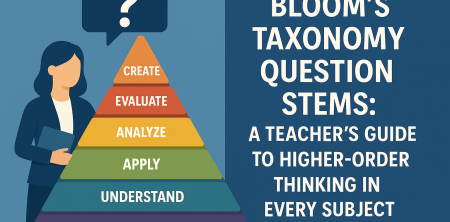
Originally developed by Benjamin Bloom in 1956, Bloom's Taxonomy categorizes cognitive skills into a hierarchy, ranging from lower-order to higher-order thinking. The original six categories included Knowledge, Comprehension, Application, Analysis, Synthesis, and Evaluation. In 2001, a revised version redefined these categories as Remembering, Understanding, Applying, Analyzing, Evaluating, and Creating, reflecting a more dynamic view of learning processes.
Each level of the taxonomy builds upon the previous one. For instance, before students can analyze or evaluate information, they must first comprehend and remember it. This hierarchical structure serves as a roadmap for educators, helping them gauge where their students are in the learning process and how to challenge them to think more critically.
2. The Importance of Question Stems
Question stems are pivotal in facilitating students’ engagement with content. They guide learners to think critically and creatively, prompting them to explore concepts deeply rather than just skimming the surface. By using well-crafted question stems aligned with Bloom's taxonomy, teachers can promote a culture of inquiry in the classroom.
For example, instead of asking, "What are the key themes in this poem?"—a question that might only require memorization—teachers can ask, "How does the poet's choice of imagery impact the themes?" This encourages students to analyze and evaluate the text, fostering a more profound understanding of the material.
3. Bloom's Taxonomy Question Stems for Each Level
To effectively utilize Bloom's taxonomy in your teaching, it’s crucial to know the various question stems associated with each cognitive level. Here’s a breakdown:
- Remembering: What is...? Can you list...? Describe...? Identify...?
- Understanding: Explain in your own words... How would you summarize...? What do you think the main idea is...?
- Applying: How would you use...? What examples can you find...? Demonstrate how...?
- Analyzing: What are the parts of...? How can you compare...? What are the relationships between...?
- Evaluating: Do you agree or disagree...? How would you justify...? What criteria would you use to assess...?
- Creating: What would happen if...? Can you design...? How could you improve...?
These question stems not only help guide classroom discussions but also encourage students to engage with the material on a deeper level. Teachers can adapt these stems for any subject, ensuring that higher-order thinking permeates the curriculum.
4. Practical Insights for Implementing Question Stems
Integrating Bloom's taxonomy question stems into your teaching requires some deliberate practices. Start by familiarizing yourself with the taxonomy and identifying objectives for your lessons. Consider which cognitive levels you want your students to reach.
One effective strategy is to create a question bank tailored to your subject area. For instance, in a science class, you might develop stems that encourage students to analyze data from experiments or evaluate the implications of scientific theories. This not only prepares students for assessments but also cultivates critical thinking skills that are essential beyond the classroom.
5. Examples of Question Stems in Different Subjects
Different subjects lend themselves to various applications of Bloom's taxonomy question stems. Here’s how you might see these stems in action:
- Language Arts: In literature discussions, asking students to compare characters in different texts can stimulate analysis (e.g., "How do the protagonists in these novels respond to conflict, and what does that reveal about their character?").
- Mathematics: In math classes, applying concepts through real-world problems can deepen understanding (e.g., "How would you apply the Pythagorean theorem to solve a problem in architecture?").
- Science: Encouraging evaluations of experiments can enhance analytical skills (e.g., "What are the potential flaws in this experiment, and how could they be addressed?").
- Social Studies: Asking students to design a project based on historical events fosters creativity (e.g., "If you could create a documentary about a historical event, what would it focus on and why?").
By tailoring question stems to specific subjects, educators can create a more relevant and engaging learning experience for students. (See: Bloom's Taxonomy overview.)
6. Current Relevance in Education
In today’s educational climate, where critical thinking and problem-solving are paramount, the relevance of Bloom's Taxonomy question stems cannot be overstated. With a growing emphasis on 21st-century skills, educators are tasked with preparing students to think critically and creatively.
Furthermore, the rise of standardized testing has led to increased scrutiny of teaching methods. Teachers who incorporate Bloom's taxonomy question stems not only align with educational standards but also promote a deeper understanding of content. This approach equips students with the skills necessary for both academic success and real-world application.
7. Challenges in Implementing Bloom's Taxonomy
Despite the benefits, implementing question stems based on Bloom's taxonomy can pose challenges. One significant hurdle is the transition from traditional teaching methods focused on rote memorization to a more inquiry-based approach. Some educators may struggle to shift their mindset and adapt their lesson plans accordingly.
Additionally, time constraints can limit the ability to foster higher-order thinking. Teachers often feel pressured to cover a substantial amount of material within a short timeframe, which can make it difficult to engage students in deeper discussions. Addressing these challenges requires ongoing professional development and support from educational institutions.
8. Strategies for Overcoming Barriers
Overcoming the challenges associated with implementing Bloom's taxonomy question stems can be managed through several strategies. First, collaboration among educators can provide a supportive environment for sharing ideas and resources. Teachers can work together to develop question stems that are subject-specific and effective in promoting higher-order thinking.
Secondly, integrating technology can facilitate the use of these question stems. Digital tools can help students engage with content in innovative ways, such as through interactive quizzes and online discussion forums. This not only aids in formative assessment but also allows for a more personalized learning experience.
9. Resources for Further Exploration
For educators looking to deepen their understanding of Bloom's taxonomy and question stems, several resources are available. Books such as “The Essential Guide to Assessing Secondary Schools” by Peter C. L. McGowan provide comprehensive frameworks and practical strategies for implementing higher-order thinking in the classroom.
Online platforms like TeachThought and Edutopia regularly publish articles and guides related to Bloom's taxonomy, offering insights from experienced educators. Additionally, workshops and webinars focused on critical thinking can provide valuable professional development opportunities.
10. Applying Bloom's Taxonomy in Real-World Situations
Bloom's Taxonomy question stems are not just limited to academic environments; they can also be essential in real-world applications. For example, during job interviews, employers often ask candidates to demonstrate problem-solving and critical thinking skills. Incorporating question stems derived from Bloom's taxonomy into interview preparation can help candidates articulate their thoughts effectively.
In corporate training programs, employers can apply these question stems when developing training modules that require employees to engage with complex material actively. For instance, a training session on customer service could use stems like, "How would you handle a complaint from a difficult customer?" This encourages employees to think analytically about their responses, preparing them for real-life scenarios.
11. Bloom's Taxonomy and Differentiated Instruction
One of the advantages of using Bloom's Taxonomy question stems in the classroom is its adaptability for differentiated instruction. Teachers can tailor question stems to meet the varied needs of learners. For example, struggling students can be asked more straightforward, remembering-level questions to build foundational knowledge, while advanced students can be challenged with higher-order questions that require analysis and synthesis.
This approach not only allows for personalized learning experiences but also ensures that all students are engaged at their level of understanding. By providing appropriate challenge levels, educators can foster a more inclusive classroom environment where every student feels empowered to participate. (See: importance of evaluation in education.)
12. Expert Perspectives
Many educational professionals advocate for the use of Bloom's taxonomy in contemporary teaching. Dr. Patricia B. Dede, an educational psychologist, emphasizes that "Bloom's Taxonomy is a powerful tool for fostering critical thinking skills necessary for success in today’s world." She points out that the taxonomy's structured approach allows educators to scaffold learning effectively, ensuring students build on their knowledge progressively.
Another expert, Dr. Richard E. Mayer, an educational psychologist known for his work on multimedia learning, argues that "effective questioning is key to engaging students in meaningful learning experiences." He suggests that teachers should not only use question stems but also encourage students to create their question stems, which can deepen their understanding and ownership of their learning process.
13. Statistics on Critical Thinking in Education
Recent studies highlight the importance of critical thinking in education. According to a report from the National Education Association, 88% of educators believe that fostering critical thinking skills is essential for student success. Furthermore, research by the Partnership for 21st Century Skills shows that schools that implement frameworks like Bloom's Taxonomy report an increase in students' ability to perform at higher cognitive levels, demonstrating the effectiveness of these question stems in promoting critical engagement.
14. Frequently Asked Questions (FAQ)
What is Bloom's Taxonomy?
Bloom's Taxonomy is a framework that categorizes cognitive skills and learning objectives, originally created by Benjamin Bloom in 1956 and revised in 2001 to include six levels: Remembering, Understanding, Applying, Analyzing, Evaluating, and Creating.
How can I create my question stems using Bloom's Taxonomy?
Begin by identifying the cognitive level you wish to target. Use the level's key verbs as inspiration. For example, if targeting "Analyzing," you might create stems like, "What patterns do you notice in this data?" or "How does this concept relate to what we've learned previously?"
Can Bloom's Taxonomy be applied across all subjects?
Absolutely! Bloom's Taxonomy is versatile and can be adapted to any subject area. Whether in math, science, literature, or social studies, the question stems can facilitate deeper engagement and critical thinking.
How do I assess student understanding using Bloom's Taxonomy question stems?
Assessment can be achieved through various means, including formative assessments like quizzes and discussions, or summative assessments like projects and presentations. By incorporating question stems into assessments, educators can gauge students' comprehension and critical thinking skills effectively.
What are some common pitfalls when using Bloom's Taxonomy question stems?
One common pitfall is focusing too heavily on lower-order questions, which can limit student engagement. Another is failing to align questions with learning objectives. It's essential to review your question stems regularly to ensure they are promoting the desired level of thinking.
15. The Role of Technology in Enhancing Bloom's Taxonomy
Technology can significantly enhance the implementation of Bloom's Taxonomy question stems in the classroom. Online platforms like Kahoot! and Quizizz allow educators to create interactive quizzes that apply various levels of Bloom's taxonomy. By using these tools, teachers can present questions that require not just recall but also analysis and evaluation in a fun and engaging format.
Additionally, educational apps and software can provide students with personalized learning experiences. For instance, platforms like Edmodo or Google Classroom enable teachers to assign projects that require students to create and collaborate, facilitating higher-order thinking through digital means.
Moreover, virtual reality (VR) and augmented reality (AR) offer immersive experiences that can enhance learning. For example, a history lesson can incorporate VR tours of ancient civilizations, and students can be prompted to analyze the impacts of historical events through guided questions based on Bloom's taxonomy.
16. Case Studies: Successful Implementation of Bloom's Taxonomy
Several schools have successfully integrated Bloom's Taxonomy question stems into their curricula, illustrating the framework's effectiveness. For example, a high school in California transformed its science department by emphasizing inquiry-based learning. Teachers began incorporating question stems into labs and discussions, resulting in a notable increase in student engagement and understanding.
Another case study involves an elementary school that focused on literacy. Educators developed a series of reading comprehension activities using Bloom’s question stems. They found that students not only performed better on assessments but also expressed greater enthusiasm for reading, as they were able to connect with the texts on a deeper level.
These case studies highlight that when educators intentionally design their questions, students gain a more meaningful educational experience and develop vital skills that are essential for their futures.
17. Global Perspectives on Bloom's Taxonomy
Bloom's Taxonomy has gained international recognition as a valuable educational tool. Countries around the world have adopted variations of the taxonomy to improve their educational systems. For instance, in Finland, educators use Bloom's framework to underline the importance of critical thinking across various subjects, which has contributed to the country’s high rankings in global education assessments.
In Australia, the Australian Curriculum uses a version of Bloom's Taxonomy to guide teachers in creating learning outcomes that encourage higher-order thinking. The emphasis on inquiry-based learning aligns well with Australian education priorities, promoting an educational environment where students are prepared for the complexities of the modern world.
These global applications demonstrate the versatility of Bloom's Taxonomy and its impact on education systems, reinforcing its relevance in various cultural and educational contexts.
By harnessing the power of Bloom's taxonomy question stems, teachers can transform their classrooms into dynamic environments that encourage exploration, creativity, and critical thinking. The journey may present challenges, but the rewards—students who can think deeply and critically about the world around them—are well worth the effort.
```
Trending Now
Frequently Asked Questions
What are Bloom's Taxonomy question stems?
Bloom's Taxonomy question stems are prompts based on a hierarchical framework that categorizes cognitive skills. They help educators create questions that encourage higher-order thinking, allowing students to engage deeply with content rather than just memorizing facts.
How can teachers use Bloom's Taxonomy in the classroom?
Teachers can use Bloom's Taxonomy by crafting questions that align with its levels, from remembering to creating. This approach helps gauge student understanding and encourages critical thinking through structured inquiry, enhancing the learning experience.
Why is higher-order thinking important in education?
Higher-order thinking is crucial in education because it promotes critical analysis, creativity, and problem-solving skills. It prepares students to tackle complex real-world issues and fosters a deeper understanding of subjects beyond rote memorization.
What are some examples of question stems for higher-order thinking?
Examples of question stems include: 'What are the implications of...?', 'How would you justify...?', and 'What alternatives could be considered...?'. These prompts encourage students to analyze, evaluate, and create, fostering deeper engagement with the material.
How does Bloom's Taxonomy enhance student engagement?
Bloom's Taxonomy enhances student engagement by providing a structured way to formulate questions that challenge students intellectually. By encouraging critical and creative thinking, it transforms the classroom into an environment of inquiry and exploration.
Agree or disagree? Drop a comment and tell us what you think.

