```html
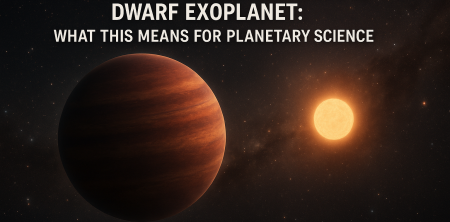
On June 17, 2026, a groundbreaking study published in Nature revealed the discovery of a distant brown dwarf exoplanet that shares its cosmic neighborhood with a warm Jupiter and a hot super-Earth. This remarkable finding is not just another dot in the vast galaxy; it challenges existing paradigms about planetary systems and the formation of celestial bodies, igniting curiosity and excitement among astronomers and space enthusiasts alike.
1. The Discovery: A New Kind of Cosmic Triad
At the heart of this discovery is a brown dwarf, a type of celestial object that straddles the line between stars and planets. These enigmatic entities are often referred to as "failed stars" due to their inability to sustain hydrogen fusion like true stars do. The brown dwarf in question is intriguingly positioned in a system that also boasts a warm Jupiter, a gas giant that orbits its star at a relatively comfortable distance, and a hot super-Earth, typically rocky in nature and larger than Earth but smaller than Neptune.
The alignment of these three bodies raises several compelling questions. How do such diverse celestial bodies coexist in the same system? What does this mean for our understanding of planetary formation? The implications of this arrangement are profound and could reshape our theories on how planetary systems, including our own, develop over time.
2. What Are Brown Dwarfs and Why Do They Matter?
Brown dwarfs occupy a unique niche in the celestial hierarchy. Weighing between 13 and 80 times the mass of Jupiter, they are too massive to be considered planets yet too light to be classified as stars. Their significance lies in their ability to bridge the gap between the two categories, providing insights into both stellar and planetary formation processes. By studying brown dwarfs, astronomers can glean valuable information regarding the conditions that lead to the creation of stars and planets.
This new discovery adds depth to our understanding of brown dwarfs, particularly in how they interact with neighboring celestial bodies. The presence of a warm Jupiter and a hot super-Earth in close proximity to the brown dwarf offers a unique laboratory for studying the dynamics of such systems. Researchers can examine gravitational influences, atmospheric characteristics, and even potential habitability scenarios, ultimately contributing to a more nuanced understanding of our universe.
3. The Significance of System Architecture
The arrangement of celestial bodies within a system, referred to as system architecture, plays a crucial role in shaping the evolution of planets and their potential for hosting life. In this case, the cohabitation of a brown dwarf, a warm Jupiter, and a hot super-Earth suggests a complex gravitational ballet at play. This peculiar architecture challenges traditional models that dictate how planets and stars form and interact over time.
Understanding these dynamics is essential for astronomers. For instance, how does the gravitational pull of the brown dwarf affect the orbits and atmospheres of the warmer Jupiter and the hot super-Earth? The study hints that the unique alignment could influence the atmospheric conditions of these planets, potentially affecting their compositions and climates.
4. How Do Brown Dwarfs Influence Nearby Planets?
The gravitational influence of a brown dwarf can significantly impact the orbits of nearby planets. In this specific system, researchers are keen to explore how the brown dwarf might affect the warm Jupiter and hot super-Earth. Are the orbits of these planets stable, or could the presence of the brown dwarf lead to chaotic interactions over astronomical timescales?
Investigating these gravitational interactions could reveal a wealth of information about how planetary systems evolve. For example, if the brown dwarf's gravity causes the warm Jupiter to migrate, it could lead to alterations in the entire system's dynamics, possibly even pushing the hot super-Earth into a more habitable zone or destabilizing it entirely.
5. What This Discovery Tells Us About Planet Formation
The alignment of a brown dwarf with a warm Jupiter and a hot super-Earth also speaks volumes about the processes that lead to planet formation. Traditional models tend to depict a more straightforward sequence where star formation occurs first, followed by planet formation in a protostellar disk. However, the existence of such diverse objects in close proximity suggests that the process is not as linear or predictable as once thought.
This finding opens the door to new theories about how planets can form under varying conditions, potentially challenging our long-held beliefs. For instance, could the presence of a brown dwarf contribute to the heating of a protoplanetary disk, facilitating the formation of hotter planets? These questions, while complex, drive home the point that our understanding of planetary systems is far from complete.
6. Technological Advances in Exoplanet Discovery
The identification of this distant brown dwarf exoplanet is a testament to the incredible advancements in technology that have revolutionized our ability to explore the cosmos. Methods such as transiting photometry and direct imaging have allowed astronomers to locate and study exoplanets with unparalleled precision. In this case, the brown dwarf's discovery was likely aided by new observational techniques that measure the light and gravitational effects of distant objects. (See: Learn more about brown dwarfs.)
As technology continues to improve, we can expect to unearth even more complex systems like this one. Future telescopes and instruments will be crucial in deepening our understanding of these celestial formations, enabling scientists to gather more data on the interactions between brown dwarfs and their planetary companions.
7. The Broader Implications for Exoplanet Research
This discovery is not just significant for the research team involved; it has profound implications for the entire field of exoplanet research. The existence of a brown dwarf, a warm Jupiter, and a hot super-Earth in the same system encourages scientists to reevaluate how we categorize and understand various celestial bodies. It reinforces the idea that our classification systems may need to evolve as we gather more information and discover new examples.
Understanding the dynamics of this system can help refine models that predict the likelihood of life on other planets. If brown dwarfs can coexist with planets that exhibit conditions favorable for life, it opens up an exciting avenue for further exploration. Imagine the potential for discovering life-supporting conditions on planets that were previously considered too extreme or inhospitable.
8. What’s Next for Astronomers?
Following this discovery, astronomers will likely focus on collecting more data about the brown dwarf exoplanet and its neighboring planetary bodies. Detailed observations could reveal critical information regarding atmospheric compositions, temperatures, and potential habitability. Future missions may be designed to observe this system in greater depth, using both ground-based and space-based telescopes to unravel the mysteries of this cosmic trio.
Additionally, continued collaboration among scientists globally will be essential. By sharing data and findings, researchers can piece together a more comprehensive picture of how brown dwarfs and planets interact, enhancing our collective understanding of these intriguing systems.
9. The Quest for Knowledge in Astronomy
The discovery of a brown dwarf exoplanet aligned with a warm Jupiter and a hot super-Earth is a reminder of the relentless quest for knowledge in the field of astronomy. Each new discovery adds another piece to the puzzle of our universe, prompting researchers to ask deeper questions and challenge existing paradigms.
This finding is not just a scientific achievement; it underscores humanity's innate curiosity and desire to understand our place in the cosmos. As we continue to explore the depths of space, who knows what other astonishing discoveries await us? In a universe so vast and filled with mysteries, each revelation brings us closer to understanding the origins and evolution of planets and the potential for life beyond Earth.
10. Understanding Brown Dwarfs: Characteristics and Classifications
Brown dwarfs are often classified into spectral types based on their temperature and luminosity. They are generally categorized into types L, T, and Y:
- L Dwarfs: These are the warmest brown dwarfs, with surface temperatures ranging from about 1,300 to 2,000 K. They typically exhibit strong absorption features in their spectra due to molecules like titanium oxide and vanadium oxide.
- T Dwarfs: With temperatures between about 500 and 1,300 K, T dwarfs are cooler than L dwarfs and show significant methane absorption in their spectra. This group provides a wealth of information about the atmospheres and compositions of brown dwarfs.
- Y Dwarfs: Y dwarfs are the coolest of the brown dwarfs, with temperatures below 500 K. They are faint and challenging to detect, making their study an exciting frontier in astrophysics.
Each classification helps scientists understand the formation processes and evolutionary paths of these elusive objects. New discoveries continually refine these categories, leading to richer insights into celestial mechanics and the lifecycle of such entities.
11. Statistical Insights into Brown Dwarfs and Exoplanets
Recent studies estimate that there are likely more brown dwarfs in our galaxy than stars. In fact, according to the European Southern Observatory, for every star in the Milky Way, there could be up to two brown dwarfs. This staggering statistic highlights the importance of studying these objects.
Furthermore, the discovery of brown dwarf exoplanets provides exciting data points for astronomers trying to understand how often such systems exist. Observations from telescopes like the Transiting Exoplanet Survey Satellite (TESS) and the James Webb Space Telescope (JWST) are crucial for tracking the prevalence of these brown dwarfs alongside their planetary companions. Analyzing data from these missions allows researchers to create models that predict the occurrence rates of different types of exoplanets within various celestial environments.
12. Comparative Analysis: Brown Dwarfs vs. Gas Giants
While both brown dwarfs and gas giants like Jupiter and Saturn are primarily composed of hydrogen and helium, their formation processes and characteristics vary significantly. Brown dwarfs form in a similar way to stars, through the gravitational collapse of gas and dust; however, they do not acquire enough mass to ignite nuclear fusion in their cores. In contrast, gas giants form through a different process, often starting as solid cores that later accumulate massive atmospheres from the surrounding gas in a protoplanetary disk.
Moreover, brown dwarfs generally have higher surface temperatures compared to gas giants, especially in younger systems. This temperature difference can lead to distinct chemical atmospheres. For example, while gas giants may exhibit ammonia clouds, brown dwarfs may display clouds rich in water vapor and various metal oxides. (See: NASA's insights on brown dwarfs.) For more on this, see new discoveries in exoplanets.
Understanding these differences helps astronomers refine their models of planetary formation and evolution, providing a clearer picture of the diversity of planetary systems across the universe.
13. Implications for Habitability
One of the most intriguing questions in exoplanet research revolves around habitability. The presence of a brown dwarf in a solar system raises questions about the potential for life on nearby planets. While brown dwarfs emit significantly less heat than stars, their gravitational influence can stabilize the orbits of nearby planets, creating conditions that could be hospitable.
For example, in a system where a brown dwarf coexists with a warm Jupiter and a hot super-Earth, the latter might experience a stable climate that could support liquid water, depending on its atmospheric conditions. This stability could allow for complex chemistry to develop, raising the possibility of life forms emerging under unexpected circumstances.
Additionally, future observations focusing on atmospheric compositions of these planets could reveal the presence of biosignatures, crucial indicators of life. The diverse conditions around brown dwarf exoplanets present a fascinating area of study for astrobiologists and astronomers alike.
14. Frequently Asked Questions (FAQ)
What is a brown dwarf exoplanet?
A brown dwarf exoplanet is a sub-stellar object that has characteristics of both stars and planets. It is not massive enough to sustain hydrogen fusion like a star but has more mass than a typical planet.
How are brown dwarfs detected?
Brown dwarfs are detected using methods such as direct imaging, gravitational microlensing, and transiting photometry, which measure the light emitted or reflected by these objects and their influence on nearby celestial bodies.
Can brown dwarfs support life?
Although brown dwarfs themselves do not provide the necessary conditions for life, their gravitational influence can stabilize nearby planets, potentially creating environments conducive to life, especially if those planets are in the habitable zone of their stars.
Are brown dwarfs common in the universe?
Yes, studies suggest that brown dwarfs may outnumber stars in our galaxy. Their unique characteristics make them an important focus for understanding stellar and planetary formation.
What are the differences between brown dwarfs and stars?
Brown dwarfs are unable to sustain hydrogen fusion in their cores, which is the fundamental process that powers stars. Their mass typically ranges from 13 to 80 times that of Jupiter, placing them in a unique category between planets and stars.
How do brown dwarfs impact the formation of planets?
Brown dwarfs can influence the formation and evolution of planets through their gravitational forces, affecting the orbits and stability of nearby celestial bodies. This can lead to diverse outcomes in planetary system development.
What role do brown dwarfs play in understanding the universe?
Brown dwarfs serve as essential benchmarks for studying the processes of star and planet formation, providing insights into the conditions that govern the creation of celestial bodies and the potential for life in the universe.
15. Future Directions in Brown Dwarf Research
As the field of astronomy continues to evolve, the study of brown dwarf exoplanets will likely take on new dimensions. With advancements in technology, researchers are developing more sophisticated models to understand the interactions within these multi-body systems. For instance, scientists are exploring the use of machine learning algorithms to analyze vast datasets and identify patterns that human researchers might miss. (See: Scientific articles on brown dwarfs.)
In addition, future missions such as the European Space Agency's ARIEL (Atmospheric Remote-sensing Infrared Exoplanet Large-survey) are set to investigate the atmospheres of exoplanets, including those near brown dwarfs. This mission could provide insights into the chemical composition of these atmospheres, further illuminating the potential for habitability.
Moreover, upcoming observatories like the Extremely Large Telescope (ELT) will enhance our ability to directly image brown dwarfs and their planetary companions, enabling detailed studies of their atmospheres and compositions. Such observations could yield valuable data about the distribution of elements and compounds that are essential for life, thereby broadening our understanding of the conditions necessary for habitability in diverse celestial environments.
16. Challenges in Studying Brown Dwarfs
Studying brown dwarfs presents unique challenges. Due to their faint luminosity, they are difficult to detect and characterize. Unlike stars, which emit significant light, brown dwarfs emit most of their energy in the infrared spectrum, requiring advanced instruments capable of observing in these wavelengths.
Additionally, the overlapping characteristics of brown dwarfs and certain types of planets can make classification challenging. Distinguishing between a brown dwarf and a massive exoplanet often relies on subtle differences in spectra and temperature, which necessitates sophisticated analytical techniques and a comprehensive understanding of both categories.
Finally, the gravitational interactions between brown dwarfs and their neighboring planets can lead to complex dynamics that are difficult to predict. As scientists develop simulations to model these interactions, they must account for a myriad of variables, including initial conditions, mass distributions, and evolutionary pathways, making it a formidable task.
17. Community Engagement and Public Interest
The excitement surrounding the discovery of brown dwarf exoplanets is not confined to scientists alone; it has captured the public's imagination. Astronomy outreach programs have begun to incorporate these discoveries into their curricula to encourage interest in space science among students. Public talks, science fairs, and online forums provide platforms for discussing the implications of such findings, fostering a broader understanding of our universe.
Social media has also played a crucial role in disseminating information about brown dwarfs and exoplanets. Astronomers and institutions share their findings with visuals and engaging narratives, sparking curiosity and discussions among a global audience. This level of engagement helps highlight the importance of scientific research and may inspire the next generation of astronomers.
As more discoveries are made, the hope is to maintain this momentum, ensuring that the wonders of the universe are accessible and engaging for everyone.
```
Trending Now
Frequently Asked Questions
What is a brown dwarf exoplanet?
A brown dwarf exoplanet is a celestial object that lies between a planet and a star in terms of mass, typically weighing between 13 and 80 times that of Jupiter. They are often referred to as 'failed stars' because they do not sustain hydrogen fusion like true stars do.
Why are brown dwarfs important in planetary science?
Brown dwarfs are crucial because they help bridge the gap between stars and planets, providing insights into the formation processes of both. Studying them can reveal conditions that lead to the creation of stars and planets, enhancing our understanding of cosmic evolution.
What does the discovery of a brown dwarf mean for planetary systems?
The discovery of a brown dwarf in a system with a warm Jupiter and a hot super-Earth challenges existing theories about planetary formation and coexistence. It raises questions about how diverse celestial bodies can exist in the same system, potentially reshaping our understanding of planetary system development.
What are the characteristics of a warm Jupiter and a hot super-Earth?
A warm Jupiter is a gas giant that orbits its star at a relatively comfortable distance, while a hot super-Earth is a rocky planet larger than Earth but smaller than Neptune. Both types of planets provide valuable context for understanding the dynamics of planetary systems.
How do discoveries like this impact our understanding of the universe?
Discoveries of unique celestial bodies, like the distant brown dwarf exoplanet, enhance our understanding of the universe by challenging existing paradigms and encouraging new theories about planetary formation and the evolution of cosmic systems.
What's your take on this? Share your thoughts in the comments below — we read every one.

