```html
As parents and educators, we all want what’s best for our preschoolers. That desire often translates into the methods we choose for teaching young children. In the world of early childhood education, a significant debate has arisen over the use of worksheets in the classroom. Many educators and child development experts argue that worksheets are not only ineffective for preschool children but can also be detrimental to their growth and learning. This article will delve into the reasons why worksheets aren't developmentally appropriate for preschool education and what alternatives might foster a more enriching learning environment. (top programs in child development)
The Foundation of Developmentally Appropriate Preschool Education
Understanding what constitutes developmentally appropriate preschool education is crucial. This approach is rooted in research on how children learn best at various stages of their development. The National Association for the Education of Young Children (NAEYC) defines developmentally appropriate practices as those that are grounded in the knowledge of child development, tailored to each child's unique needs and interests, and responsive to the cultural contexts in which children live.
Developmentally appropriate practices prioritize active, hands-on learning experiences that promote exploration, creativity, and social interaction. This contrasts sharply with worksheet-based education, which often emphasizes rote memorization and passive learning. The philosophy behind developmentally appropriate education embraces the idea that children learn through play, interaction, and direct experiences rather than through isolated tasks typically found on worksheets.
1. Worksheets Do Not Foster Critical Thinking
One of the most compelling arguments against the use of worksheets in preschool education is that they do not promote critical thinking or problem-solving skills. Worksheets often present children with simple tasks that require little to no higher-order thinking. For instance, filling in the blanks or matching items might sharpen basic recognition skills, but it doesn’t encourage children to analyze, evaluate, or create.
In contrast, developmentally appropriate preschool education focuses on activities that stimulate curiosity and allow for exploration. For example, rather than simply matching pictures of animals, children might engage in a role-play activity where they act out different animal behaviors. This kind of engagement promotes deeper thinking and understanding, helping children build the cognitive skills that worksheets cannot nurture.
2. Worksheets Limit Creativity and Self-Expression
Preschool is a critical time for children to develop their creativity and imagination. Worksheets often present rigid structures that can stifle a child's ability to express themselves. Children thrive in environments where they can make choices, experiment, and express their thoughts in varied forms, including art, music, and movement.
For example, a child who is asked to draw a picture of their favorite food has the freedom to explore colors, shapes, and styles, allowing them to express their unique perspective. Conversely, a worksheet that requires a child to color within the lines of a specific image restricts their creative expression and can lead to frustration. Developmentally appropriate preschool education embraces open-ended activities that value the creative process over the final product.
3. Worksheets Can Create Anxiety and Disengagement
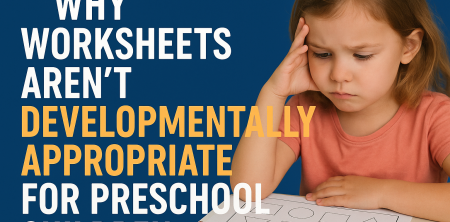
Another important factor to consider is the emotional impact worksheets can have on young learners. Many children may feel overwhelmed or anxious when faced with the pressure of completing a worksheet, particularly if they struggle with fine motor skills or literacy. This anxiety can lead to disengagement from the learning process, undermining the very goal of education.
In contrast, developmentally appropriate practices emphasize play-based learning, which is naturally engaging and often reduces performance anxiety. When children learn through play, they are more likely to enjoy the process and take risks without the fear of making mistakes. This positive emotional environment is crucial for fostering a love of learning that can last a lifetime.
4. Worksheets Do Not Promote Social Skills
Preschool is not just about individual learning; it is also about developing social skills that will serve children throughout their lives. Worksheets are typically individual tasks, which means they do not facilitate collaboration or communication with peers. In a developmentally appropriate preschool environment, children engage in group activities, facilitating social interaction and helping them learn to work as part of a team.
For instance, instead of working alone on a worksheet, children might participate in a group project where they build a structure with blocks. This activity encourages teamwork, negotiation, and problem-solving skills, teaching children how to collaborate effectively — skills that are vital both in school and later in life. (See: U.S. Department of Education on Early Learning.)
5. Worksheets Can Be Impersonal and Lacking Context
Worksheets often lack the context that makes learning meaningful for young children. Preschoolers learn best when they can connect new information to their personal experiences and understand the relevance of what they are learning. Worksheets tend to present abstract concepts devoid of real-world connections, making it difficult for children to engage with the material.
In a developmentally appropriate setting, educators can design activities that are rooted in children's interests and experiences. For example, if a class has been learning about animals, teachers could take children on a field trip to a local zoo, where they can see the animals in person. This kind of experiential learning creates lasting memories and deepens children's understanding of the subject matter.
6. Worksheets Can Reinforce a Fixed Mindset
When children are given worksheets that focus on right or wrong answers, it can foster a fixed mindset, where they believe their abilities are static and unchangeable. In this educational model, children may become discouraged when they do not achieve a perfect score or feel that mistakes are failures. This mentality can be detrimental to a child's long-term learning and personal growth.
In contrast, developmentally appropriate preschool education embraces mistakes as a natural part of the learning process. By creating a classroom culture that values effort and perseverance, educators can help children develop a growth mindset — the belief that they can improve through hard work and resilience. Activities that encourage exploration and experimentation — like science experiments or open-ended art projects — reinforce this mindset by allowing children to learn from their experiences.
7. Alternatives to Worksheets in Preschool Education
Given the drawbacks associated with worksheets, it’s essential to explore alternatives that align with developmentally appropriate principles. Here are some effective strategies to consider:
- Play-Based Learning: Central to preschool education, this method encourages children to explore, experiment, and learn through play. Activities can be structured or unstructured, allowing children to direct their own learning.
- Hands-On Activities: Engaging children in hands-on experiences, such as building, crafting, or cooking, can promote learning in ways that worksheets cannot.
- Storytelling and Role-Playing: Encourage children to express their understanding through storytelling or role-playing, which stimulates imagination and comprehension.
- Outdoor Learning: Nature walks, gardening, or outdoor science activities can provide rich, meaningful contexts for learning.
- Project-Based Learning: Allow children to work on collaborative projects that require research, planning, and execution, fostering both individual and group skills.
The Current Relevance of Moving Away from Worksheets
In today’s educational landscape, the conversation around developmentally appropriate preschool education is more pertinent than ever. With increasing pressure on early childhood educators to prepare children for standardized testing and academic success, many have adopted worksheet-centric approaches. However, the most effective education for young children is one that respects their developmental stages and prioritizes their emotional and social well-being.
Research consistently shows that high-quality early childhood education centered on play and exploration leads to better outcomes in later academic achievement and social skills. It’s becoming clear that moving away from worksheets and fostering an environment of curiosity and engagement is essential for the holistic development of preschool-aged children.
8. The Role of Educators in Implementing Developmentally Appropriate Practices
Teachers and caregivers play a crucial role in the implementation of developmentally appropriate preschool education. Professional development opportunities focusing on child development, early literacy, and inclusive practices are essential. Educators must be equipped with the tools and knowledge to create dynamic, play-based learning environments that respond to the diverse needs of all children.
Training should not only focus on what activities to implement but also on understanding the underlying principles of child development. When educators feel confident in their ability to create meaningful learning experiences, they are more likely to design activities that resonate with children and inspire a love of learning.
9. The Influence of Family and Community
The involvement of families and the broader community can significantly impact the effectiveness of developmentally appropriate preschool education. Engaging parents in their children's learning journey can enhance the educational experience and promote consistency between home and school environments. Workshops and resources can be provided to help parents understand the principles of developmentally appropriate practices and how they can support their child's learning at home.
Communities can also play a role in enriching preschool education through partnerships with local organizations. For example, museums, libraries, and cultural institutions can offer programs that align with the learning objectives of preschools, providing children with varied experiences and exposure to new concepts.
10. Real-Life Success Stories of Developmentally Appropriate Practices
Many preschools around the world exemplify the success of developmentally appropriate practices. For instance, schools like the Reggio Emilia approach in Italy emphasize child-led learning, where children’s interests guide the curriculum. This model has shown remarkable success in fostering creativity and critical thinking.
In the United States, programs like Montessori schools focus on individualized learning experiences that respect each child's unique developmental pace. These schools have demonstrated that children in such environments are not only happier but often outperform their peers in traditional settings when assessed later in their educational careers.
11. The Role of Technology in Developmentally Appropriate Education
Technology in preschool education can be a double-edged sword. While it can provide innovative tools for learning, it's crucial that technology is used in a way that aligns with developmentally appropriate practices. Interactive apps that promote creativity and problem-solving can be valuable when combined with hands-on activities and play-based learning.
However, reliance on screens can detract from social interactions and play, which are essential for preschool development. Striking a balance between technology use and traditional play is vital. Educators should carefully select age-appropriate technology that enhances learning while ensuring that children still engage in physical play and interpersonal communication.
12. Measuring the Effectiveness of Developmentally Appropriate Practices
Assessing the effectiveness of developmentally appropriate preschool education can be challenging, as traditional metrics may not apply. Instead of standardized tests, educators can utilize observational assessments, portfolios of children’s work, and documentation of learning processes to gauge development.
These methods acknowledge the individual growth of each child, allowing for a more comprehensive understanding of their strengths, challenges, and interests. By focusing on qualitative rather than quantitative measures, educators can better support each child's unique learning journey.
Frequently Asked Questions (FAQ)
What are some signs that a preschool program is developmentally appropriate?
A developmentally appropriate preschool program will typically feature child-centered learning environments, an emphasis on play, opportunities for social interaction, and a flexible curriculum that adapts to the interests and needs of the children. Look for programs that prioritize exploration over rote learning.
How can parents support developmentally appropriate learning at home?
Parents can support developmentally appropriate learning by engaging in play with their children, providing open-ended materials (like blocks, art supplies, or books), and encouraging exploration of their environment. Asking open-ended questions and giving children time to express their thoughts can also foster critical thinking and creativity. We covered active learning games for kids in more detail.
Are worksheets ever appropriate for preschoolers?
While worksheets are generally not favored in developmentally appropriate practices, there may be instances where simple worksheets could be used as a supplement to hands-on activities. However, they should never replace interactive learning experiences and should be carefully designed to avoid frustration or disengagement.
What qualifications should preschool educators have?
Preschool educators should ideally have a degree in early childhood education or a related field, along with specialized training in child development. Continuous professional development and a deep understanding of developmentally appropriate practices are also essential for fostering a nurturing and effective learning environment.
13. The Importance of Play in Early Childhood Education
Play is often referred to as a child’s work, and for good reason. Engaging in play is how preschoolers make sense of their world. It allows them to explore concepts, test boundaries, and express their feelings. According to research from the American Academy of Pediatrics, play contributes to cognitive, physical, social, and emotional well-being. Through play, children develop critical social skills such as sharing, negotiation, and empathy as they interact with their peers.
Consider a scenario where a group of children plays pretend in a kitchen setup. They take turns being the chef and the customer, negotiating what to cook and how to serve it. This form of play not only enhances their imagination but also introduces them to basic math concepts through measuring ingredients and understanding quantities. Here, play transforms into a powerful educational tool that can achieve what worksheets cannot.
14. Evidence Supporting Developmentally Appropriate Practices
The body of research supporting developmentally appropriate practices is extensive. Studies conducted by the National Institute for Early Education Research (NIEER) have shown that children who participate in high-quality, play-based preschool education exhibit stronger literacy skills, better social-emotional development, and more advanced math skills compared to those who engage in more traditional, worksheet-heavy education.
Further evidence points to the long-term benefits of developmentally appropriate practices. A longitudinal study conducted by the University of Chicago found that children enrolled in programs emphasizing play and exploration were more likely to succeed academically and socially as they progressed through school. The positive effects were evident not just in elementary school but persisted into adolescence.
15. Addressing Potential Concerns with Developmentally Appropriate Practices
Some educators and parents may worry that avoiding worksheets means students will lag in academic skills. However, developmentally appropriate practices do not ignore academic learning. Instead, they integrate it seamlessly into meaningful contexts. For example, teachers can incorporate literacy skills through storytelling, where children learn vocabulary and narrative structure while also engaging their imaginations.
Additionally, math concepts can be explored through hands-on activities like counting blocks or measuring ingredients in a cooking activity. The key is to embed those academic skills within playful contexts, making them more relevant and engaging for young learners.
16. The Future of Preschool Education
As we look to the future of preschool education, it’s essential that educators, parents, and policymakers work together to advocate for developmentally appropriate practices. This means investing in teacher training, revising curricula to emphasize play and exploration, and measuring success through holistic assessments rather than standardized tests.
Only by prioritizing the developmental needs of preschoolers can we ensure that they not only achieve academic success but also grow into well-rounded, confident, and curious individuals ready to tackle the challenges of the world. By fostering a love of learning early on, we lay the groundwork for lifelong learners.
Conclusion: Embracing Change for Future Generations
As educators, parents, and communities, we must advocate for methods that prioritize developmentally appropriate practices over outdated approaches like worksheet-based instruction. The benefits of engaging, hands-on learning experiences far outweigh the perceived convenience of worksheets. By focusing on what truly matters in preschool education — nurturing creativity, critical thinking, and social skills — we can set children on a path toward lifelong learning and success.
```
Trending Now
Frequently Asked Questions
Why are worksheets not effective for preschoolers?
Worksheets are not effective for preschoolers because they promote rote memorization and passive learning instead of active engagement. Young children learn best through hands-on experiences, exploration, and social interaction, which worksheets typically do not facilitate.
What is developmentally appropriate practice in preschool education?
Developmentally appropriate practice in preschool education involves teaching methods that are tailored to each child's unique needs, interests, and developmental stage. It emphasizes active learning, creativity, and social interactions, rather than isolated tasks like worksheets.
What are the alternatives to worksheets in preschool?
Alternatives to worksheets in preschool include hands-on activities, play-based learning, group projects, and interactive games. These methods encourage exploration, critical thinking, and collaboration among young children, fostering a more enriching learning environment.
How do worksheets hinder critical thinking in young children?
Worksheets hinder critical thinking by providing simple tasks that require minimal cognitive effort. They often lack opportunities for problem-solving and creative thinking, which are essential skills for young children's development.
What does research say about learning through play in preschool?
Research indicates that learning through play is crucial for preschoolers as it supports cognitive, social, and emotional development. Play-based learning allows children to explore, experiment, and engage with their environment, fostering deeper understanding and retention of concepts.
What did we miss? Let us know in the comments and join the conversation.

