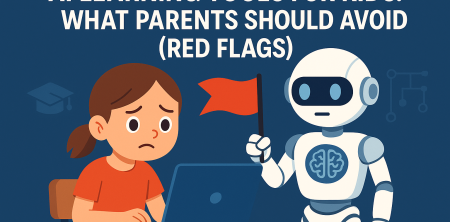
```json
{"title": "The AI Revolution in Kids' Learning: 7 Red Flags You Can't Afford to Miss", "content": "
Walk into almost any home or classroom today, and you'll see it: screens. Lots of them. And behind those glowing rectangles, something truly transformative is happening. Artificial Intelligence, or AI, isn't just for tech giants and sci-fi movies anymore; it's rapidly weaving its way into the fabric of our children's education and daily lives. From personalized tutoring apps to interactive story generators, the promise of AI learning tools for kids is certainly alluring. Imagine a world where every child gets a tailored learning experience, where homework becomes less of a chore and more of an engaging adventure. Sounds fantastic, doesn't it?
\n\n
But here’s the rub: with great power comes great responsibility, and in the case of AI, also some pretty significant risks. Parents and educators are finding themselves in the middle of an intense, emotionally charged debate about AI's profound impact on development and learning. While the potential benefits are clear – think adaptive learning paths that cater to individual paces, or AI-powered assistants that make complex subjects more digestible – the concerns are equally weighty. Are we inadvertently sacrificing critical thinking for convenience? Are our kids being exposed to information we wouldn't approve of? And perhaps most importantly, is AI starting to replace the irreplaceable human connection that's so vital for a child's growth?
\n\n
The questions are complex, and the answers aren't always clear-cut. But as parents, it's our job to be informed, to understand the landscape, and to make the best decisions for our children. So, let's pull back the curtain on AI learning tools for kids, examine the red flags, and equip ourselves with the knowledge to navigate this brave new world responsibly. There's a fuller look at Vision Future in Education.
\n\n
The Double-Edged Sword: AI's Promise Versus Its Peril for Young Minds
\n\n
On one side of the coin, AI offers a tantalizing vision of hyper-personalized education. Picture an AI tutor that understands your child's unique learning style, adapting lessons on the fly, identifying areas of struggle before they become major roadblocks, and even celebrating their small victories. This isn't just theory; many AI learning tools for kids are already delivering on this promise. They can provide instant feedback, generate practice problems tailored to a child's current mastery level, and even create immersive virtual environments for exploring subjects like history or science. For children with specific learning differences, AI can be a game-changer, offering alternative modes of engagement and support that traditional classrooms might struggle to provide.
\n\n
However, the other side of that coin reveals a darker potential. The very personalization that makes AI so appealing can also isolate children, reducing their need for collaborative problem-solving or direct interaction with peers and teachers. There's a genuine fear that over-reliance on AI could atrophy crucial cognitive muscles. If an AI provides all the answers, does a child learn how to grapple with a difficult problem, try different approaches, and experience the satisfaction of a hard-won solution? If an AI curates all their information, do they develop the discernment needed to critically evaluate sources and distinguish fact from fiction in an increasingly noisy digital world?
\n\n
These aren't hypothetical anxieties. Educators and child development specialists are openly discussing a potential decline in critical thinking skills. When AI serves up instant solutions, the process of inquiry, experimentation, and conceptual understanding can be short-circuited. Furthermore, the sheer volume of information available through AI, much of it unverified or even biased, creates a significant risk of exposure to misinformation. And perhaps most critically, the irreplaceable value of human interaction – the nuances of social cues, the empathy developed through face-to-face communication, the mentorship from a caring teacher – cannot be replicated by even the most sophisticated algorithm. These are the foundational elements of healthy development that we must protect.
\n\n
Red Flag #1: The Content Filter Fails – What Exactly Are Our Kids Seeing?
\n\n
One of the most immediate and concerning red flags with many AI learning tools for kids is the lack of robust content filtering. Parents instinctively understand the need to shield their children from inappropriate material online, but with AI, the challenge becomes infinitely more complex. Traditional filters often rely on keyword blacklists or known problematic websites. AI, however, is generative. It can create new content, synthesize information from vast datasets, and respond to prompts in ways that are difficult to predict or control.
\n\n
Consider a child using an AI chatbot for help with a school project. While the intention is educational, what happens if the child asks a question that veers into sensitive or age-inappropriate territory? Or, more subtly, what if the AI draws information from biased, inaccurate, or even harmful sources on the internet and presents it as fact? We've already seen numerous instances where AI models, when prompted, have generated everything from biased historical accounts to outright fictional "facts," or even disturbing narratives. The problem isn't necessarily malicious intent from the developers, but rather the sheer scale and unpredictability of the data AI models are trained on. They learn from the internet, and the internet, as we all know, is not always a safe or reliable place. (See: AI's impact on children's education.)
\n\n
For parents, this means digging deeper than just reading an app description. You need to investigate the specific content moderation policies of any AI learning tool your child uses. Does it have built-in safeguards against generating inappropriate text or images? Is there a clear mechanism for reporting problematic content? And perhaps most importantly, are the developers transparent about the data sources their AI is trained on? If a tool can't guarantee a safe content environment, it's a significant red flag that should make any parent pause.
\n\n
Red Flag #2: The Instant Answer Trap – Undermining Problem-Solving Skills
\n\n
We all want our kids to succeed, and the idea of an AI that can instantly provide answers to homework problems or explain complex concepts seems incredibly helpful. But here's where we encounter another major red flag: systems that provide instant answers instead of fostering genuine problem-solving. While immediate feedback can be beneficial, an over-reliance on AI for quick solutions can inadvertently strip children of the opportunity to develop crucial cognitive skills. We covered Strategies for Critical Thinking in more detail.
\n\n
Think about a math problem. If an AI gives the correct answer and the steps to get there, the child might copy it down without truly understanding the underlying principles. They miss the struggle, the trial and error, the moments of frustration followed by the 'aha!' feeling when a concept finally clicks. These are the experiences that build resilience, critical thinking, and a deeper, more lasting understanding. When AI removes the need for this struggle, it removes a vital part of the learning process.
\n\n
True learning isn't just about accumulating facts; it's about developing the ability to analyze, synthesize, evaluate, and create. It's about learning how to learn. AI learning tools for kids should act as guides, facilitators, and supplementary resources, not as a replacement for active mental engagement. Look for tools that encourage exploration, ask probing questions, or provide hints rather than direct answers. The best AI educational software will be designed to prompt children to think critically, break down problems into smaller parts, and articulate their own reasoning, rather than simply regurgitating information. If a tool consistently gives away the answer, it's likely doing more harm than good to your child's developing intellect.
\n\n
Red Flag #3: Privacy Perils – Who Owns Your Child's Data?
\n\n
This is arguably one of the most critical red flags when considering AI learning tools for kids: insufficient privacy protections for children's sensitive data. Every interaction your child has with an AI tool generates data – their learning patterns, their responses, their areas of interest, even their voice if it's a voice-activated assistant. This data is incredibly valuable, both for improving the AI and potentially for other, less benign purposes.
\n\n
Children, by their very nature, are more vulnerable online. They may not understand the implications of sharing personal information, and their digital footprints can follow them for life. The concern is multifaceted: Is the data being collected anonymously? Is it being shared with third parties, such as advertisers? How is it stored and secured? Could it be used to create detailed profiles of your child that could be exploited later on? We live in an age where data breaches are unfortunately common, and the thought of a child's learning history, preferences, and personal identifiers falling into the wrong hands is truly alarming.
\n\n
Parents must be vigilant. Before allowing your child to use any AI learning tool, thoroughly read its privacy policy – and yes, they can be dense and filled with legalese, but this is one area where you simply can't afford to skim. Look for clear statements about data collection, storage, and sharing practices. Does the company comply with regulations like COPPA (Children's Online Privacy Protection Act) in the U.S. or GDPR-K (General Data Protection Regulation – Kids) in Europe? If the policy is vague, difficult to find, or raises any red flags about data monetization or sharing, steer clear. Your child's digital privacy is paramount, and it's a non-negotiable aspect of any safe and ethical AI learning tool.
\n\n
Red Flag #4: The Loss of Human Connection – Replacing Teachers and Peers
\n\n
While AI can personalize learning, it cannot replicate the nuanced, empathetic, and often spontaneous interactions that occur between a child and a human teacher, or between a child and their peers. This brings us to another significant red flag: the risk of AI replacing crucial human interaction. The classroom isn't just a place for academic instruction; it's a vital social ecosystem where children learn collaboration, conflict resolution, empathy, and communication skills. Related reading: Overview of Adaptive Learning Tech.
\n\n
Reports about controversial models like the \"Alpha School\" further fuel these discussions. The idea of utilizing AI-powered learning to significantly reduce traditional classroom teaching time, while potentially efficient from a logistical standpoint, raises profound ethical implications for early childhood development. Teachers do more than just impart knowledge; they are mentors, role models, and facilitators of social-emotional growth. They recognize when a child is struggling emotionally, not just academically. They foster a sense of community and belonging. These are qualitative aspects of education that AI, no matter how advanced, simply cannot replicate. (See: Technology's effects on youth development.)
\n\n
The absence of peer interaction is also a major concern. Learning alongside others, debating ideas, working on group projects, and even navigating social dynamics are essential for developing well-rounded individuals. If children spend an excessive amount of time interacting solely with AI, they may miss out on these critical social developmental milestones. When evaluating AI learning tools for kids, ask yourself if the tool complements human interaction or threatens to replace it. The best tools will enhance, not diminish, the role of human teachers and collaborative learning experiences.
\n\n
Red Flag #5: The Bias Problem – AI Reflecting Societal Prejudices
\n\n
AI models are trained on vast datasets, and unfortunately, these datasets often reflect existing societal biases, prejudices, and inequalities present in the real world. This introduces a subtle yet powerful red flag: the potential for AI learning tools for kids to perpetuate or even amplify these biases. If an AI is trained predominantly on data representing certain demographics, it might inadvertently reinforce stereotypes or fail to accurately represent the diversity of human experience.
\n\n
For example, an AI designed to teach history might, without careful programming, present a Eurocentric view of events, or underrepresent the contributions of women or minorities. An AI providing career advice might subtly steer children towards gender-stereotyped professions based on historical data rather than individual aptitude. These biases aren't always overt; they can be embedded in the algorithms in ways that are difficult for an average user to detect.
\n\n
The danger here is that children, especially at a young age, are highly impressionable. If an AI tool consistently presents a biased view of the world, it can shape their perceptions and understandings in ways that are difficult to undo. Parents need to be aware that AI is not inherently neutral; it carries the fingerprints of the data it was trained on and the people who designed it. When considering AI educational software, look for developers who explicitly address issues of bias, who have diverse teams, and who are committed to creating inclusive and equitable learning experiences. Transparency about data sources and ongoing efforts to mitigate bias are crucial indicators of a responsible developer.
\n\n
Red Flag #6: The Gamification Trap – Addiction and Attention Spans
\n\n
Many AI learning tools for kids leverage gamification techniques – points, badges, leaderboards, and engaging animations – to keep children hooked. While motivation is good, this can become a red flag when it veers into manipulative territory, potentially fostering screen addiction and negatively impacting attention spans. These tools are often designed by experts in behavioral psychology, aiming to maximize engagement, which can sometimes mean maximizing screen time, irrespective of true learning outcomes.
\n\n
The constant stream of rewards and instant gratification from gamified AI can train children to expect immediate feedback and stimulation, making more traditional, slower-paced learning activities feel boring or unrewarding. This can contribute to a decline in sustained attention, the ability to focus on a single task for an extended period without external stimuli. Furthermore, the addictive nature of some of these platforms can lead to excessive screen time, displacing other vital childhood activities like outdoor play, reading physical books, creative endeavors, and face-to-face social interaction. For more on this, see Key Insights on Adaptive Learning.
\n\n
As parents, we need to distinguish between genuinely engaging educational content and manipulative design that prioritizes 'stickiness' over substantive learning. Look for AI learning tools for kids that have clear time limits, encourage breaks, and integrate real-world activities. The goal should be to use AI as a tool to enhance learning, not as a digital babysitter or an endless source of dopamine hits. Parental control solutions can be invaluable here, helping to manage screen time and ensure a balanced digital diet.
\n\n
Red Flag #7: Lack of Transparency and Accountability – Who's in Charge?
\n\n
Finally, a major overarching red flag with many AI learning tools for kids is a pervasive lack of transparency and accountability from developers. The algorithms that power these tools are often proprietary and opaque, making it incredibly difficult for parents, educators, and even regulators to understand how they work, what data they're collecting, and how decisions are being made about a child's learning path. This 'black box' problem is a significant concern. (See: Research on AI in education.)
\n\n
If an AI recommends certain content or marks a child's answer as incorrect, what's the rationale? Is it based on sound pedagogical principles, or is it a quirk of the algorithm? Without transparency, it's impossible to truly evaluate the effectiveness or fairness of these tools. Furthermore, when problems arise – such as a child being exposed to inappropriate content, data breaches, or biased outcomes – it can be incredibly difficult to identify who is accountable. Is it the developer, the school, or the platform provider?
\n\n
For parents, this means demanding more information. Look for companies that are transparent about their AI's design principles, data governance, and safety protocols. Seek out organizations that are open to external audits and provide clear channels for feedback and complaints. The future of education is too important to leave to opaque algorithms and unaccountable corporations. As AI becomes more integral to our children's lives, we need stronger regulatory frameworks and a collective commitment from developers to prioritize child welfare, privacy, and genuine educational value over profit or technological novelty.
\n\n
Empowering Parents in the Age of AI Education
\n\n
The rapid integration of AI into education isn't slowing down. It's an exciting frontier, but one that demands our careful attention and discernment as parents. We can't simply ban AI; it's already here, and its potential benefits are real. Instead, we must become digitally literate ourselves, understand the nuances of these technologies, and equip our children with the skills to navigate them safely and effectively.
\n\n
This means more than just installing parental control solutions, though those are certainly important. It means engaging in ongoing conversations with our children about what they're learning, how they're learning it, and what they encounter online. It means teaching them digital literacy skills, critical thinking, and media discernment so they can evaluate information, regardless of its source. It also means actively researching reviews of AI educational software, looking for tools that are transparent, prioritize child safety and privacy, and genuinely foster deep learning rather than just instant answers.
\n\n
Ultimately, the goal isn't to fear AI, but to master it. To harness its power for good, while diligently safeguarding our children from its pitfalls. By staying informed, asking tough questions, and advocating for ethical AI development, we can ensure that AI learning tools for kids become a force for empowerment, not a source of concern, helping them to thrive in an increasingly technological world while preserving the essential human elements of their growth and education.
"}
```
Trending Now
- read the full story
- our breakdown of the startling truth about ai: why college students are ditching traditional therapy
- our breakdown of this one thing is quietly reshaping student mental health support
- our breakdown of why kredit quest is quietly reshaping financial education for gen z
- the complete explanation
Frequently Asked Questions
What are the risks of using AI learning tools for kids?
The risks of using AI learning tools for kids include potential over-reliance on technology, which may hinder critical thinking skills. Additionally, concerns about exposure to inappropriate content and the loss of valuable human interaction in learning environments are significant issues that parents should consider.
How can parents identify red flags in AI learning tools?
Parents can identify red flags in AI learning tools by looking for signs such as lack of transparency in data usage, overly simplistic content that doesn't challenge their child, or tools that prioritize engagement over educational value. It's crucial to evaluate whether the tool fosters critical thinking and creativity.
Are AI learning tools replacing traditional education methods?
While AI learning tools are enhancing educational experiences, they are not replacing traditional methods. Instead, they complement them by providing personalized learning opportunities. However, the balance between technology and human interaction is essential to ensure comprehensive educational development.
What should parents avoid when choosing AI learning tools for their children?
Parents should avoid AI learning tools that lack credible reviews, have vague privacy policies, or do not offer parental controls. Additionally, tools that do not encourage active learning or critical thinking should be approached with caution, as they may not support a child's overall growth.
How do AI learning tools affect children's social skills?
AI learning tools can impact children's social skills by reducing face-to-face interactions, which are vital for developing communication and empathy. While these tools can provide valuable educational support, it's important for parents to balance screen time with opportunities for social engagement and play.
What's your take on this? Share your thoughts in the comments below — we read every one.

