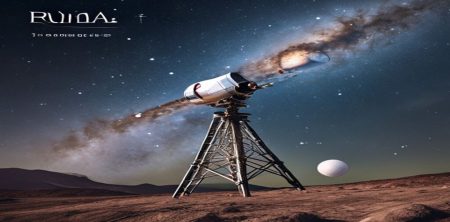
Get ready for a paradigm shift in our understanding of the cosmos. NASA’s Nancy Grace Roman Space Telescope, an observatory poised to fundamentally alter the landscape of astronomy, is on schedule for an August 30 launch. This isn't just another space telescope; it’s a colossal leap forward, promising to deliver insights that will rewrite textbooks and ignite the imaginations of generations to come. The excitement is palpable, and for good reason. A press conference held on July 29, 2026, confirmed that final preparations are in full swing, including the critical fueling process that gives the spacecraft its maneuvering capabilities. When we talk about the Roman telescope launch, we’re discussing an event that could very well be the most significant astronomical milestone of the decade.
What makes Roman so revolutionary? Imagine a telescope with a field of view 100 times greater than the venerable Hubble Space Telescope, capable of capturing vast swaths of the sky in a single glance. This isn’t just an incremental improvement; it’s a radical departure in observational capability. This wide-field prowess is central to its mission, allowing it to survey enormous volumes of space with unprecedented efficiency. Experts are projecting that Roman will discover an astonishing 100,000 exoplanets – a number that, if achieved, would surpass all previous exoplanet discoveries combined. Think about that for a moment: more planets found by one telescope than by every other effort in history. It’s a staggering prospect that has astronomers and space enthusiasts buzzing. (top astronomy programs) We covered Employee cost calculator in more detail.
This potential for a 'catalog reset' of exoplanet knowledge, coupled with its ambitious mandate to investigate the mysteries of dark energy and dark matter, is why the Roman telescope launch is generating such immense excitement. Social media is already alight with discussions, speculation, and shared anticipation. Beyond the scientific breakthroughs, this mission also opens up significant opportunities for online education in astronomy and data science, investment in cutting-edge space technology companies, and the development of specialized B2B SaaS solutions to manage the estimated terabyte of data Roman will transmit daily. Clearly, this is more than just a scientific endeavor; it's an economic and educational catalyst, too.
The Wide-Field Advantage: Seeing the Universe in a New Light
The core innovation behind the Nancy Grace Roman Space Telescope is its unparalleled wide-field instrument. Unlike telescopes designed for deep, narrow observations, Roman is built to survey vast areas of the sky efficiently. This isn't just about covering more ground; it's about fundamentally changing the way we approach cosmic surveys. Historically, telescopes like Hubble, with their incredibly sharp but tiny fields of view, are like looking at the universe through a soda straw. They give us exquisite detail of a small patch, but to map a large region, you need to stitch together thousands of individual images, a time-consuming and resource-intensive process.
Roman, on the other hand, is equipped with a 2.4-meter primary mirror, identical in size to Hubble’s, but its Wide Field Instrument (WFI) boasts a field of view 0.28 square degrees. To put that in perspective, imagine trying to map a city. Hubble might give you a perfect photograph of a single house. Roman would give you a high-resolution map of an entire neighborhood in one shot. This capability is absolutely crucial for its primary scientific goals, particularly in the realm of exoplanet discovery and mapping the large-scale structure of the universe.
This wide-field advantage isn't just a technical specification; it's a strategic design choice that dictates the entire mission profile. It allows Roman to perform large-scale surveys much faster than any previous observatory. For instance, to cover the same area of sky that Roman can image in a single exposure, Hubble would require hundreds of separate observations. This efficiency is what makes the projected discovery of 100,000 exoplanets even remotely feasible. It also means that Roman will be able to detect rare, transient events, like supernovae or gravitational lensing anomalies, that might be missed by narrower-field instruments.
The Exoplanet Revolution: A Catalog Reset on the Horizon
If you've followed astronomy for any length of time, you'll know that exoplanet discoveries have been steadily increasing, from the first confirmed planet orbiting a sun-like star in 1995 to the thousands we know today. But the Roman telescope launch is poised to blow those numbers out of the water. The projection of 100,000 new exoplanets isn't just a big number; it represents a qualitative leap in our understanding of planetary systems beyond our own. This isn't merely adding to a list; it's about creating a comprehensive catalog that allows for entirely new types of statistical analysis and scientific inquiry.
How will Roman achieve this? Its primary method for exoplanet detection will be gravitational microlensing. This phenomenon occurs when a star, and potentially its orbiting planets, passes in front of a more distant background star from our vantage point. The foreground star's gravity acts like a lens, temporarily magnifying and brightening the light of the background star. If the foreground star has planets, they will create additional, smaller magnification spikes in this brightening event. Roman's wide-field view allows it to monitor millions of stars simultaneously over extended periods, dramatically increasing the odds of catching these rare microlensing events. (See: NASA's Roman Space Telescope overview.)
The sheer volume of data from these discoveries will allow astronomers to statistically characterize exoplanet populations in ways never before possible. We'll gain a much clearer picture of the distribution of planets across different stellar types, their sizes, their orbital periods, and their prevalence. Are Earth-sized planets common around sun-like stars? What about 'super-Earths' or 'mini-Neptunes'? Roman will provide the data to answer these questions with far greater confidence, fundamentally reshaping our models of planet formation and evolution. This isn't just about finding planets; it's about understanding the cosmic rules that govern their existence.
Unraveling Dark Energy and Dark Matter: The Universe's Greatest Mysteries
While exoplanets grab a lot of headlines, Roman's mission to probe dark energy and dark matter is arguably even more profound. These two enigmatic components make up about 95% of the universe's mass and energy budget, yet we can't directly observe them. Dark energy is believed to be responsible for the accelerating expansion of the universe, a discovery that earned the Nobel Prize in Physics in 2011. Dark matter, on the other hand, provides the gravitational glue that holds galaxies and galaxy clusters together. Understanding these cosmic unknowns is central to completing our picture of the universe's past, present, and future.
Roman will tackle dark energy using several independent methods. One key approach is to precisely measure the distances to millions of distant galaxies and observe their spatial distribution. By mapping the clustering of galaxies over vast cosmic scales, scientists can look for the subtle imprints of baryon acoustic oscillations (BAOs), which are remnants of sound waves propagating through the early universe. The characteristic scale of these BAOs acts as a 'standard ruler' in the sky. By measuring how this ruler appears stretched at different distances, Roman can infer the expansion history of the universe and, critically, how dark energy has influenced it over billions of years.
Another powerful technique Roman will employ is weak gravitational lensing. This involves observing how the light from distant galaxies is subtly distorted by the gravitational pull of intervening matter, including dark matter. By meticulously mapping these distortions across huge swathes of the sky, astronomers can create a 3D map of the distribution of dark matter. This will provide crucial insights into its properties, how it clusters, and how it interacts with normal matter. The wide-field view of Roman is absolutely indispensable for these large-scale cosmological surveys, allowing it to gather the massive datasets required to detect these faint, subtle signals and distinguish them from noise.
The Technology Behind the Breakthrough: Instruments and Optics
The ambitious goals of the Roman Space Telescope demand cutting-edge technology, and its instruments are truly a marvel of engineering. At its heart lies the 2.4-meter primary mirror, which, as mentioned, is identical in diameter to Hubble's. However, Roman's optical system is designed for a fundamentally different purpose: wide-field imaging rather than ultra-deep, narrow observations. This means a different focal length and a different arrangement of corrective optics to ensure a sharp image across its vast field of view.
The Wide Field Instrument (WFI) is the workhorse of the mission. It features an array of 18 detectors, each with 4096 x 4096 pixels, totaling over 300 million pixels. These aren't just any detectors; they are highly sensitive mercury cadmium telluride (HgCdTe) sensors, optimized for observing in the infrared spectrum. Why infrared? Because light from very distant galaxies, due to the expansion of the universe, is 'redshifted' into the infrared, and infrared light can penetrate dust clouds that block visible light, allowing us to see through obscuring material in our own galaxy.
Beyond the WFI, Roman also carries a Coronagraph Instrument (CGI). While the WFI is for broad surveys, the CGI is a technology demonstration designed to directly image exoplanets by blocking out the glare of their host stars. This is incredibly challenging, as a star can be billions of times brighter than its orbiting planets. The CGI uses advanced deformable mirrors and masks to suppress starlight by a factor of up to a billion, allowing for the direct detection and characterization of light from large exoplanets. While primarily a technology demonstrator, its success could pave the way for future dedicated direct imaging missions, providing invaluable data on the atmospheres and potential habitability of alien worlds. This combination of wide-field survey capability and high-contrast imaging technology makes Roman a truly versatile and powerful observatory.
From Design to Launch Pad: The Journey of the Roman Telescope
The journey of the Nancy Grace Roman Space Telescope has been a long and complex one, spanning decades of scientific vision, engineering challenges, and political navigation. Originally conceived as the Wide-Field Infrared Survey Telescope (WFIRST), the mission underwent numerous design reviews, cost assessments, and scientific prioritization debates. It was officially named the Nancy Grace Roman Space Telescope in May 2020, honoring NASA's first chief astronomer, often referred to as the 'Mother of Hubble,' for her foundational role in making space telescopes a reality. (See: Scientific insights on telescope advancements.)
The telescope's primary mirror itself has an interesting lineage. It's a flight-qualified 2.4-meter mirror originally built for a classified U.S. government reconnaissance satellite. When that program was canceled, two such mirrors were transferred to NASA by the National Reconnaissance Office (NRO) in 2012. This opportunistic acquisition significantly reduced development costs and accelerated the project timeline, providing a high-quality, flight-ready primary optic. This kind of synergy between different government agencies is a testament to clever resource management and a willingness to adapt.
The final stages of preparation for the Roman telescope launch are a flurry of activity, as confirmed by the July 29, 2026, press conference. Fueling is a critical and hazardous step, involving the careful transfer of propellants into the spacecraft's tanks. These propellants will be used for trajectory corrections, station-keeping maneuvers once in orbit, and eventually, for de-orbiting at the end of its operational life. Every component, every system, every line of code undergoes rigorous testing and re-testing to ensure flawless operation in the harsh environment of space. The entire enterprise is a testament to meticulous planning and dedicated teamwork, bringing together thousands of engineers, scientists, and technicians from across NASA, industry, and academia.
The Economic and Educational Impact of the Roman Telescope Launch
Beyond its profound scientific contributions, the Roman telescope launch is set to have significant economic and educational ramifications. The sheer volume of data it will generate – an estimated terabyte per day – presents both a challenge and an opportunity. This isn't just data; it's a goldmine for researchers, educators, and even commercial entities. Processing, archiving, and analyzing such massive datasets will require innovative solutions, fueling growth in specialized areas of data science and artificial intelligence.
For online education, Roman provides a unique hook. Imagine astronomy courses that incorporate near real-time data from a cutting-edge space observatory. The projected discovery of 100,000 exoplanets alone is a powerful narrative for engaging students of all ages. Platforms offering courses in astrophysics, planetary science, and even the data science techniques used to sift through Roman's observations are likely to see increased interest. This mission makes complex scientific concepts tangible and exciting, offering a direct pathway from classroom learning to cutting-edge discovery.
From an investment perspective, the Roman mission reinforces the long-term viability and growth of the space technology sector. Companies involved in advanced optics, detector technology, spacecraft manufacturing, and ground segment operations will benefit. Furthermore, the need for B2B SaaS solutions tailored for astronomical data processing is clear. Imagine cloud-based platforms offering specialized algorithms for microlensing event detection, gravitational lensing analysis, or automated exoplanet candidate identification. These aren't just niche tools; they are essential infrastructure for managing and extracting value from the torrent of information Roman will send back. The Roman telescope launch, therefore, isn't just about science; it's about stimulating innovation and creating new economic value.
Addressing the Challenges: Data, Operations, and Longevity
No major space mission is without its challenges, and Roman is no exception. While the wide-field capability is its greatest strength, it also creates an immense data management problem. A terabyte of data per day is a staggering amount, requiring robust ground infrastructure, sophisticated data pipelines, and advanced algorithms to process, calibrate, and make it accessible to the global scientific community. This isn't just about storage; it's about intelligent data triage, identifying the most scientifically valuable observations, and distributing them efficiently.
Operational challenges also abound. Roman will operate in a halo orbit around the Sun-Earth L2 Lagrange point, approximately 1.5 million kilometers (930,000 miles) from Earth. This stable orbit is ideal for infrared observations because it provides a cold, stable environment away from Earth's heat and light interference. However, it also means that servicing missions, like those performed for Hubble, are not feasible. Therefore, the telescope must be incredibly reliable and robust, built to last for its projected five-year primary mission, with hopes for an extended operational lifetime. (See: New York Times coverage of the launch.)
Ensuring longevity involves careful design choices, redundant systems, and thorough testing. Every component must withstand the rigors of launch and the vacuum and radiation of space. The Roman team has learned invaluable lessons from previous missions, incorporating best practices in mission design, software development, and operational planning. The success of the Roman telescope launch and its subsequent operations will depend on the continued vigilance and ingenuity of the teams managing this complex, distant observatory.
The Future Beyond Roman: What Comes Next?
The Nancy Grace Roman Space Telescope is a pivotal mission, but it's also a stepping stone to future astronomical endeavors. The exoplanet discoveries, in particular, will provide a rich target list for subsequent observatories. Imagine a future mission, perhaps a next-generation extremely large telescope on the ground or an even more powerful space observatory, specifically designed to follow up on Roman's discoveries, performing detailed atmospheric characterization of the most promising potentially habitable worlds.
The lessons learned from Roman's investigation into dark energy and dark matter will also inform the design of future cosmological surveys. If Roman's data reveals unexpected nuances in the universe's expansion or the distribution of dark matter, it will undoubtedly spark new theoretical models and the need for even more precise observational tools. The Coronagraph Instrument, as a technology demonstrator, is a direct precursor to dedicated exoplanet imaging missions. Its success or failure will significantly influence the design and feasibility of observatories like the Habitable Worlds Observatory, which aims to find and characterize Earth-like planets around other stars.
In essence, Roman isn't just an endpoint; it's a critical bridge. It will push the boundaries of our knowledge, generate new questions, and pave the way for the next generation of instruments and scientific breakthroughs. The data it collects will be analyzed for decades, forming the bedrock for countless PhD theses and scientific papers. The Roman telescope launch represents not just the beginning of one mission, but a crucial chapter in humanity's ongoing quest to understand our place in the vast, mysterious cosmos.
The countdown to August 30 is on, and the anticipation is reaching a fever pitch. When the Nancy Grace Roman Space Telescope lifts off, it won't just be a rocket ascending into the sky; it will be humanity taking another monumental step into the unknown. We're on the cusp of truly redefining our universe, and it’s going to be an incredible ride. Related reading: leading planetary science schools.
Trending Now
Frequently Asked Questions
What is NASA's Roman Telescope?
NASA's Nancy Grace Roman Space Telescope is an advanced observatory set to launch on August 30, 2026. It promises to revolutionize astronomy with a field of view 100 times greater than the Hubble Space Telescope, enabling the discovery of vast numbers of celestial bodies and new insights into dark energy and dark matter.
How will the Roman Telescope change astronomy?
The Roman Telescope will significantly enhance our observational capabilities, allowing astronomers to survey large areas of the sky efficiently. It is expected to discover around 100,000 exoplanets, potentially surpassing all previous discoveries combined, and will provide critical insights into cosmic phenomena.
When is the launch date for the Roman Telescope?
The Nancy Grace Roman Space Telescope is scheduled for launch on August 30, 2026. This launch is highly anticipated due to the telescope's potential to redefine our understanding of the universe and contribute groundbreaking discoveries in astronomy.
What are the main goals of the Roman Telescope mission?
The primary goals of the Roman Telescope mission include discovering a vast number of exoplanets, investigating the mysteries of dark energy and dark matter, and providing a comprehensive survey of the cosmos, which could reshape our knowledge of the universe.
Why is the Roman Telescope considered revolutionary?
The Roman Telescope is considered revolutionary due to its unprecedented wide-field capabilities, allowing it to capture extensive areas of the sky in a single observation. This advancement is expected to lead to major breakthroughs in our understanding of exoplanets and cosmic phenomena.
What did we miss? Let us know in the comments and join the conversation.

