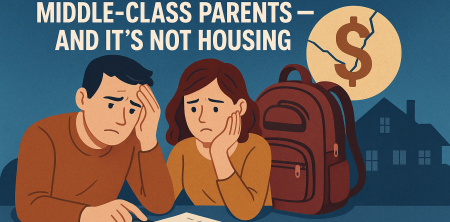
For far too long, we've heard the drumbeat of rising housing costs. It's a valid concern, a genuine struggle for countless families across the nation. But what if I told you there's another Goliath in the room, one that's increasingly outstripping even the formidable expense of a roof over your head? We're talking about childcare, and for many middle-class parents, the battle of childcare costs vs housing costs middle-class parents face is being won by the former, often silently, and with devastating financial consequences.
A recent spotlight by National Debt Relief in September 2026 really underscored this escalating financial pressure. They pointed out that even families pulling in what used to be considered a solid, middle-class income are now finding themselves in a perpetual squeeze. Groceries, transportation, and, yes, housing are all biting hard, but childcare? That's the one that often pushes families to the brink, forcing them into reliance on debt just to cover the basics. It’s not just about affording essentials; it’s about the complete erosion of any hope for saving, for absorbing an unexpected car repair, or God forbid, a medical emergency. This isn't just a financial crunch; it's a profound source of parental stress, impacting everything from mental health to overall family well-being. Inflation, that relentless beast, continues to outpace wage growth, leaving many feeling like they're running on a treadmill that's constantly speeding up.
As someone who’s spent years immersed in education, from K-12 classrooms to university leadership, I’ve seen firsthand how external pressures ripple into the home and, subsequently, into a child's readiness to learn. When parents are constantly worried about making ends meet, when the financial tightrope is stretched taut by the twin burdens of shelter and care, it creates an environment of pervasive stress. This article aims to pull back the curtain on this often-underestimated struggle, comparing the financial weight of childcare against housing, and offering some perspective on how middle-class families are navigating these treacherous waters.
1. The Unseen Surge: Childcare's Rising Tide
Let's be blunt: childcare costs have skyrocketed to a point where they often rival, and sometimes exceed, the average monthly mortgage or rent payment in many parts of the country. Think about that for a second. You spend years saving for a down payment, meticulously budgeting for property taxes and insurance, only to find that the cost of simply caring for your child during work hours is just as, if not more, expensive. This isn't just about premium, fancy daycares; we're talking about standard, licensed childcare facilities.
Data consistently shows that in numerous states, the annual cost of infant care surpasses in-state college tuition. In some urban centers, a single child in daycare can cost upwards of $20,000 to $30,000 annually. When you have two young children, that figure can easily double. This isn't a luxury expense; for most working parents, it's a non-negotiable necessity. Without reliable childcare, many parents, particularly mothers, would be forced out of the workforce, further impacting family income and career trajectories. The economic implications are staggering, not just for individual families but for the broader economy.
2. Housing: The Traditional Heavyweight, Still Punching Hard
Of course, we can't ignore housing. It remains, for many, the single largest monthly expense. The American dream of homeownership feels increasingly distant for a significant portion of the middle class. Median home prices have continued their upward trajectory, driven by low inventory, rising interest rates, and fierce competition. Renters aren't faring much better, with rental markets seeing consistent increases, leaving less disposable income for everything else.
The burden of a mortgage or rent payment isn't just about the monthly sticker price. It includes property taxes, homeowner's insurance (which has also seen considerable increases in recent years), utilities, and ongoing maintenance. For those who own, unexpected repairs like a new roof or a broken HVAC system can easily wipe out years of savings. For renters, security deposits and first/last month's rent can be a massive upfront hurdle. So, while housing remains a monumental financial challenge, it's crucial to examine how it stacks up against childcare, especially when considering the long-term financial health of a middle-class family.
3. The Crucial Comparison: Childcare Costs vs Housing Costs Middle-Class Parents Face
So, which is more burdensome: childcare or housing? For many middle-class parents, especially those with multiple young children, childcare often takes the lead as the more immediate and crippling expense. Housing, while substantial, is often a more fixed cost (at least for homeowners with fixed-rate mortgages) and, in many cases, an asset that appreciates over time. Childcare, on the other hand, is a recurring, often escalating, expense that yields no long-term financial return.
Consider a family in a metropolitan area. Their mortgage might be $2,500 a month. Sounds like a lot, right? Now, add two children under five, each in full-time daycare at $1,800 a month. Suddenly, their childcare bill is $3,600 – significantly more than their mortgage. This isn't an isolated example; it's the reality for countless families. The sheer volume of this expense, coupled with its non-asset nature, makes it a particularly difficult pill to swallow. It’s money spent, not invested, and it disappears as quickly as it arrives.
4. The Geographic Divide: Where You Live Matters Immensely
The impact of childcare costs vs housing costs middle-class parents experience isn't uniform across the country. There's a significant geographic divide that dictates which expense hits harder. In high-cost-of-living areas like New York City, San Francisco, or Boston, both housing and childcare are astronomical. Here, families are often squeezed from both ends, leading to impossible choices or reliance on extended family support. (See: impact of financial stress on families.)
However, in more affordable regions, where housing prices might be moderate, the relative burden of childcare can become even more pronounced. A family might find a perfectly reasonable home for $300,000 with a manageable mortgage, but then discover that quality childcare still costs upwards of $1,200-$1,500 per child per month. The disparity here highlights how childcare, regardless of local housing market dynamics, remains stubbornly high. This makes it a national crisis, not just a regional one.
5. The Debt Spiral: Funding Essentials with Credit
When essential costs like childcare and housing devour such a large portion of a family's income, something has to give. And far too often, that 'something' is savings, or worse, it leads to a reliance on debt. The National Debt Relief report rightly pointed out that many middle-class families are now using credit cards to cover routine expenses. This isn't about frivolous spending; it's about making ends meet when wages simply can't keep pace with the cost of living. For more context, see modern parenting struggles.
Accumulating high-interest credit card debt for necessities like childcare is a particularly insidious trap. It creates a vicious cycle where minimum payments eat into future income, making it even harder to escape. This isn't just about short-term financial stress; it has long-term implications for a family's financial stability, their ability to save for retirement, or even send their children to college. It's a silent emergency playing out in millions of households.
6. The Stress Factor: Beyond the Balance Sheet
The financial strain of managing childcare costs vs housing costs for middle-class parents extends far beyond the numbers on a balance sheet. It manifests as profound stress, anxiety, and guilt. Parents are constantly agonizing over choices: Should one parent stay home, sacrificing a career and potentially future earning potential? Can they afford that slightly cheaper, but less reputable, daycare? How do they save for their child's future when they're drowning in present expenses?
This emotional toll is immense. It impacts parental mental health, marital relationships, and even the quality of time parents can spend with their children. When you're constantly worried about money, it's hard to be fully present and engaged. As an educator, I've seen how this stress can subtly impact a child's home environment, sometimes even affecting their behavior and readiness to learn in school. It's a holistic problem that demands more than just financial solutions; it requires a societal reckoning.
7. Strategies for Survival: Navigating the Financial Minefield
So, what's a middle-class family to do when caught between these two financial behemoths? There are strategies, though none are easy fixes. First, a meticulous budget is non-negotiable. Knowing exactly where every dollar goes is the first step. For childcare, exploring all available options is crucial: family daycare homes, co-op programs, in-home care (nannies or au pairs if shared with another family), and employer-sponsored benefits. Some companies are starting to offer childcare subsidies or on-site facilities, which can be a game-changer.
When it comes to housing, refinancing a mortgage if interest rates drop can save significant money. For renters, negotiating lease terms or considering slightly less expensive neighborhoods might be necessary. Beyond individual actions, advocating for broader policy changes – like universal pre-kindergarten, expanded childcare subsidies, or affordable housing initiatives – is vital. These aren't just individual family problems; they are systemic issues that require systemic solutions. Until then, parents are left to creatively, and often exhaustingly, find their own ways through this financial labyrinth.
8. The Workforce Participation Dilemma: A National Economic Issue
The crushing weight of childcare costs isn't just a personal family burden; it’s a significant drag on the national economy. When childcare becomes unaffordable, many parents, disproportionately mothers, are forced to reduce their work hours or leave the workforce entirely. This isn't a choice made lightly; it's a financial calculation where the cost of childcare outweighs the income earned, especially for those in lower-paying jobs. The Center for American Progress estimated in 2022 that the U.S. loses $57 billion annually in lost earnings, productivity, and tax revenue due to the childcare crisis.
Think about the ripple effects: a parent leaves their job, reducing household income. This means less money spent in the local economy, less tax revenue for public services, and a loss of skilled workers in various industries. From an educational perspective, I've seen how career interruptions can significantly impact an individual's long-term earning potential and professional development. It's a lose-lose situation for families and for the broader economic health of the country. This isn't just about individual choices; it's a systemic barrier to full workforce participation and economic growth.
9. The Quality vs. Affordability Tightrope: No Easy Answers
One of the most agonizing dilemmas for middle-class parents caught in the childcare costs vs housing costs middle-class parents struggle is the trade-off between quality and affordability. Everyone wants the best for their child – a safe, stimulating, and nurturing environment that fosters early development. But these high-quality programs often come with exorbitant price tags. Parents are then forced to weigh their options: Do they stretch their budget to the absolute limit for a top-tier center, or do they opt for a less expensive, potentially lower-quality alternative?
This isn't an abstract concern. A study by Child Care Aware of America highlighted that many states have very low standards for staff-to-child ratios or caregiver education, especially in more affordable settings. This means that while a cheaper option might ease the immediate financial strain, it could come at the cost of less individualized attention or fewer developmental opportunities for the child. As an educator, I know how crucial those early years are for cognitive and social-emotional development. Asking parents to compromise on this fundamental need because of financial constraints is a profound societal failing. It creates inequities from the very start of a child's life. (See: rising childcare costs in the U.S..)
10. Expert Perspectives: Economists and Child Development Specialists Weigh In
Economists consistently point to the childcare crisis as a major economic impediment. Dr. Betsey Stevenson, an economist at the University of Michigan, has frequently spoken about how high childcare costs act as a "tax on parents," particularly mothers, discouraging them from working. She emphasizes that investments in affordable, high-quality childcare yield significant returns, not just for individual families but for the entire economy through increased tax revenue and consumer spending.
From a child development perspective, experts like Dr. Dana Suskind, author of "Thirty Million Words: Building a Child's Brain," stress the importance of early childhood experiences. She argues that high-quality interactions and environments in the first few years of life are foundational for language development, cognitive skills, and school readiness. When financial pressures force parents into suboptimal childcare choices, or create chronic stress in the home, it can have lasting negative impacts on a child's developmental trajectory. This intersection of economics and developmental science makes it clear that the childcare crisis is not just a monetary issue, but a critical public health and educational one. For more context, see lack of qualified teachers.
11. Comparison with International Models: Learning from Others
The United States stands out among developed nations for its lack of comprehensive, affordable childcare policies. Countries like France, Germany, and many Scandinavian nations offer extensive public subsidies, universal preschool programs, or generous parental leave policies that significantly reduce the financial burden on families. In France, for example, the government heavily subsidizes crèches (daycares) and écoles maternelles (preschools), making childcare costs a fraction of what they are in the U.S.
These models demonstrate that it is possible to create systems where childcare is both accessible and affordable without bankrupting families. They also show positive outcomes in terms of parental workforce participation, gender equality, and improved child development metrics. While adapting these models to the U.S. context would require significant political will and investment, looking at how other developed nations successfully tackle the childcare challenge offers valuable insights and underscores that the current American system is not an inevitable reality, but a policy choice.
12. The Long-Term Impact: Erosion of the Middle-Class Dream
The continuous battle between childcare costs vs housing costs for middle-class parents isn't just about monthly budgeting; it's about the gradual erosion of the middle-class dream itself. The ability to save for a down payment, afford a comfortable home, raise children, and save for retirement – these hallmarks of middle-class stability are becoming increasingly unattainable. The financial squeeze means less money for higher education savings, delaying homeownership, or pushing retirement further out of reach.
When families are constantly living paycheck to paycheck, burdened by debt from essential expenses, the upward mobility that defined previous generations of the middle class becomes a distant memory. This has profound implications for social equity and economic stability. As an educator, I see how these financial pressures manifest in students' lives, impacting their opportunities and their families' ability to support their educational journeys. It’s a systemic issue that threatens the very fabric of American society.
13. The Role of Policy: What Needs to Change?
Addressing the childcare crisis requires more than individual belt-tightening; it demands robust policy interventions. Here are some key areas:
- Universal Pre-Kindergarten: Expanding access to free, high-quality pre-K for all 3- and 4-year-olds would significantly reduce childcare costs for families and provide crucial early education.
- Increased Childcare Subsidies: Boosting federal and state subsidies for low- and middle-income families would make existing childcare more affordable.
- Tax Credits: Enhancing the Child and Dependent Care Tax Credit (CDCTC) and making it fully refundable would put more money back into parents' pockets.
- Investing in the Childcare Workforce: Raising wages and improving benefits for childcare workers is essential to attracting and retaining talent, which in turn improves the quality and stability of care.
- Affordable Housing Initiatives: Continuing efforts to increase the supply of affordable housing and provide rental assistance can alleviate one side of the dual burden.
- Employer Incentives: Creating tax incentives for companies to offer on-site childcare, childcare stipends, or flexible work arrangements would provide much-needed relief.
These aren't quick fixes, but they represent a comprehensive approach that acknowledges the severity of the problem and offers tangible solutions. Without significant policy changes, middle-class families will continue to struggle under these immense financial pressures.
Frequently Asked Questions (FAQ)
Q: Are childcare costs really more expensive than housing for middle-class parents?
A: In many parts of the country, especially for families with multiple young children, yes. While housing is a substantial expense, the recurring, non-asset nature of childcare can often make its monthly cost exceed a mortgage or rent payment. Data from organizations like Child Care Aware of America consistently show that infant care costs can surpass college tuition in numerous states. For more context, see widening learning gaps. (See: childcare costs vs housing costs.)
Q: Why have childcare costs risen so dramatically?
A: Several factors contribute to this surge. The childcare industry is labor-intensive, requiring specific staff-to-child ratios, which means personnel costs are high. There's also a shortage of qualified childcare workers, leading to higher wages (though often still inadequate). Regulations, licensing requirements, and the cost of maintaining safe, educational facilities also add to the expense. Demand consistently outstrips supply, driving prices up.
Q: What's considered "middle-class" in the context of these costs?
A: "Middle-class" can be tricky to define, as it varies significantly by region. Generally, it refers to households with incomes that fall between two-thirds and double the national median income. However, the struggle with childcare and housing costs often affects families earning well above this range in high-cost-of-living areas, demonstrating that even a "good" income can be stretched thin by these expenses.
Q: How do these costs impact a child's education and development?
A: The financial strain can indirectly impact a child's development. Parents under immense stress may have less capacity for engaging with their children. Furthermore, if parents are forced to choose less expensive, lower-quality childcare due to cost, it can mean fewer educational opportunities and less individualized attention during crucial developmental years. This can affect school readiness and long-term academic outcomes.
Q: What are some individual strategies parents can use to cope?
A: While systemic change is needed, individual strategies include meticulous budgeting, exploring all childcare options (family daycare homes, co-ops, in-home care shares), utilizing employer benefits (if available), and advocating for policy changes. Some families also rely on extended family for care or adjust work schedules to reduce full-time childcare needs.
Q: Is there any hope for policy changes to make childcare more affordable?
A: Absolutely. There's growing bipartisan recognition of the childcare crisis. Proposals for universal pre-kindergarten, expanded childcare subsidies, enhanced tax credits, and investments in the childcare workforce are frequently discussed. While progress can be slow, public awareness and advocacy are crucial for pushing these policy changes forward.
Q: How does the U.S. compare to other developed countries regarding childcare costs?
A: The U.S. generally ranks among the most expensive countries for childcare, with significantly less public investment and fewer comprehensive support systems compared to many European nations, Canada, and Australia. These countries often offer substantial subsidies, universal programs, or extended parental leave, making childcare much more affordable and accessible for families.
The struggle between childcare costs vs housing costs for middle-class parents isn't just a financial equation; it's a profound societal challenge that speaks to the very core of what it means to raise a family in America today. We need to acknowledge that for many, childcare has become the ultimate financial bottleneck, often eclipsing even the formidable expense of housing. It's time for a serious conversation and real solutions, because the well-being of our families, and indeed our future, depends on it.
Trending Now
Frequently Asked Questions
What is the biggest financial burden for middle-class parents?
While housing costs are commonly discussed, childcare is emerging as the most significant financial strain for middle-class parents. Many families find that childcare expenses are increasingly outpacing even their housing costs, leading to financial distress and reliance on debt.
How do childcare costs affect middle-class families?
Childcare costs are forcing many middle-class families into a financial squeeze, often eroding their ability to save or manage unexpected expenses. This pressure can lead to increased stress levels and impact overall family well-being.
Why are childcare expenses rising so rapidly?
Childcare expenses are rising due to various factors, including inflation and stagnant wage growth. These rising costs are outpacing overall income growth, making it increasingly difficult for families to afford basic needs.
What are the long-term effects of childcare costs on parents?
The long-term effects of high childcare costs on parents include financial stress, decreased mental health, and diminished family well-being. This ongoing pressure can hinder parents' ability to focus on their children's education and emotional needs.
How can middle-class families cope with rising childcare costs?
Middle-class families can cope with rising childcare costs by exploring flexible work arrangements, seeking community resources, or advocating for policy changes that address childcare affordability. Budgeting and prioritizing expenses can also help manage financial strain.
Agree or disagree? Drop a comment and tell us what you think.

