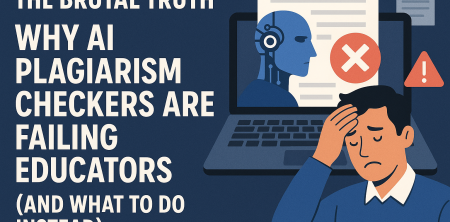
Look, as an educator who’s spent years in the trenches – from K-12 classrooms to leading university departments – I’ve seen firsthand how quickly the educational landscape can shift. Right now, one of the biggest seismic events we’re grappling with is the rise of artificial intelligence and its impact on academic integrity. Everyone’s talking about AI, and inevitably, that brings us to the thorny issue of plagiarism. Teachers, professors, and administrators are all asking the same question: what are the best AI plagiarism checkers for educators?
It's a fair question, and for a while, it seemed like the obvious solution. Get a tool, detect the AI-generated text, and problem solved, right? Well, if only it were that simple. The truth, and it's a brutal one, is that many of these tools are proving to be unreliable, prone to false positives, and frankly, causing more stress than solutions. This isn't just my opinion; it’s a growing sentiment backed by research and a significant shift in strategy from major educational bodies, like the New South Wales Education Standards Authority, which are actively moving away from relying on these detectors.
So, while I'm going to review some of the leading AI plagiarism checkers for educators, it's crucial to understand the broader context. We need to talk about why they're failing, and more importantly, what we, as educators, should be doing instead to genuinely foster academic integrity and prepare our students for an AI-integrated future. It’s about more than just detection; it’s about adaptation and promoting AI literacy.
1. Turnitin: The Veteran with a New AI Twist
Turnitin has been the undisputed heavyweight champion of plagiarism detection for decades. Most educators are intimately familiar with its interface, its similarity reports, and the sometimes-dreaded percentage it assigns to student submissions. When AI writing tools like ChatGPT exploded onto the scene, it was only natural for Turnitin to pivot and integrate AI detection capabilities into its existing platform. They recognized the urgent need and quickly rolled out their AI writing detection feature, aiming to give educators a familiar tool to combat a new challenge.
Their approach leverages machine learning to analyze text characteristics commonly associated with AI-generated content. The idea is to provide educators with an additional layer of insight, flagging submissions that show high probabilities of being written by AI. For many institutions already subscribed to Turnitin, this integration felt like a seamless, logical extension of their existing academic integrity infrastructure, making it one of the most widely considered AI plagiarism checkers for educators. It's an attempt to evolve with the technology, offering a comprehensive solution for both traditional plagiarism and AI-assisted writing.
2. Copyleaks: Gaining Traction with System Integrations
Copyleaks has been making significant waves in the AI detection space, distinguishing itself through its aggressive pursuit of integrations across various learning management systems (LMS). This strategy makes a lot of sense from a user adoption perspective: the easier it is for educators to incorporate a tool into their existing workflows, the more likely they are to use it. Copyleaks aims to provide a robust solution that not only identifies traditional plagiarism but also excels at detecting AI-generated text, even when it's been lightly edited by a human.
Their technology is built to be highly sensitive, capable of discerning the subtle patterns and linguistic nuances that often betray AI authorship. This level of sophistication is what makes Copyleaks a contender for the title of best AI plagiarism checkers for educators, especially for those looking for a tool that can keep pace with increasingly sophisticated AI models. The platform's commitment to continuous improvement and its focus on enterprise-level integrations suggest it's serious about becoming a long-term solution in the academic integrity arena.
3. GPTZero: The Educator-Focused Innovator
GPTZero burst onto the scene with a clear mission: to provide educators with a reliable tool to detect AI-generated content. What makes GPTZero particularly interesting is its origin story – it was developed by a student, Edward Tian, who recognized the immediate challenge AI presented to academic integrity. This grassroots beginning gave it an initial appeal, suggesting a tool built by someone who understood the problem from both sides of the classroom.
GPTZero focuses on metrics like 'perplexity' and 'burstiness' to determine the likelihood of AI authorship. Essentially, AI-generated text often exhibits lower perplexity (it's very predictable) and lower burstiness (sentences tend to be uniform in length and structure). While these metrics have faced scrutiny regarding their absolute accuracy, GPTZero's user-friendly interface and its initial focus on supporting educators quickly positioned it as a popular choice among the emerging best AI plagiarism checkers for educators, especially for those seeking a straightforward, dedicated AI detection solution. (See: importance of school climate.)
4. QuillBot's AI Detector: Part of a Broader Writing Suite
QuillBot is probably best known for its paraphrasing and summarization tools, which ironically, can also be used by students to manipulate text. However, recognizing the dual nature of AI writing tools, QuillBot has also introduced its own AI content detector. This positions it as a somewhat paradoxical offering: a tool that helps with writing and also helps detect when writing has been generated by AI. For educators, this means QuillBot offers a more integrated approach to writing assistance and integrity checks.
Its AI detection feature aims to identify patterns indicative of AI writing, providing a percentage score that suggests the likelihood of a text being AI-generated. The advantage here is that if students are already using QuillBot for other writing assistance, the AI detector is right there, potentially simplifying the tech stack for both students and educators. It’s an interesting play in the market of AI plagiarism checkers for educators, demonstrating how companies are adapting their existing platforms to address the evolving challenges of AI in education. For more context, see The AI Revolution in Education: Is It a Cheating Catastrophe or a Learning Leap?.
5. Sapling AI Content Detector: Focusing on Granularity
Sapling, often recognized for its grammar and writing assistant features, has also stepped into the AI detection arena with its AI Content Detector. What sets Sapling apart is its emphasis on providing granular feedback, not just a simple AI detection score. It aims to highlight specific sentences or phrases that are likely to be AI-generated, giving educators a more detailed understanding of where potential AI influence might lie within a student's submission.
This level of detail can be incredibly valuable for educators who want to engage in more nuanced conversations with students about their writing process, rather than just issuing a blanket accusation. By pinpointing areas, Sapling allows for targeted interventions and discussions. This focus on detailed analysis makes it a strong contender among the best AI plagiarism checkers for educators who prioritize instructional feedback alongside detection, offering more than just a yes/no answer about AI use.
6. Writer's AI Content Detector: A Free and Accessible Option
For educators and institutions with limited budgets, free tools are often the first port of call. Writer's AI Content Detector offers a publicly accessible and free-to-use tool that allows users to paste text and receive an assessment of its AI-generated probability. While it might not boast the enterprise-level integrations or the deep analytics of some paid platforms, its accessibility makes it a valuable resource for quick checks.
The simplicity of Writer's tool means it's incredibly easy to use – just paste and check. This can be particularly useful for individual educators who need to verify a short piece of text or get a preliminary sense of whether AI might have been involved. While free tools often come with limitations in terms of accuracy or advanced features, Writer's detector serves an important role in making AI detection available to a broader audience, making it a noteworthy mention when discussing AI plagiarism checkers for educators, especially those seeking cost-effective solutions.
7. ZeroGPT: Another Free Tool for Quick Checks
Similar to Writer's AI Content Detector, ZeroGPT is another free online tool that has gained traction for its straightforward approach to AI detection. It offers a simple interface where users can paste text and receive an immediate analysis of its likelihood of being AI-generated. The appeal of ZeroGPT lies in its ease of use and its zero-cost entry point, making it attractive to individual educators or students curious about their own writing's 'AI score.'
While free tools like ZeroGPT might not offer the same guarantees of accuracy or the comprehensive features found in subscription-based services, they play a role in democratizing access to AI detection technology. For educators who need a quick sanity check or want to explore the capabilities of AI detectors without financial commitment, ZeroGPT provides a viable, albeit basic, option among the various AI plagiarism checkers for educators available today. It highlights the growing number of tools emerging in this space, catering to different needs and budgets.
The Unsettling Reality: Why AI Detectors Are Falling Short
Now, let's get down to the brass tacks, the part where I, as an educator, have to lay out the hard truth. Despite the proliferation of these tools and the genuine effort by companies to address the challenge, a significant body of research, and increasingly, institutional policy, is suggesting that AI detection software is simply not reliable enough. The New South Wales Education Standards Authority's move away from these tools isn't an isolated incident; it's a canary in the coal mine.
Why are they failing? Primarily, it's about accuracy. These tools are prone to false positives, meaning they can wrongly accuse a student of cheating when their work is entirely original. Imagine the stress and anxiety this causes for students, who are already navigating complex academic pressures. Furthermore, AI-generated text, especially when lightly edited by a human, often slips past these detectors. The AI models are constantly evolving, making it a perpetual arms race where the detectors are always playing catch-up. It's like trying to hit a moving target that keeps changing its trajectory.
The Ethical Minefield of False Accusations
Beyond the technical limitations, there's a profound ethical dilemma at play here. As educators, our primary goal is to foster learning and trust. When we deploy tools that can falsely accuse students of academic dishonesty, we erode that trust. A false accusation can have devastating consequences for a student's mental health, their academic record, and their relationship with their educators and institution. It's not just about a grade; it's about their integrity and their future. (See: AI's impact on education.)
We've always taught students about the importance of evidence and due process. To then subject them to a system where a black box algorithm can render a judgment that impacts their lives, without irrefutable proof, feels fundamentally at odds with our educational values. We need to be incredibly careful not to let the fear of AI-assisted cheating lead us down a path that sacrifices fairness and student well-being.
Redesigning Assessments: A More Sustainable Approach
So, if relying solely on AI plagiarism checkers for educators isn't the answer, what is? The growing consensus, and one I strongly advocate for, is to pivot our focus from detection to prevention and adaptation. This means fundamentally redesigning our assessments. Instead of trying to catch AI, let's design assignments that AI struggles with, or better yet, assignments that strategically integrate AI as a tool for learning. For more context, see This Crucial Debate About AI in Education Is Missing the Entire Point.
Think about it: Can AI write a truly reflective essay about a personal experience? Can it conduct original research that requires critical thinking and synthesis of disparate sources? Can it engage in a Socratic seminar or a nuanced debate? Probably not to the depth we expect from our students. We need to create assessments that measure genuine understanding, critical thinking, creativity, and the application of knowledge, rather than just the regurgitation of information. This might involve more in-class writing, oral presentations, project-based learning, or assignments that require students to connect course material to their own lives and experiences in unique ways.
Embracing AI Literacy: Empowering Students for the Future
This brings me to perhaps the most critical long-term strategy: fostering AI literacy. Our students are growing up in an AI-powered world. Denying its existence or trying to ban it outright is like trying to ban calculators in a math class – it's futile and counterproductive. Instead, we need to teach students how to understand, ethically apply, and critically evaluate AI tools. This means discussing the capabilities and limitations of AI, the ethical implications of its use, and how to cite AI-generated content appropriately (if at all, depending on the assignment).
AI literacy isn't just about using AI; it's about understanding its biases, its potential for misinformation, and its role in shaping information. By equipping students with these skills, we're not just addressing academic integrity; we're preparing them for the workforce and for life in a technologically advanced society. This proactive approach, rather than a reactive one focused solely on detection, is where our efforts as educators should truly lie.
The Role of Dialogue and Clear Policies
Beyond redesigning assessments and promoting AI literacy, open dialogue is paramount. We need to have clear, transparent conversations with our students about our expectations regarding AI use. What's permissible? What's not? How should they cite AI tools if they use them as part of their brainstorming process? These aren't questions with easy answers, and the policies will likely evolve over time. But the important thing is to have the conversation, involve students in it, and establish clear guidelines.
Institutions also need to develop comprehensive policies that address AI. This isn't just about plagiarism; it's about defining what constitutes acceptable use in research, writing, and problem-solving across disciplines. These policies should be flexible enough to adapt to new AI advancements but firm enough to uphold academic integrity. It's a challenging balancing act, but one that's absolutely essential.
Expert Perspectives on AI in Education
It's not just me saying this; the conversation around AI in education is heating up, and many experts are echoing similar sentiments about moving beyond mere detection. Dr. Ethan Mollick from the Wharton School, for example, has been a vocal proponent of integrating AI into teaching, arguing that ignoring it is a disservice to students. He suggests that educators should focus on teaching students how to use AI effectively and ethically, viewing it as a powerful co-pilot rather than a cheating tool to be feared. His research often highlights the productivity gains AI can offer when used thoughtfully.
Similarly, the shift in focus towards AI literacy is gaining traction. Organizations like UNESCO are advocating for the development of AI competencies for all students, recognizing that understanding AI isn't just a technical skill but a critical component of modern citizenship. This includes teaching about data privacy, algorithmic bias, and the societal impact of AI. It’s about creating informed users, not just consumers, of AI technology. (See: Harvard University research.)
Some educators are even experimenting with "AI-inclusive" assignments, where students are explicitly allowed, or even required, to use AI tools, but then must critically analyze, edit, and reflect on the AI's output. This pushes students to develop higher-order thinking skills, making them editors and critical evaluators of information, rather than just generators. This approach helps students understand the limitations of AI and highlights the indispensable value of human judgment and creativity.
Challenges in Implementing New Approaches
Now, let's be real. Shifting away from AI plagiarism checkers and redesigning assessments isn't a walk in the park. It comes with its own set of challenges. For starters, it requires significant professional development for educators. Many teachers, especially those who haven't grown up with AI, might feel overwhelmed by the prospect of integrating it into their curriculum or creating AI-resistant assignments. Training and support are crucial here.
Then there's the issue of time and resources. Crafting complex, project-based assignments or facilitating deep, reflective discussions takes more time than simply grading a multiple-choice test or running an essay through a detector. Institutions need to provide educators with the bandwidth and resources to make these changes effectively. This might mean smaller class sizes, more planning time, or access to educational technology specialists.
And let's not forget the sheer scale of change. Education systems are often slow to adapt. Implementing new policies and pedagogical approaches across an entire district or university can be a monumental task. It requires leadership, clear communication, and a willingness to iterate and learn from what works and what doesn't. We're talking about a cultural shift, not just a technical one.
Looking Ahead: A Shift in Mindset
The debate around the best AI plagiarism checkers for educators really forces us to confront a larger issue: how do we define learning and demonstrate knowledge in an age of ubiquitous AI? If an AI can generate a passable essay in seconds, does that mean essay writing is obsolete, or does it mean we need to teach students how to craft arguments, synthesize complex ideas, and express original thought in ways that AI simply can't replicate?
I believe it's the latter. This isn't the first time technology has challenged traditional education, and it won't be the last. From the printing press to the internet, each technological revolution has forced us to reconsider our pedagogical approaches. AI is no different. It's an opportunity for us to innovate, to focus on higher-order thinking skills, and to truly prepare our students for a future that will undoubtedly be shaped by artificial intelligence. Let's move beyond the detection arms race and embrace a more proactive, empowering approach to AI in education.
Trending Now
Frequently Asked Questions
What are the limitations of AI plagiarism checkers?
AI plagiarism checkers often struggle with accuracy, leading to false positives and negatives. Many educators find these tools unreliable, as they can misidentify original work as plagiarized or fail to detect AI-generated text, causing more stress than solutions.
Why are educators moving away from AI plagiarism detection tools?
Educators are increasingly skeptical of AI plagiarism detection tools due to their inaccuracy and the growing understanding that these tools do not effectively support academic integrity. Institutions like the New South Wales Education Standards Authority are shifting focus towards fostering AI literacy instead.
What should educators do instead of relying on AI plagiarism checkers?
Instead of relying solely on AI plagiarism checkers, educators should focus on promoting academic integrity through education about AI, encouraging original thought, and adapting teaching methods to incorporate AI literacy, preparing students for a future where AI is integrated into their work.
How does Turnitin address AI-generated content?
Turnitin, a longstanding leader in plagiarism detection, has adapted its platform to better identify AI-generated content. However, its effectiveness remains under scrutiny as educators report mixed results, leading to ongoing discussions about the reliability of such tools.
What is the impact of AI on academic integrity?
The rise of AI has significantly impacted academic integrity, challenging traditional methods of assessment and prompting educators to rethink how they evaluate originality and authenticity in student work, leading to a broader conversation about adapting educational practices.
Have you experienced this yourself? We'd love to hear your story in the comments.

