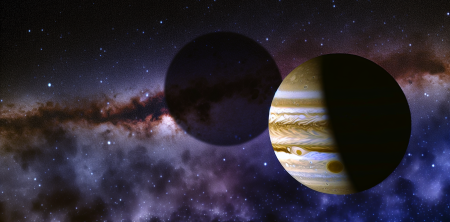
On the morning of March 14, 2026, skywatchers across the United States will be treated to a spectacular astronomical event: the transit of Io, one of Jupiter's most fascinating moons, across the giant planet's disk. This event is not just a mere spectacle; it offers a unique opportunity to witness the intricate dance of celestial bodies and the gravitational influences that govern their movements.
Understanding Io and Its Importance
Io, the innermost of Jupiter's four largest moons, is renowned for its intense volcanic activity, making it the most geologically active body in the solar system. With a diameter of about 3,643 kilometers (2,263 miles), Io is slightly larger than Earth's moon. Its surface is dotted with hundreds of volcanoes, some of which are capable of erupting lava fountains reaching heights of over 500 kilometers (310 miles).
This volcanic activity is primarily a result of tidal heating, caused by the gravitational interaction with Jupiter and its other moons, particularly Europa and Ganymede. As these moons orbit, they exert varying gravitational forces on Io, flexing its interior and generating heat. This makes Io a point of interest not only for astronomers but also for astrobiologists who study the potential for life in extreme environments.
The Transit Event: What to Expect
On the morning of the transit, Io will make its way across Jupiter's face, moving from the eastern limb to the western limb of the planet. Observers in the U.S. will be able to catch this event, with Io's shadow following closely behind. Here's a breakdown of the key timings:
- Io's Transit Start: Early morning, specific times will vary by location.
- Shadow Appearance: Io's shadow will join the transit later in the morning, although it may not be visible for observers on the eastern coast, as Jupiter will be low on the horizon by that time.
- Evening Event: Later that evening, Io will approach the western limb of Jupiter.
- Io Behind Jupiter: Io will slip behind the planet around 12:10 A.M. EDT (March 15 for Eastern time).
- Reappearance: Io will reemerge about 20 arcseconds east of the eastern limb at 2:40 A.M. CDT on March 15.
For optimal viewing, enthusiasts are encouraged to use telescopes equipped with high magnification. Even small telescopes or binoculars can provide a decent view, but larger instruments will enhance the experience significantly.
Viewing Conditions and Locations
The visibility of Io's transit will depend on the observer's location. For those in the eastern U.S., Jupiter will be relatively low on the horizon as dawn approaches, potentially limiting visibility. However, observers in more western states may have a clearer view as the planet will remain higher in the sky for a longer duration.
Weather conditions will also play a significant role in the observability of this event. Clear skies are essential for a successful viewing experience. Observers should check local forecasts and be prepared to relocate to areas with minimal light pollution for the best results.
The Geometry of Our Solar System
The transit of Io across Jupiter is an excellent demonstration of the geometry of celestial bodies in our solar system. As Io moves into the shadow of Jupiter, it provides a vivid illustration of how these massive bodies interact gravitationally. The positioning of Earth, the Sun, and Jupiter contributes to the visibility of the transit, making it a fascinating subject for both amateur and professional astronomers alike.
In addition to its aesthetic appeal, this event serves as a reminder of the dynamic nature of our solar system. Each transit and shadow event highlights the intricate ballet of moons and planets, governed by the laws of physics.
Conclusion: A Call to Stargazers
The transit of Io on March 14, 2026, is not merely an astronomical occurrence but a celebration of the wonders of the cosmos. Whether you are a seasoned astronomer or a casual observer, this event is a fantastic opportunity to connect with the night sky and appreciate the beauty of our solar system's mechanics.
So gather your telescopes, invite friends and family, and prepare for an unforgettable experience as Io dances across the face of Jupiter. This event promises to be a highlight for astronomy enthusiasts and casual stargazers alike, offering a glimpse into the majestic world of our planetary neighbors.

