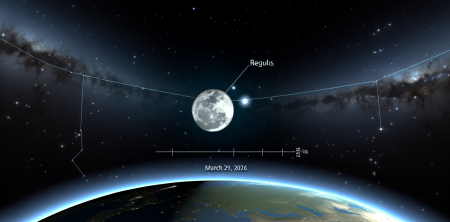
As we gaze up at the night sky on March 29, 2026, astronomy enthusiasts are in for a treat. The Moon will be making a close approach to one of the brightest stars in the constellation Leo, known as Regulus. This celestial event, occurring at approximately 4 P.M. EDT, presents a unique opportunity to observe the Moon's position relative to Regulus and other notable stars in the Leo constellation.
Understanding the Lunar Passage
The Moon will pass just 0.3° north of Regulus during this event, making it a remarkable sight for stargazers. After sunset, the Moon will stand about 3.5° east of Regulus, tracing a path along the ecliptic line, which is the imaginary line that represents the Sun's apparent path across the sky.
Regulus: The Heart of Leo
Regulus, shining brightly at a magnitude of 1.4, is considered the alpha star of the constellation Leo. Located at the base of the Sickle asterism, Regulus is not only a prominent feature in the night sky but also holds significant cultural and historical importance. Known as the "Heart of the Lion," Regulus has been revered in various cultures and has been a guiding star for navigators throughout history.
The Sickle Asterism
The Sickle of Leo is a distinctive asterism that resembles a backward question mark. It is formed by several key stars, each contributing to the overall shape and brightness of this celestial formation. The stars that make up the Sickle include:
- Regulus (Alpha Leo) - Magnitude 1.4
- Gamma Leo - Magnitude 2.0
- Epsilon Leo - Magnitude 3.0
- Mu Leo - Magnitude 3.9
- Zeta Leo - Magnitude 3.4
- Eta Leonis - Magnitude 3.5
Each of these stars plays a vital role in forming the recognizable image of the lion in the night sky. The Sickle asterism is a favorite among amateur astronomers and serves as a reference point for locating other celestial objects within the constellation.
Observing the Event
For those wishing to observe the Moon's close approach to Regulus, the best time will be after dark when the Moon has settled east of the star. Observing conditions will be most favorable in areas with minimal light pollution, allowing for clearer views of both the Moon and Regulus.
To enhance your observation experience, consider using a telescope or binoculars. These tools can provide a closer look at the Moon's surface features, such as craters and maria, while also allowing you to appreciate the brilliance of Regulus against the backdrop of the night sky.
Why This Event Matters
This lunar event is not just a feast for the eyes; it also serves as an excellent opportunity for education and inspiration. Observing celestial events can ignite curiosity about astronomy and encourage individuals to learn more about the universe.
Moreover, the relationship between the Moon and Regulus exemplifies the dynamic interactions between celestial bodies. As the Moon orbits Earth, its position relative to stars like Regulus changes, providing a visual representation of our place in the solar system.
The Cultural Significance of Leo
The constellation Leo has been significant in various cultures throughout history. In ancient times, it was associated with strength and bravery, often depicted as a lion in mythology and art. The Greeks and Romans recognized Leo as a symbol of the zodiac, marking the period of summer. The name "Leo" itself derives from Latin, meaning "lion," and has been used in various cultures to represent power and nobility.
Today, Leo remains a popular constellation among astrologers and stargazers alike. Its presence in the night sky continues to inspire stories and legends that connect humanity to the cosmos.
Conclusion
On March 29, 2026, as the Moon approaches Regulus, it offers a captivating spectacle to all who look up at the night sky. Whether you are an amateur astronomer, a seasoned observer, or simply someone who enjoys the beauty of the universe, this celestial event is a perfect reminder of the wonders that await us among the stars.
So, gather your friends and family, find a dark spot away from city lights, and prepare to witness the Moon gracefully tracing its path near the heart of Leo. This is an experience not to be missed, as the universe invites us to connect with its splendor and mystery.

