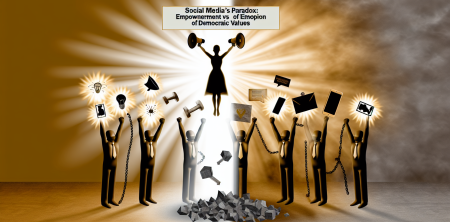
The landscape of American democracy is undergoing a significant transformation, fueled in part by the rise of social media. A recent Gallup study involving over 20,000 adults across the United States, conducted between July and August 2025, sheds light on the complex relationship between social media usage and attitudes towards democracy.
Heavy Social Media Use and Civic Empowerment
According to the Gallup findings, individuals who identify as heavy social media users—defined as those spending five or more hours a day on these platforms—exhibit a heightened sense of civic empowerment. Notably, 44% of these users express belief in the power of citizens to effect change compared to only 30% of individuals who do not engage heavily with social media.
This data suggests that social media can serve as a tool for individuals to feel more connected and influential within their communities. It provides a platform for activism, mobilization, and the sharing of ideas, potentially fostering a sense of agency among users.
Contradictory Support for Democracy
Despite the increased sense of empowerment among heavy users, the study also reveals a troubling trend: these same individuals show significantly less support for democratic principles. The survey indicates that only 57% of heavy social media users endorse the idea of democracy, in stark contrast to 72% of non-heavy users.
This contradiction raises critical questions about the implications of social media on public perception of democratic values. While individuals may feel empowered to express their views, their alignment with democratic ideals appears to weaken, suggesting a nuanced relationship that warrants further exploration.
Support for Government Intervention and Political Violence
In addition to the decline in support for democracy, the Gallup study highlights that heavy social media users are more inclined to endorse government intervention in news dissemination and even support violent measures for political goals. These findings reveal a significant ideological shift that could have profound consequences for the health of American democracy.
- Government Influence in News: Heavy users are more likely to favor greater government involvement in regulating news content.
- Endorsement of Violence: A concerning percentage of heavy users also agree with the use of violence to achieve political objectives.
These attitudes suggest that while social media may empower individuals to engage politically, it can also foster a sense of disillusionment with democratic processes, leading to extreme viewpoints and potential radicalization.
The Ideological Impact of Social Media
The Gallup study underscores the dual-edged nature of social media's impact on civic engagement and democratic attitudes. Researchers controlled for demographic factors, indicating that the observed trends are not merely a reflection of age, education, or socioeconomic status but may stem from the unique ways in which social media shapes political discourse.
Social media platforms often create echo chambers, where users are exposed primarily to viewpoints that align with their own. This can reinforce existing beliefs and contribute to polarization, as heavy users may become entrenched in their ideological positions. The consequence is a complex interplay where individuals may feel empowered to act but lack the foundational support for democratic norms.
The Future of Democracy in the Age of Social Media
The implications of these findings extend beyond individual attitudes; they pose significant questions about the future of democracy itself. As social media continues to evolve and integrate into everyday life, its role in shaping public opinion and political behavior cannot be underestimated.
Policymakers, educators, and social media platforms must consider the responsibility they hold in fostering an environment that encourages informed civic engagement while safeguarding democratic values. Strategies may include:
- Media Literacy Programs: Educating users on distinguishing between credible information and misinformation.
- Encouraging Diverse Perspectives: Promoting platforms that facilitate exposure to a range of viewpoints.
- Accountability Measures: Implementing policies that hold platforms accountable for the spread of harmful content.
Conclusion
As the Gallup study reveals, social media is a powerful tool that can both empower citizens and erode democratic ideals. The challenge lies in harnessing its potential for positive civic engagement while mitigating its risks to democratic discourse. Navigating this complex landscape will be crucial for the sustainability of democracy in a rapidly changing digital world.

