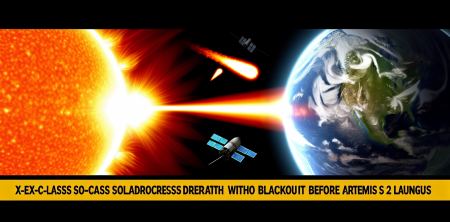
In a striking display of solar activity, the Sun unleashed a powerful X1.4-class solar flare on March 30, 2026, which has triggered significant radio blackouts on Earth. This event comes at a crucial moment as NASA prepares for the upcoming Artemis 2 mission, marking a vital step towards human exploration of the Moon and beyond.
The Solar Flare: What Happened?
The X1.4 solar flare erupted in the early hours, releasing an immense amount of energy that not only impacted radio communications but also raised concerns regarding the safety and viability of the Artemis 2 mission preparations. X-class flares are the most intense category of solar flares, capable of causing widespread disruption to technology on Earth.
Consequences of the Flare
The immediate consequence of the solar flare was a significant radio blackout, which is categorized as an R3 event on the NOAA scale. This level of disturbance can severely disrupt high-frequency radio communications, making it particularly problematic for aviators and maritime operations that rely on such technology for navigation and communication.
Additionally, the solar flare was accompanied by a coronal mass ejection (CME), which is a large expulsion of plasma and magnetic field from the Sun's corona. This CME reached Earth shortly after the flare, leading to a geomagnetic storm that has been classified as a moderate (G2) event. NOAA's Space Weather Prediction Center issued a geomagnetic storm watch for March 31, with warnings of possible minor (G1) storm conditions extending into both March 30 and April 1.
Implications for NASA's Artemis 2 Mission
The timing of the solar flare poses a potential challenge for NASA's Artemis 2 mission, which aims to send astronauts on a flyby mission around the Moon. Scheduled for launch later this year, the mission is a key step in NASA's broader Artemis program, which seeks to establish a sustainable human presence on the Moon and prepare for future Mars exploration.
The increased solar activity could affect launch conditions, including communication systems and the safety of the astronauts onboard. NASA engineers are closely monitoring the situation, assessing any potential risks associated with the solar activity.
Preparedness and Monitoring
NASA and other space agencies have systems in place to monitor solar activity and assess its impact on space missions. These include real-time observations from satellites and ground stations, which track solar flares and CMEs. The Artemis team is equipped to adapt to space weather conditions, ensuring that the mission remains safe and on schedule.
Furthermore, the agency has protocols to adjust launch windows in response to solar activity. This flexibility is critical, as the safety of the astronauts is the top priority. As the launch date approaches, NASA will continue to evaluate the solar weather and make necessary adjustments to their plans.
Geomagnetic Storm Effects on Earth
The geomagnetic storm triggered by the CME is not only a concern for space missions but also offers some unique phenomena for those on Earth. One of the most anticipated effects of such storms is the potential for enhanced visibility of the auroras, commonly known as the northern and southern lights.
- Increased Aurora Visibility: Areas typically outside the auroral oval may experience stunning displays of the northern lights, providing a spectacular show for sky watchers.
- Impact on Technology: Geomagnetic storms can disrupt satellite operations, GPS accuracy, and power grids, making it essential for operators to remain vigilant during such events.
As the storm progresses, NOAA has issued guidelines for those in affected areas to prepare for possible disruptions in technology and communications.
Looking Ahead
As we continue to explore the cosmos, understanding solar activity and its effects on Earth becomes increasingly important. Events like the recent X-class solar flare serve as a reminder of the Sun's power and the need for ongoing research in heliophysics.
The Artemis 2 mission, positioned at the forefront of human space exploration, underscores the significance of robust preparedness strategies in the face of unpredictable solar phenomena. With careful monitoring and adaptive planning, NASA aims to navigate these challenges and continue its mission of advancing human presence in space.
In conclusion, while the recent solar flare poses challenges, it also highlights the ever-changing dynamics of our solar system and the importance of continuous observation and preparation in the realm of space exploration.

