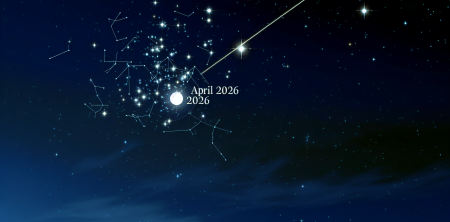
As darkness enveloped the skies on April 17, 2026, at 7:52 a.m. EDT (11:52 GMT), stargazers were treated to a remarkable display of celestial bodies during the new moon. This astronomical event not only signaled a period of optimal viewing conditions but also unlocked the mysteries of our universe, showcasing stunning views of notable constellations, planets, and other celestial phenomena.
The New Moon Phenomenon
The new moon occurs when the Moon is positioned between the Earth and the Sun, resulting in the Moon's illuminated side being turned away from us. This absence of moonlight creates a dark canvas in the night sky, perfect for observing stars, planets, and deep-sky objects. The new moon in April 2026 provided stargazers with several nights of ideal conditions for astronomical observations.
Observing the Constellation Hydra
One of the highlights of the April 2026 new moon was the visibility of the constellation Hydra. As the largest constellation in the night sky, Hydra stretches across a significant portion of the southern hemisphere. Known as the Water Snake, this constellation is a fascinating area to explore, containing a wealth of stars and deep-sky objects.
Key Features of Hydra
- Location: Hydra winds its way through the sky, nestled between the constellations of Virgo and Centaurus.
- Brightest Star: Alphard, the solitary bright star in Hydra, shines with a magnitude of 2.0 and is located approximately 177 light-years from Earth.
- Deep-Sky Objects: Hydra is home to several interesting deep-sky objects, including the Hydra I and II galaxy clusters, and the stunning spiral galaxy NGC 4038/NGC 4039, known as the Antennae Galaxies.
With the dark skies provided by the new moon, amateur astronomers and enthusiasts could observe these features with greater clarity, revealing the rich tapestry of stars that make up this intriguing constellation.
The Bright Evening Star: Venus
On the evening of April 17, 2026, Venus emerged as a dazzling sight in the western sky. Positioned approximately 15 degrees above the horizon, this planet, often referred to as the "Evening Star," was perfectly situated for observation.
Venus and the Pleiades Star Cluster
Venus’ brilliance was further enhanced by its proximity to the Pleiades star cluster, a well-known open star cluster that is also referred to as the Seven Sisters. The Pleiades is a beautiful sight, with its rich blue hues and tight grouping of stars. Here are some details about this remarkable celestial duo:
- Visibility: The Pleiades is best viewed with the naked eye or binoculars, revealing its seven brightest stars, though up to 14 are visible with good eyesight.
- Distance: The Pleiades is located approximately 444 light-years away from Earth.
- Mythology: Many cultures have significant myths surrounding the Pleiades, ranging from Greek mythology to Native American folklore, highlighting its importance in human culture.
As Venus and the Pleiades cluster shone brightly in the evening sky, stargazers were encouraged to take advantage of this stunning view and capture the moment through photography or simply by enjoying the wonder of the cosmos.
Jupiter's Majestic Presence
High above in the night sky, Jupiter made its grand entrance, positioned prominently beneath the twin stars of Gemini, Castor and Pollux. As the largest planet in our solar system, Jupiter has long captivated the imaginations of astronomers and stargazers alike.
Observation Tips for Jupiter
Jupiter is not only a sight to behold with the naked eye, but it also offers rich details for those equipped with telescopes. Here are some tips for observing this magnificent planet:
- Telescopic Views: A 6-inch telescope allows enthusiasts to observe Jupiter’s cloud bands and the Great Red Spot, a massive storm larger than Earth.
- Galilean Moons: Through a modest telescope, viewers can spot Jupiter's four largest moons: Io, Europa, Ganymede, and Callisto. These moons, known as the Galilean moons, were first discovered by Galileo in 1610.
- Best Viewing Times: The best time to observe Jupiter is typically during opposition when it is closest to Earth and fully illuminated by the Sun.
Jupiter’s presence in the night sky during the new moon phase provided an excellent opportunity for both amateur and experienced astronomers to appreciate its beauty and complexity.
The Early Morning Planetary Triangle
As night transitioned into dawn on April 18, 2026, a spectacular alignment of planets came into view in the eastern sky. This planetary triangle featured Mars, Saturn, and Mercury, creating a striking visual that captivated early risers.
Details of the Planetary Triangle
This celestial arrangement offered a rare sight, with each planet showcasing its unique characteristics:
- Mars: Known as the Red Planet, Mars had a distinct reddish hue, making it easy to identify.
- Saturn: Recognized for its stunning rings, Saturn is a favorite target for telescope users, who can catch a glimpse of its iconic ring system.
- Mercury: The closest planet to the Sun, Mercury is often challenging to observe due to its proximity to the Sun, but its visibility during this event made it a noteworthy target.
While Neptune was also present nearby, it required binoculars or a telescope for observation due to its dimmer brightness. Stargazers were encouraged to seek out this distant planet for an even broader understanding of our solar system.
Why Stargazing Matters
Events like the April 2026 new moon serve as more than just an opportunity to observe celestial bodies. They provide a unique chance for education, inspiration, and connection with the universe. Stargazing has numerous benefits:
- Educational Opportunities: Observing celestial events encourages learning about astronomy, physics, and the vastness of space.
- Connection to Nature: Stargazing can foster a deeper appreciation for our planet and the cosmos, encouraging a sense of wonder and curiosity.
- Community Engagement: Stargazing events often bring people together, creating a sense of community among those who share a passion for the night sky.
As we continue to explore the mysteries of the universe, events like the April 2026 new moon remind us of our place in the cosmos and the beauty that surrounds us.
Conclusion
The new moon of April 2026 provided a remarkable opportunity for stargazers to connect with the cosmos, showcasing stunning views of the constellation Hydra, the brilliance of Venus, the majesty of Jupiter, and the alignment of Mars, Saturn, and Mercury. As we look forward to future celestial events, let us remember the joy and inspiration that comes from gazing up at the night sky, where wonders await discovery.

