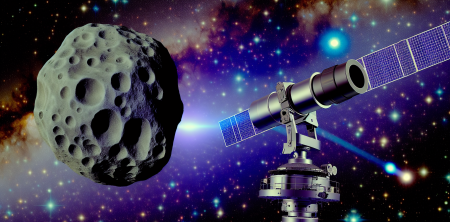
On April 29, 2026, Earth will witness an astronomical event as two sizable asteroids, designated as 2026 HL3 and 2026 HP3, are set to skim past our planet. NASA has confirmed that both celestial bodies will pass at safe distances of approximately 1.6 million miles and 3.68 million miles, respectively. Despite the close approaches, scientists are not alarmed, emphasizing the effectiveness of current asteroid monitoring systems.
Understanding the Asteroids
Asteroids are remnants from the early solar system, composed primarily of rock and metal. They vary significantly in size, shape, and composition. The two asteroids approaching Earth in April 2026 are relatively large, comparable in size to an airplane, prompting interest from both scientists and the public.
Asteroid 2026 HL3
Asteroid 2026 HL3 is expected to pass Earth at a distance of 1.6 million miles, which is about 6.8 times the distance between the Earth and the Moon. This distance is significant enough to ensure that there is no risk of collision. The size of 2026 HL3 makes it a notable object for observation, allowing scientists to study its composition and trajectory.
Asteroid 2026 HP3
Similarly, asteroid 2026 HP3 will pass at a distance of 3.68 million miles, making it even less of a concern for Earth's safety. This asteroid, like its counterpart, offers an opportunity for researchers to expand their knowledge about near-Earth objects (NEOs) and their potential implications for our planet.
The Importance of Monitoring NEOs
The close approaches of these asteroids highlight the importance of ongoing monitoring and tracking of NEOs. NASA and other space agencies around the world have developed advanced technologies to detect and track these objects, allowing scientists to predict their paths with increased accuracy.
NASA's Planetary Defense Program
NASA's Planetary Defense Coordination Office (PDCO) plays a crucial role in identifying and monitoring asteroids and comets that come close to Earth's orbit. The PDCO utilizes a combination of ground-based telescopes and space-based observatories to scan the skies for potential threats. These efforts have led to significant advancements in our ability to predict the paths of asteroids and assess any potential risks they may pose.
Technological Advancements in Tracking
- Infrared Surveys: Telescopes equipped with infrared technology can detect asteroids that are otherwise invisible to the naked eye.
- Radar Observations: Ground-based radar systems provide detailed information about the size, shape, and speed of asteroids.
- Space Missions: Missions such as OSIRIS-REx and Hayabusa2 have gathered samples from asteroids, offering insights into their composition and origins.
Why Scientists Aren't Alarmed
Despite the close approach of these asteroids, scientists remain calm and collected. The distances at which 2026 HL3 and 2026 HP3 will pass Earth are well beyond what is considered dangerous. According to experts, the likelihood of an asteroid colliding with Earth is extremely low, especially for those that are being actively monitored.
Public Perception and Misinformation
Public fascination with asteroids often leads to misconceptions about their threat level. Movies and media portrayals can exaggerate the dangers of asteroid impacts, leading to unnecessary panic. However, scientists emphasize the importance of relying on accurate data and scientific reasoning to understand these celestial phenomena.
Future Asteroid Approaches
As technology advances, the ability to track and predict asteroid paths will only improve. Upcoming years will likely see more close approaches, providing valuable opportunities for research and observation. As space agencies continue to develop their monitoring capabilities, the risk of unforeseen impacts becomes even more remote.
Ongoing Research and Collaboration
International collaboration among space agencies is vital for effective asteroid monitoring. Organizations such as NASA, ESA (European Space Agency), and various observatories around the globe share data and findings, enhancing the collective understanding of NEOs.
The Role of Education and Outreach
Educating the public about asteroids and their impact on Earth is essential. Outreach programs help demystify the science behind asteroid tracking and promote awareness of the measures in place to protect our planet. By fostering a well-informed public, scientists can mitigate fear and encourage interest in planetary science.
Engaging with the Community
Many institutions and organizations host events, lectures, and workshops aimed at educating the public about space science. These initiatives allow citizens to engage with scientists and learn more about the ongoing efforts to safeguard Earth from potential asteroid impacts.
Conclusion
The passage of asteroids 2026 HL3 and 2026 HP3 serves as a reminder of the dynamic nature of our solar system. While these objects will safely pass Earth in April 2026, they highlight the importance of continuous monitoring and research in the field of planetary defense. With advancements in technology and international collaboration, humanity is better equipped than ever to understand and respond to the challenges posed by near-Earth objects.
As we look forward to the future, the ongoing efforts to track asteroids not only enhance our safety but also deepen our understanding of the universe. The knowledge gained from studying these celestial bodies can potentially unlock secrets about the formation of our solar system and the origins of life on Earth.

