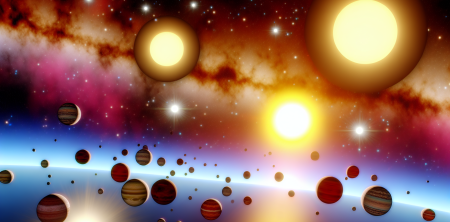
In a groundbreaking leap for exoplanet research, NASA's Transiting Exoplanet Survey Satellite (TESS) has unveiled a stunning discovery: 27 new circumbinary planet candidates. These celestial bodies orbit two stars instead of the traditional single star configuration, reminiscent of the iconic Star Wars planet, Tatooine. This discovery not only propels our understanding of the cosmos but also captures the imagination of both scientists and the general public, drawing a tangible connection to popular culture.
The Fascinating World of Circumbinary Planets
Circumbinary planets are an intriguing category of exoplanets that travel around two suns. Unlike their more common counterparts, which orbit a solitary star, these planets exist in a complex gravitational ballet, influenced by the gravitational pulls of both stars in the system. The concept of planets orbiting two stars was once deemed purely theoretical, but recent advancements in technology and deep-space observation have allowed scientists to confirm their existence.
A Historical Perspective
The very notion of exoplanets with two suns has long captivated scientists and science fiction enthusiasts alike. The idea found its roots in the works of early astronomers who speculated on the possibility of varied planetary systems. However, it wasn't until the advent of advanced telescopes and observational techniques that astronomers began discovering actual exoplanets.
- 1992: The first exoplanets were discovered orbiting a pulsar.
- 1995: The first exoplanet around a sun-like star, 51 Pegasi b, was identified.
- 2011: The Kepler Space Telescope launched, revolutionizing exoplanet detection methods.
Despite the rich history of exoplanet research, circumbinary planets remained elusive until recently. The enhanced capabilities of TESS have opened up new avenues for exploration and have finally shed light on these mysterious worlds.
The Recent TESS Discoveries
The new findings from TESS involve planets that orbit two stars, further emphasizing the diversity of planetary systems in our galaxy. The 27 circumbinary candidates identified by TESS are part of a larger set of observations that aim to understand the dynamics and characteristics of such systems.
These planets are significant not only for their unique orbital mechanics but also for the potential they hold in the search for extraterrestrial life. The presence of two suns creates unique climates and conditions that could lead to habitable environments, albeit under different circumstances than those found on Earth.
Understanding the Candidates
The candidates identified by TESS are located in various systems, each exhibiting distinct characteristics. Some of these worlds are expected to have temperatures conducive to liquid water, one of the essential ingredients for life as we know it. Others may experience extreme weather patterns due to the gravitational interactions between the two stars.
- Unique Climate Dynamics: Planets in dual-star systems could have vastly different climates depending on their distance from each star.
- Orbital Stability: The gravitational interplay between two stars can affect a planet's orbital stability, impacting its potential habitability.
- Potential for Life: The presence of liquid water, combined with the right atmospheric conditions, could foster life on these planets.
As scientists continue to analyze these candidates, they hope to uncover more about their formation, evolution, and potential for hosting life.
The Cultural Resonance of Dual-Sun Systems
The discovery of exoplanets with two suns strikes a chord in popular culture, particularly due to its association with Star Wars. The fictional planet Tatooine, known for its twin suns and iconic desert landscapes, has become a cultural symbol that resonates deeply with fans around the world. The connection between real science and beloved science fiction generates excitement and intrigue, making complex astronomical concepts more accessible and shareable.
As public interest grows, the scientific community is encouraged to engage with broader audiences, utilizing relatable examples from popular culture to explain scientific findings. This helps to bridge the gap between scientific inquiry and public understanding, fostering a greater appreciation for the wonders of the universe.
Social Media and Viral Potential
The viral potential of discoveries like TESS's 27 new circumbinary planet candidates is immense. Social media platforms serve as powerful tools for disseminating information rapidly, allowing for the wide sharing of scientific discoveries. Imagery of dual-sun systems, combined with relatable narratives from science fiction, create compelling content that can easily captivate audiences.
As news of these findings spreads, space enthusiasts and casual observers alike can engage in discussions about the implications of such discoveries. The ability to visualize and contextualize complex scientific research through familiar cultural references enhances public interest and understanding.
Future Research Directions
Moving forward, scientists are eager to delve deeper into the characteristics of the newly discovered exoplanets with two suns. Future missions and advanced telescopes, such as the James Webb Space Telescope, will offer unprecedented observational capabilities to study these distant worlds.
- Atmospheric Studies: Future research will focus on characterizing the atmospheres of these exoplanets, searching for signs of habitability or even biosignatures.
- Orbital Dynamics: Understanding the gravitational interactions between the stars and their planets will provide insights into the stability and evolution of circumbinary systems.
- Public Outreach: Engaging the public through educational initiatives and outreach programs will help demystify complex astronomical concepts and inspire future generations of scientists.
The exploration of dual-sun systems opens a new chapter in our understanding of planetary formation and evolution, and the curiosity surrounding these worlds will undoubtedly persist.
Conclusion: A New Era in Exoplanet Research
The discovery of 27 new exoplanets with two suns marks a significant milestone in exoplanet research. As scientists continue to explore the complexities of circumbinary planets, the potential for groundbreaking discoveries remains vast. The connection to popular culture, especially through the lens of Star Wars, serves to bridge the gap between the scientific community and the public, highlighting the importance of these celestial worlds.
With every discovery, we inch closer to understanding the intricacies of our universe and the potential for life beyond our home planet. The journey to explore these alien worlds is just beginning, and the excitement surrounding exoplanets with two suns will only grow as we uncover more of their secrets.

