```html
The digital age has ushered in an era where equal internet access education is often championed as a panacea for learning disparities. However, an emerging body of research suggests that simply providing students with the same access to the internet does not guarantee equal learning outcomes. This article digs deeper into the nuances of internet access and its impact on educational equity, challenging widely held assumptions and offering a critical perspective on how we define and address educational disparities.
Understanding the Concept of Equal Internet Access Education
Equal internet access education refers to the effort to provide all students, regardless of socioeconomic status, with the same availability and opportunity to use the internet for learning purposes. This concept has gained traction as schools and policymakers work to bridge the digital divide that has long existed between affluent and less privileged communities.
While the intention behind equal internet access is commendable, it overlooks a fundamental reality: access alone does not equate to effective learning. A study highlighted by Screenwise reveals that the quality of learning derived from internet usage varies significantly depending on students’ baseline knowledge and educational background.
The Knowledge Gap: Understanding Learning Efficiencies
The research indicates that students' ability to extract valuable information from online resources is closely tied to their prior knowledge and educational experiences. Students with a stronger foundation of knowledge are shown to be more efficient in their online searches, leading to greater learning gains even when the time and effort invested are the same across the board.
For instance, a student with a solid understanding of basic math concepts is likely to grasp advanced mathematical principles more quickly than a peer who lacks that foundational knowledge. This phenomenon illustrates the knowledge gap that exists within educational settings, revealing that equal internet access does not bridge the divide in learning outcomes.
Financial Incentives and Verbal Encouragement: What the Study Reveals
The study mentioned earlier found that financial incentives and verbal encouragement could increase the effort students put into their online searches. However, while these motivational strategies can enhance engagement, they do not effectively eliminate the gap in learning outcomes between students of varying educational backgrounds.
This finding prompts a critical question: What good is increased effort if it does not translate into equal learning gains? The implication here is profound: without addressing the underlying knowledge disparities, efforts to promote equal internet access education may fall short of their intended goals.
Revisiting Assumptions About Digital Equity
The assumption that providing all students with equal internet access equates to leveling the educational playing field is deeply flawed. This notion can lead to complacency among educators and policymakers, who may believe that the challenge of educational inequality has been solved simply by ensuring connectivity.
In reality, to foster true equity in education, a multifaceted approach is necessary. This approach must not only include access to technology but also target the enhancement of students’ foundational knowledge, critical thinking skills, and digital literacy. Without addressing these factors, the internet—despite its vast resources—may not serve as a suitable substitute for traditional learning experiences. (See: challenges of equal internet access.)
Concrete Examples of Learning Disparities
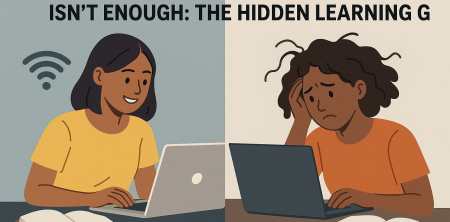
To illustrate the implications of these findings, consider two hypothetical students, Alex and Jamie. Both have access to the internet and the same amount of time to conduct research for a school project. Alex, who comes from a family where education is emphasized, has a wealth of prior knowledge regarding the topic. In contrast, Jamie, who has limited exposure to the subject matter and lacks sufficient academic support at home, struggles to extract meaningful information.
Despite both students spending the same amount of time online, Alex is likely to produce a more comprehensive and insightful project than Jamie. This disparity highlights how equal internet access education does not automatically translate into equivalent learning outcomes. Such examples underscore the importance of addressing the root causes of educational inequality.
Real-World Implications: Case Studies in Educational Inequity
Several real-world case studies illustrate the complexities of equal internet access education. For example, a school district in a low-income urban area implemented a program providing laptops and internet access to students. Initial metrics indicated increased engagement; however, a follow-up study revealed that students struggled to leverage these tools effectively due to inadequate digital literacy skills and lack of parental support. In contrast, a suburban district with similar internet access rates saw higher academic performance, attributed not solely to access but to a comprehensive support system involving parents and community resources.
This underscores the necessity of integrating support mechanisms that enhance learning rather than focusing solely on access. Schools must create an ecosystem that includes professional development for teachers, workshops for parents, and access to tutoring services that can help bridge these gaps.
Statistics on Educational Disparities and Internet Access
According to a report by the Pew Research Center, over 15% of U.S. households with school-age children do not have a high-speed internet connection, highlighting a significant digital divide. Moreover, the National Center for Education Statistics (NCES) indicates that students in low-income families score significantly lower on standardized tests than their peers in higher-income brackets. This gap persists despite the availability of internet resources, suggesting that access alone is insufficient for improving educational outcomes.
Furthermore, a study conducted by the Brookings Institution found that while 70% of students in affluent areas reported feeling prepared for online learning, only 30% of their counterparts in economically disadvantaged neighborhoods felt the same. These statistics reveal a stark reality: the perception of preparedness and actual performance is deeply influenced by factors beyond mere internet access.
FAQs: Addressing Common Concerns
What can educators do to improve learning outcomes for all students?
To enhance learning outcomes across the board, educators can implement targeted interventions that provide additional support and resources to students with weaker foundational skills. This can include tutoring programs, personalized learning plans, and enrichment activities that not only leverage internet resources but also focus on building core knowledge.
How can parents support their children's learning in a digital environment?
Parents can play a crucial role by fostering an environment conducive to learning. This includes encouraging curiosity, facilitating discussions about academic content, and providing access to diverse educational resources—online and offline. Additionally, parents should monitor their children's online activities to ensure they are engaging with high-quality educational content.
Why is digital literacy important in the context of equal internet access education?
Digital literacy is essential as it empowers students to navigate the vast amount of information available online effectively. Without these skills, students may struggle to discern credible sources from unreliable ones, leading to misinformation and shallow learning. Moreover, strong digital literacy can help bridge the knowledge gap that exists due to varying levels of prior education.
What role do community organizations play in facilitating equal internet access education?
Community organizations can serve as crucial allies in the pursuit of educational equity. They can offer resources such as after-school programs, workshops on digital literacy, and additional tutoring for students who struggle with online learning. By coordinating efforts with schools and local governments, these organizations can help ensure that students not only have internet access but also the skills necessary to use it effectively.
The Role of Schools in Promoting True Equity
Schools have a pivotal role in promoting true educational equity. Beyond simply providing internet access, they must engage in practices that elevate the educational experiences of all students. This includes implementing curriculum changes that address the diverse needs of the student population, integrating technology in a meaningful way, and fostering an inclusive learning environment. (See: health behaviors and internet access.)
Additionally, schools should work collaboratively with parents and communities to create support networks that amplify learning opportunities. By forming partnerships with local organizations, schools can offer workshops and resources aimed at building foundational skills, thus enhancing the overall educational landscape.
Innovative Approaches to Equal Internet Access Education
As educational institutions face the challenges of bridging the digital divide, innovative approaches are emerging. One notable example is the implementation of blended learning models that combine online instruction with traditional classroom experiences. Studies show that blended learning can enhance engagement and foster deeper learning by allowing students to work at their own pace while still receiving essential face-to-face support from educators.
Moreover, initiatives such as mobile hotspot distributions for students without reliable internet access have gained traction. This approach has proven effective in reaching underserved populations, facilitating a smoother transition to online learning environments, and ultimately improving student performance. Such initiatives highlight the importance of not just addressing access, but also ensuring that students can utilize technology effectively.
The Future of Equal Internet Access Education
As we move forward in the digital age, the conversation surrounding equal internet access education must evolve. Policymakers, educators, and communities need to shift their focus from merely ensuring internet access to creating comprehensive strategies that address the complexities of educational inequity. This includes exploring innovative solutions such as blended learning environments, where in-person instruction complements online learning.
Moreover, ongoing research is crucial in understanding the long-term effects of equal internet access on educational outcomes. By continuously evaluating and adapting strategies based on emerging findings, stakeholders can work towards a more equitable education system that genuinely supports all learners.
Challenges in Implementing Equal Internet Access Education
While the goal of equal internet access education is commendable, several challenges persist in its implementation. One significant hurdle is the variability in infrastructure across regions. Rural areas often face limited broadband availability, while urban centers may struggle with network congestion. This disparity in infrastructure can result in unequal accessibility, where students in less served areas are at a distinct disadvantage.
Furthermore, economic barriers also play a crucial role. Families may not only lack access to high-speed internet but also the necessary devices. Despite initiatives aimed at providing laptops, many students still find themselves without the essential tools needed for effective online learning. Schools must consider these barriers when developing strategies to ensure all students can benefit equally from digital resources.
The Economic Implications of Digital Inequity
The economic implications of digital inequity extend beyond individual learning outcomes. Regions with widespread educational disparities often face long-term economic consequences. A well-educated workforce is vital for the competitiveness of a region, and when a significant portion of the population lacks access to quality education facilitated by technology, it can hinder economic growth. Studies have shown that states that have made significant investments in education and technology tend to experience higher rates of economic development.
Additionally, bridging the digital divide can lead to substantial cost savings for educational institutions. By adopting online resources and digital tools, schools can reduce expenditures on physical materials and streamline administrative processes. As such, investments in equal internet access education are not purely altruistic; they can yield significant returns on investment for both educational institutions and the economy at large.
Expert Perspectives on Equal Internet Access Education
Education experts emphasize that addressing the digital divide requires a holistic approach. Dr. Emily Chen, an expert in educational technology, states, “Access to the internet is only the beginning. We must invest in training for both teachers and students to ensure that digital tools are used effectively.” This insight underscores the importance of educational training and support as essential complements to internet access.
Furthermore, Dr. Marcus Taylor, a sociologist specializing in education equity, argues that “the focus should shift from just access to understanding how different students utilize that access.” He notes that cultural and contextual factors play a significant role in how students engage with online resources, pointing to the need for tailored curriculum and teaching strategies that reflect diverse backgrounds and experiences.
Engaging the Community: A Collaborative Approach
Community engagement is crucial for promoting equal internet access education. Schools can partner with local businesses, libraries, and non-profits to create comprehensive educational programs that extend beyond the classroom. For instance, public libraries can serve as community hubs for digital literacy training, offering workshops on internet safety, research skills, and even coding. Such collaborations not only enhance student learning but also foster a sense of community investment in education.
Moreover, community organizations can facilitate mentorship programs, where older students or local professionals help younger students navigate online resources and develop their skills. These initiatives enhance learning experiences and build stronger ties within the community, ultimately leading to a more supportive educational environment for all students.
Conclusion: Moving Beyond Access to Equal Learning
The evidence is compelling: equal internet access education, while essential, is not sufficient to guarantee equal learning outcomes. As we grapple with educational disparities, it is imperative to recognize the importance of prior knowledge, digital literacy, and supportive learning environments in fostering true equity.
By acknowledging these complexities and implementing holistic approaches, we can move towards an educational landscape where all students have the opportunity to thrive—regardless of their backgrounds. Only then can we hope to fully harness the potential of the internet as a powerful educational tool that uplifts and empowers every learner.
```
Trending Now
- this guide on the surprising impact of parental controls: 5 essential parenting tips for the digital age
- this guide on how ai in education is revolutionizing learning outcomes—a closer look at new findings
- the complete explanation
- this guide on why winter could be wreaking havoc on your sexual health: the startling truth about erectile dysfunction
Frequently Asked Questions
Why is equal internet access not enough for education?
Equal internet access is often seen as a solution to educational disparities, but it does not guarantee equal learning outcomes. Research shows that students' ability to effectively utilize online resources depends on their prior knowledge and educational background, highlighting that access alone is insufficient for bridging learning gaps.
What are the hidden learning gaps in education?
Hidden learning gaps refer to the disparities in students' ability to benefit from equal internet access. Factors like prior knowledge and educational experiences significantly affect how efficiently students can extract valuable information online, leading to unequal learning gains despite having the same resources.
How does prior knowledge affect online learning?
Prior knowledge plays a crucial role in online learning efficiency. Students with a solid foundation in relevant subjects can navigate and utilize online resources more effectively, resulting in greater learning gains compared to those with weaker foundational knowledge, even when both invest similar time and effort.
What is the digital divide in education?
The digital divide in education refers to the gap between students who have equal access to the internet and those who do not. While efforts are made to provide equal access, disparities in learning outcomes persist due to differences in prior knowledge, skills, and educational backgrounds among students.
How can we address educational disparities beyond internet access?
Addressing educational disparities requires a multifaceted approach that goes beyond providing equal internet access. It involves enhancing foundational knowledge, improving teaching methods, and offering tailored support to help all students effectively utilize online resources for learning.
Agree or disagree? Drop a comment and tell us what you think.

