```html
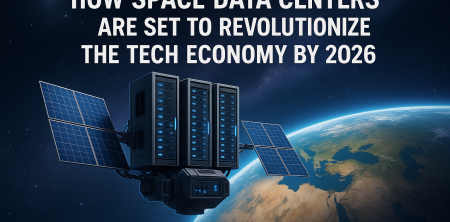
The tech landscape is undergoing a radical transformation that could redefine the very foundation of our digital infrastructure. With the successful operation of an H100 chip in orbit and the passing of radiation tests by Google TPUs, the concept of space data centers has moved from science fiction to a tangible reality. This groundbreaking shift occurred in mid-2026, backed by over $2 billion in startup funding, making it a hot topic among tech enthusiasts and investors alike. As interest surges, let’s explore the implications of this development and what it means for the future of computing and digital infrastructure.
The Breakthrough: Why Space Data Centers Matter
When we think of data centers, we often picture sprawling facilities filled with servers, located on the ground, consuming vast amounts of energy and resources. However, the successful operation of high-performance computing chips in space reveals a counterintuitive possibility: data centers in space could significantly change the dynamics of digital infrastructure.
Space data centers offer unique advantages that traditional ground-based centers cannot match. For instance, they can potentially avoid the limitations imposed by terrestrial geography and infrastructure. Imagine data processing occurring in low Earth orbit (LEO), where latency is reduced, and access to vast amounts of solar power is available. This could lead to faster computation speeds and lower operational costs.
The Economic Implications of Space Data Centers
The emergence of space-based computing could create a ripple effect across the entire tech economy. With over $2 billion in funding already secured, investors see the potential for massive returns in an industry that’s still in its infancy. The validation of space data centers not only challenges conventional economic assumptions but also attracts a wave of interest from various stakeholders: entrepreneurs, tech enthusiasts, and government agencies.
Moreover, the race to establish operational space data centers could ignite fierce competition among tech giants. If companies like Google, Amazon, and Microsoft start investing heavily in this sector, we might witness a rapid scaling of technology development, driving down costs and improving services for end-users.
The Role of Google TPUs and H100 Chips
The pivotal role of Google's Tensor Processing Units (TPUs) and NVIDIA’s H100 chips cannot be understated. Both technologies have undergone rigorous tests and proven their resilience in the harsh conditions of space. For instance, TPUs are specifically designed to accelerate machine learning tasks, while the H100 chips enhance the processing capabilities required for complex computations.
What does this mean for industries dependent on high-performance computing? A myriad of sectors, including artificial intelligence, scientific research, and cloud computing, could benefit immensely from the capabilities offered by space-based data centers. Businesses that rely on real-time data processing will have unprecedented access to resources that can significantly reduce downtime and increase efficiency.
Technical Challenges and Considerations
Despite the optimistic outlook, the journey toward operational space data centers is fraught with challenges. One of the primary concerns is the technical feasibility of deploying and maintaining servers in space. While radiation tests have been successful, there are still numerous factors that need to be addressed, including cooling systems, power supply, and hardware maintenance.
Furthermore, connectivity poses a significant challenge. While LEO satellite constellations are being developed to provide global internet coverage, the reliability and speed of such connections must be proven for effective data transfer between space and ground-based operations. Addressing these technical challenges will be key to the long-term success of space data centers.
The Social Media Buzz: Why It Matters
The topic of space data centers is generating significant buzz on social media platforms. It’s not just the technical achievements that excite people; it’s the sheer potential for innovation and the fear of missing out on the next big thing. The combination of cutting-edge technology and a rapidly changing economy creates a perfect storm for virality.
Social media engagement around this topic highlights a growing interest among the public in space technology and its applications. As the conversation expands, it presents opportunities for education and awareness about the future of data infrastructure—something that many people may not have considered before. (See: NASA on space data centers.)
The Impact on Global Tech Economy
The implications of successful space data centers extend beyond the tech industry. As companies begin to establish these infrastructures, we could see a shift in job markets and economic activities surrounding tech, research, and development. High-skilled jobs in aerospace engineering, software development, and data analysis may experience a renaissance.
Moreover, new companies and startups may emerge, focusing on the specific needs of space-based operations. This could lead to innovations in satellite technology, energy solutions, and even space law as regulations catch up with advancements. The economic landscape could be reshaped as a result of this new frontier.
Potential Risks and Ethical Considerations
With every breakthrough, there are risks and ethical considerations to evaluate. The potential for increased space debris due to the proliferation of space data centers must be addressed. As more satellites and infrastructure are sent into orbit, the risk of collisions increases, which poses a threat to existing satellites and the overall safety of space activities. There's a fuller look at class action news.
Additionally, we must consider the implications of data privacy and security in space. If sensitive data is processed in orbit, what regulations will govern its protection? As data centers in space become a reality, policymakers will need to establish frameworks to ensure ethical use and security of the data being handled.
What Lies Ahead: Predictions for Space Data Centers
Looking ahead, the potential trajectory of space data centers seems promising. As technology continues to develop, we might witness the launch of fully operational facilities in the coming years. Tech giants are likely to invest further in research and development, paving the way for innovative applications of space-based computing.
Moreover, partnerships between private companies and governments could facilitate the growth of this industry. Collaborative efforts will be crucial in tackling the technical and regulatory challenges associated with deploying data centers in space. If successful, such collaborations could foster a new era of tech development that leverages space for economic growth.
Exploring the Technological Advantages of Space Data Centers
Space data centers are poised to harness several technological advantages that ground-based facilities simply cannot replicate. One of the most significant benefits is the ability to leverage zero-gravity environments for advanced computing tasks. In a zero-gravity setting, components can be designed to work more efficiently, potentially leading to novel cooling solutions that might further reduce the energy requirements of data processing.
Additionally, the proximity to a vast array of satellites means that space data centers could facilitate unprecedented levels of data integration and connectivity. For example, by processing data closer to the source—such as Earth observation satellites—companies can gain real-time insights that are critical for industries like agriculture, disaster management, and urban planning.
According to a report from the European Space Agency, the global space economy is projected to grow from $423.8 billion in 2022 to over $1 trillion by 2030. The integration of data centers in space could play a significant role in this growth trajectory, as companies seek faster, more efficient data processing solutions.
Case Studies: Early Innovators in Space Data Center Technology
A number of companies are already exploring the potential of space data centers, serving as early innovators in this emerging field. For instance, a small startup named SpaceComputing recently launched a prototype space data center aboard the International Space Station, which has successfully processed data from earth monitoring satellites in real-time.
Similarly, companies like AWS and Microsoft have begun to explore partnerships with aerospace organizations to establish space-based computing solutions. AWS’s project to build a cloud platform that operates in collaboration with LEO satellites exemplifies how traditional tech giants are adapting to this new frontier.
These case studies underscore the importance of experimentation in the development of space data centers. They also highlight the potential for innovation that can arise from failures and successes in testing new technologies in the harsh environment of space.
Comparison with Ground-Based Data Centers
To fully appreciate the promise of space data centers, it's worth comparing them with traditional ground-based data centers. Ground facilities are typically subject to several limitations, such as high energy costs, physical space restrictions, and cybersecurity vulnerabilities. In contrast, space data centers can harness solar energy directly, potentially reducing operational costs significantly. (See: Research on satellite data processing.)
For example, a study conducted by the International Energy Agency found that data centers accounted for about 1% of global electricity demand. By relocating processing capabilities to space, which has direct access to solar power, companies can not only cut costs but also lower their carbon footprints. This could greatly appeal to environmentally conscious consumers and businesses.
Additionally, while ground data centers are vulnerable to natural disasters and geopolitical tensions, space operations can avoid these risks. A data center in orbit could theoretically maintain continuous operation regardless of what happens on the ground, ensuring that critical operations remain uninterrupted.
Expert Perspectives on the Future of Space Data Centers
Industry experts are increasingly optimistic about the long-term viability of space data centers. Dr. Mia Chen, a space technology researcher at Stanford University, states, "The future of computing will not just be in data processing but in how we can obtain insights from data collected in real-time from space." She emphasizes that as businesses seek more efficient ways to harness data, the push toward space-based solutions will accelerate.
Similarly, aerospace engineer Mark Sullivan notes that the exploration of space data centers could lead to unexpected innovations: "When you push the boundaries of what's possible, you often find solutions to problems that weren't even on your radar." His perspective underlines the transformative nature of this technology beyond just computing, potentially influencing satellite designs and space exploration missions.
Frequently Asked Questions about Space Data Centers
What exactly are space data centers?
Space data centers are facilities designed to process and store data in orbit, utilizing advanced computing technologies like TPUs and H100 chips. They aim to leverage the advantages of space, such as reduced latency and direct access to solar power.
How would space data centers reduce latency?
By positioning data centers closer to satellite networks in low Earth orbit, space data centers can minimize the time it takes for data to travel between the source and the processing center, resulting in faster data processing and transmission times.
What are the potential environmental benefits?
Space data centers have the potential to utilize solar energy for power, reducing reliance on fossil fuels and lowering the carbon footprint of data processing operations. This can help companies meet sustainability goals more effectively.
Are there any current examples of operational space data centers?
While fully operational space data centers are still in the development phase, various companies are conducting tests and prototypes in partnership with organizations like NASA and the International Space Station.
What are the key challenges facing space data centers?
Some of the primary challenges include maintaining server functionality in extreme temperatures, ensuring reliable connectivity with ground-based operations, and dealing with potential space debris. Additionally, there will be regulatory hurdles that need to be navigated.
How will space data centers impact the job market?
As this industry grows, there will likely be an increase in demand for specialized roles in aerospace engineering, data analysis, and software development. New companies will emerge, creating new job opportunities focused on space technologies and operations.
What types of data will be processed in space data centers?
Space data centers will likely process a range of data types, including satellite imagery, scientific research data, machine learning models, and climate data for various applications, from agriculture to disaster response and urban planning. (See: New York Times on tech advancements.)
How will space data centers enhance global communications?
Due to their strategic placement in orbit, space data centers can improve global communications by reducing latency for satellite internet services, thereby enabling faster and more reliable internet access in remote areas and improving connectivity for mobile users.
Exploring the Future: Implications for Technology Development
The establishment of space data centers isn’t just about improving current technologies; it’s about creating an entirely new ecosystem. As companies push the boundaries of what’s technologically feasible, we can expect a wave of innovations that may change our lives in unforeseen ways. For instance, the use of artificial intelligence in space data centers could revolutionize data analytics, making it possible to provide real-time insights that impact sectors like healthcare, transportation, and energy management.
Imagine AI algorithms working with data collected in real time to predict natural disasters or optimize energy consumption across multiple sectors. As these AI systems are developed for space, they will also have applications on Earth, potentially transforming industries and creating new markets. The crossover potential of this technology could generate a substantial economic impact, fostering an environment ripe for innovation.
Global Collaborations and the Role of Governments
As space data centers emerge, the role of governments and international collaborations will be critical. Nations may need to establish agreements on how to manage the space environment, address concerns about space debris, and ensure equitable access to space-based resources. Initiatives could include international frameworks for sharing data processed in space or cooperative research programs between countries.
Governments can also act as facilitators by investing in infrastructure that supports the growth of space data centers. This includes developing launch capabilities for satellites and funding research in space technology, further encouraging private-sector participation. The synergy between public and private entities could fast-track the benefits of space data centers, making it a truly collaborative venture.
What’s Next for Space Data Centers: A Look at Upcoming Projects
Several upcoming projects are set to advance the concept of space data centers further. One noteworthy initiative is the Lunar Gateway, a planned space station in orbit around the Moon. This project aims to facilitate lunar exploration and could host data processing capabilities that support missions to the Moon and beyond. By establishing data centers on the Gateway, researchers could analyze data collected from lunar missions in near real-time, significantly enhancing our understanding of the Moon and the broader solar system.
Additionally, private companies are testing prototypes that aim to establish dedicated space data centers in orbit. Companies like Relativity Space are exploring 3D printing technologies to build satellites and structures, which could include data processing facilities. These innovations could lead to a new generation of space data centers that are not only efficient but also cost-effective.
Conclusion: The Future of Space Data Centers
The advent of space data centers represents a significant leap forward in our understanding of computing infrastructure. With the successful operational tests of crucial technology and the influx of funding, we're on the brink of something revolutionary. As discussions around this concept continue to evolve, tech enthusiasts and investors alike need to stay informed about the developments in this field. The future of computing may very well take place among the stars, forever altering the landscape of our global tech economy.
```
Trending Now
Frequently Asked Questions
What are space data centers and how do they work?
Space data centers are facilities located in low Earth orbit that utilize advanced computing technologies, such as H100 chips and Google TPUs, to process data. By operating in space, these centers can leverage reduced latency and abundant solar energy, transforming the dynamics of digital infrastructure.
How will space data centers impact the tech economy?
The emergence of space data centers is expected to significantly disrupt the tech economy by attracting over $2 billion in investments. This innovation could lead to faster computation speeds, lower operational costs, and new business opportunities, appealing to a wide range of stakeholders, including entrepreneurs and government agencies.
What advantages do space data centers have over traditional ones?
Space data centers offer several advantages, including reduced latency due to proximity to satellites, access to unlimited solar power, and the ability to circumvent geographical limitations. These factors can lead to enhanced performance and efficiency compared to traditional ground-based data centers.
What is the significance of the H100 chip in space data centers?
The H100 chip represents a breakthrough in high-performance computing technology that can operate effectively in space. Its successful deployment in orbit marks a pivotal moment for space data centers, enabling advanced processing capabilities that could revolutionize digital infrastructure.
What future developments can we expect in space data centers by 2026?
By 2026, we can expect significant advancements in space data centers, including expanded operational capabilities, increased investment, and the potential for commercial applications. This evolution is likely to redefine how data is processed and accessed, ultimately transforming the tech landscape.
What did we miss? Let us know in the comments and join the conversation.

