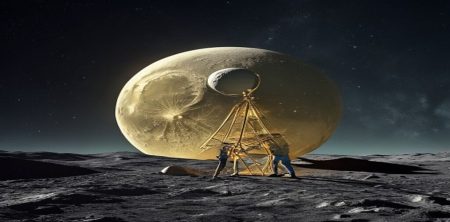
Imagine a future where the energy crisis is a distant memory, where cities are powered by a clean, virtually limitless fuel source. Now, imagine that source isn't buried deep within our planet, but scattered across the dusty, airless surface of the Moon. This isn't science fiction anymore; it's the driving force behind a new, audacious space race, a scramble for lunar resources, specifically for something called helium-3. And it's poised to become a trillion-dollar industry.
For billions of years, the Moon has been bombarded by solar wind, a constant stream of particles from the sun. Unlike Earth, which is protected by its magnetic field and atmosphere, the Moon has no such shield. This direct exposure has led to a fascinating accumulation: an extraordinary abundance of helium-3 embedded in the lunar regolith. On Earth, this rare isotope is incredibly valuable, fetching prices around $30,000 per gram. But on the Moon? It’s everywhere, and that stark difference in availability is sparking a modern-day gold rush, with lunar mining companies rapidly developing the technologies to go get it.
This isn't just about resource extraction; it's about laying the groundwork for an entirely new economy, one that extends beyond our planet. The potential for immense wealth, groundbreaking technological advancements, and a complete rethinking of our energy infrastructure makes the prospect of lunar mining helium-3 one of the most compelling narratives in space exploration today. The stakes are incredibly high, and the implications for humanity are profound.
The Allure of Helium-3: A Fusion Fuel Dream
So, what exactly makes helium-3 so special that companies are willing to invest hundreds of millions, if not billions, to extract it from a quarter-million miles away? The answer lies in its unique properties as a potential fuel for nuclear fusion reactors. Unlike traditional nuclear fission, which splits heavy atoms like uranium and produces radioactive waste, nuclear fusion involves fusing light atoms together, mimicking the process that powers the sun. The holy grail of fusion energy is a reaction that uses deuterium and helium-3.
Why this specific combination? The deuterium-helium-3 fusion reaction is considered 'aneutronic,' meaning it produces very few neutrons. This is a crucial advantage. Neutron radiation is damaging to reactor components, makes materials radioactive, and requires heavy shielding. Aneutronic fusion would significantly reduce these challenges, making reactors safer, more efficient, and potentially much smaller. The primary byproducts are charged particles, which can be directly converted into electricity with high efficiency, bypassing the need for steam turbines. This clean, efficient energy source, if harnessed, could provide abundant power with minimal environmental impact, solving many of the energy challenges facing our planet.
While terrestrial fusion research continues to make progress, the scarcity of helium-3 on Earth has always been a bottleneck. It exists naturally in tiny quantities, primarily as a byproduct of tritium decay in nuclear weapons stockpiles, making it incredibly expensive and limited. The Moon, however, offers a solution, holding an estimated million metric tons of helium-3. To put that into perspective, just a few hundred kilograms could theoretically power a major city for a year. The sheer scale of this lunar resource is what transforms it from a scientific curiosity into a genuine economic driver.
Pioneers of the Lunar Frontier: Interlune Leads the Charge
Among the boldest players in this emerging lunar mining helium-3 landscape is a company called Interlune. They aren't just talking about lunar extraction; they're actively building the infrastructure and securing the partnerships needed to make it a reality. Interlune has positioned itself as a frontrunner, not merely exploring the idea but committing to tangible missions within the next few years.
Their strategy involves a strong collaboration with established industrial giants. One key partnership is with Vermeer Corporation, a name synonymous with heavy industrial equipment here on Earth. This collaboration is critical because lunar mining isn't just about rockets; it's about developing rugged, reliable machinery that can operate autonomously in the Moon's harsh environment. Think of it: extreme temperatures, vacuum conditions, abrasive regolith, and vastly different gravity. Vermeer's expertise in excavation and heavy machinery is being adapted to design and test autonomous lunar excavation and site-preparation tools, purpose-built for the unique challenges of the lunar surface.
Interlune isn't just relying on speculative future demand either. They've already secured nearly $500 million in binding helium-3 purchase agreements. This isn't venture capital; these are concrete commitments from government and commercial customers who see the long-term value and strategic importance of this resource. This significant financial backing underscores the serious commercial intent and the genuine market demand that exists for lunar helium-3, even before the first gram is extracted. It signals to the broader market that this isn't just a distant dream, but a viable, fundable enterprise. (See: Helium-3 overview on Wikipedia.)
The Technological Hurdles: Building for the Moon
Getting to the Moon is one thing; staying there and operating heavy machinery is another entirely. The technological hurdles for lunar mining helium-3 are formidable, requiring innovative solutions across multiple engineering disciplines. You can't just send a regular excavator to the Moon; it needs to be redesigned from the ground up.
First, consider the environment. The lunar surface experiences extreme temperature swings, from scorching daylight reaching over 100°C (212°F) to frigid nights plummeting to -173°C (-280°F). Equipment must be designed to withstand these radical fluctuations without freezing up or overheating. Then there's the vacuum of space, which presents challenges for lubricants, electronics, and even the structural integrity of materials. Dust, too, is a major concern. Lunar regolith is incredibly abrasive and electrostatically charged, posing a significant threat to moving parts, seals, and optical sensors. It clings to everything and can quickly degrade equipment.
Gravity is another factor. At one-sixth of Earth's gravity, excavators will behave differently. Digging, scooping, and moving material requires different mechanics and control systems to prevent the machines from bouncing or losing traction. Robotics and autonomous operation are paramount. Human operators are too expensive and logistically complex to deploy for continuous mining operations. Therefore, these machines must be capable of operating with minimal human intervention, performing tasks like digging, processing regolith, and even self-repairing to some extent.
Interlune and its partners are focused on developing and rigorously testing these autonomous systems. This includes advanced AI for navigation and task execution, specialized materials resistant to the lunar environment, and energy-efficient designs for power generation and thermal management. The goal is to have mission-ready equipment by 2028, a timeline that highlights the rapid pace of development in this sector. It's an incredible engineering challenge, but one that promises enormous rewards.
From Regolith to Riches: The Extraction Process
How do you actually get helium-3 out of lunar dust? It’s not as simple as scooping it up. Helium-3 is implanted in the very fine grains of lunar regolith by the solar wind. The process involves heating the regolith to release the trapped gases, then separating the helium-3 from other volatile compounds.
Here’s a simplified breakdown of the proposed extraction process for lunar mining helium-3: First, autonomous excavators will dig up vast quantities of lunar soil, or regolith. This material will then be transported to processing plants. These plants will likely employ a system of heating chambers, where the regolith is gradually heated to specific temperatures. As the temperature rises, various gases trapped within the regolith grains are released. These gases include hydrogen, helium (including helium-3), neon, argon, and other volatiles.
Once released, this mixture of gases needs to be cooled and then subjected to cryogenic distillation or other gas separation techniques. Because helium-3 has a slightly different boiling point than other gases, it can be separated and purified. This purified helium-3 would then be compressed and stored in specialized containers, ready for transport back to Earth or for use in future lunar power generation facilities. The extreme expense of lunar operations means that proving these extraction methods and demonstrating the concentration of resources is absolutely critical. It's not enough to know it's there; you have to prove you can get it out efficiently and economically.
The Economic Imperative: Why Lunar Mining is Worth the Cost
When you consider the staggering costs associated with space travel and lunar operations, it's fair to ask: is lunar mining helium-3 truly economically viable? The short answer, according to proponents, is a resounding yes, especially when looking at the long game. The initial investment will be astronomical, no pun intended, but the potential returns could be even larger.
The current $30,000 per gram valuation of helium-3 on Earth is a testament to its scarcity and potential. However, this price is also a reflection of limited supply. If lunar extraction scales up, the price might adjust, but the sheer volume and strategic importance of clean fusion fuel suggest a persistent high value. The half-billion dollars in purchase agreements secured by Interlune is a strong indicator that industrial and governmental entities are ready to pay a premium for this resource. (See: NASA's lunar exploration overview.)
Beyond the direct sale of helium-3, a successful lunar mining operation could kickstart an entirely new economic ecosystem. Think of it as the foundational commodity for a burgeoning lunar economy. What does that mean? It means the infrastructure built for extraction could also support scientific research, tourism, and even future lunar settlements. Companies providing everything from B2B software for operational management to specialized hardware for lunar environments would flourish. This isn't just about selling fuel; it's about establishing human industrial capability beyond Earth, creating new jobs, new technologies, and entirely new markets.
The long-term vision is that the Moon becomes a strategic outpost, a stepping stone for deeper space exploration, and a critical energy supplier for Earth. The economic ripple effects could be transformative, driving innovation in robotics, materials science, artificial intelligence, and propulsion systems. It's an investment not just in a resource, but in humanity's future beyond our home planet.
Regulatory Frameworks and the Space Treaty Conundrum
As private companies race to the Moon, the question of who owns what on celestial bodies becomes increasingly pressing. The existing international legal framework, primarily the 1967 Outer Space Treaty, states that outer space, including the Moon and other celestial bodies, is not subject to national appropriation by claim of sovereignty. It also promotes the exploration and use of outer space for the benefit and in the interests of all countries.
This creates a fascinating legal gray area. While no nation can claim ownership of the Moon itself, what about the resources extracted from it by private entities? Can a company like Interlune, backed by private investment, claim ownership of the helium-3 it mines? This is where the legal discussions get complex and, frankly, vital for the future of lunar mining helium-3.
Several nations, including the United States, have passed domestic legislation attempting to address this. For example, the U.S. Commercial Space Launch Competitiveness Act of 2015 affirms the right of U.S. citizens to engage in commercial exploration and recovery of space resources. However, international consensus on the exact interpretation and implementation of these rights is still evolving. The lack of a clear, universally accepted international regulatory framework could lead to disputes, or even conflict, as more players enter the lunar arena. Establishing clear rules of engagement, property rights, and benefit-sharing mechanisms will be crucial to ensure a stable and equitable lunar economy, avoiding a 'wild west' scenario.
The Geopolitical Race: China, Russia, and the Lunar Frontier
While private companies like Interlune are making headlines, it's impossible to discuss lunar mining helium-3 without acknowledging the significant geopolitical dimensions. Major global powers, particularly China and Russia, have their own ambitious lunar programs, often with explicit long-term goals of resource utilization, including helium-3.
China, through its Chang'e lunar exploration program, has already achieved significant milestones, including landing on the far side of the Moon and returning lunar samples to Earth. Their stated long-term plans include establishing a permanent lunar research station and exploring resource extraction. Russia, too, has expressed interest in lunar resources and has its own series of Luna missions planned. Both nations view lunar resources not just for their economic value but also for strategic dominance in space.
This dual track of private enterprise and national programs creates a complex and competitive landscape. The 'space gold rush' isn't just about companies vying for market share; it's also about nations vying for influence, technological leadership, and access to critical resources. The implications for international relations are immense. Will there be collaboration, or will competition dominate, potentially leading to new forms of geopolitical tension? The outcome of this race will undoubtedly shape the future of space exploration and resource governance for decades to come, adding another layer of intrigue to the already captivating narrative of lunar mining helium-3. (See: Research on lunar resources and helium-3.)
Beyond Energy: Other Lunar Resources and the Future
While helium-3 rightly captures most of the headlines due to its potential as a fusion fuel, it's important to remember that the Moon holds a wealth of other resources that could prove invaluable. Lunar mining helium-3 is just one piece of a much larger puzzle. The lunar regolith also contains significant amounts of oxygen, silicon, iron, aluminum, calcium, magnesium, and titanium – elements that are critical for construction and manufacturing.
Imagine using lunar soil to 3D-print habitats and infrastructure directly on the Moon, reducing the exorbitant cost of launching materials from Earth. Water ice, found in permanently shadowed craters at the lunar poles, is another game-changer. Water can be used for drinking, growing food, and, crucially, split into hydrogen and oxygen to produce rocket fuel. This 'in-situ resource utilization' (ISRU) is essential for making long-duration lunar missions and deeper space exploration sustainable. If we can 'live off the land' on the Moon, it becomes a far more viable outpost.
The development of lunar mining technologies for helium-3 will inevitably pave the way for extracting these other resources. The autonomous excavation, processing, and transportation systems being developed by companies like Interlune are foundational. They are not just building for one commodity; they are laying the groundwork for a multifaceted lunar economy that could support human settlements, scientific research, and eventually, even space tourism. The Moon, once seen as a barren rock, is rapidly transforming into a potential wellspring of resources and a critical stepping stone for humanity's expansion into the cosmos.
The Road Ahead: Challenges and Opportunities
The vision of lunar mining helium-3 is compelling, but the path to realizing it is fraught with challenges. The technological hurdles are immense, requiring breakthroughs in robotics, materials science, power generation, and propulsion. The financial investment is staggering, demanding sustained capital and long-term commitment from investors and governments alike. The regulatory and geopolitical landscapes are complex and still largely undefined, posing potential risks of conflict or legal disputes.
However, the opportunities are equally immense. The promise of clean, virtually limitless energy from fusion power could fundamentally change life on Earth, mitigating climate change and powering global development. A thriving lunar economy could create entirely new industries, jobs, and technological advancements that benefit humanity in unforeseen ways. The push to the Moon also serves as a powerful catalyst for innovation, driving research and development in fields far beyond space exploration.
As companies like Interlune push forward with ambitious timelines and secure significant investment, it's clear that lunar mining helium-3 is no longer just a futuristic fantasy. It's becoming a concrete, achievable goal, albeit one that requires immense courage, ingenuity, and international cooperation. The next decade will be pivotal, as initial missions aim to prove the viability of extraction and processing. If successful, we could be on the cusp of an era where humanity's energy needs are met by resources from another world, fundamentally reshaping our future in ways we can only begin to imagine.
Trending Now
Frequently Asked Questions
What is helium-3 and why is it valuable?
Helium-3 is a rare isotope of helium that is valuable because it has potential as a clean fuel for nuclear fusion reactors. On Earth, it can fetch prices around $30,000 per gram, and its abundance on the Moon, where it accumulates from solar wind, has sparked interest in lunar mining ventures.
How could helium-3 reshape our energy future?
Helium-3 has the potential to provide a clean, virtually limitless energy source through nuclear fusion, which could eliminate the energy crisis. By harnessing this isotope from the Moon, we could develop a new energy infrastructure that significantly reduces reliance on fossil fuels and minimizes radioactive waste.
What is the significance of lunar mining for helium-3?
Lunar mining for helium-3 represents a new frontier in resource extraction, potentially creating a trillion-dollar industry. It could lead to technological advancements and economic growth beyond Earth, as companies race to develop the technology needed to harvest this valuable resource from the Moon's surface.
Why is there a race to mine the Moon?
The race to mine the Moon is driven by the immense potential wealth and technological advancements associated with helium-3. As countries and private companies invest in lunar mining, they aim to secure resources that could transform energy production and establish a new economy that extends beyond our planet.
What are the environmental impacts of extracting helium-3 from the Moon?
Extracting helium-3 from the Moon is expected to have minimal environmental impact compared to terrestrial mining. Since the Moon has no atmosphere or ecosystems, the primary concerns will revolve around sustainable practices and ensuring that lunar activities do not interfere with future exploration and scientific research.
What did we miss? Let us know in the comments and join the conversation.

