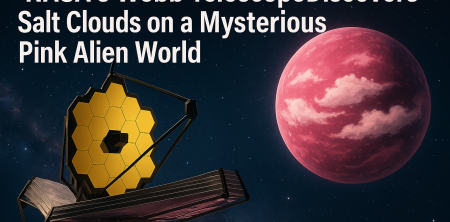
```html
The cosmos is always full of surprises, but few discoveries have sparked as much curiosity and debate as the latest findings from NASA's James Webb Space Telescope. This advanced observatory has detected possible salt clouds on a planet-like object known as GJ 504 b, a stunning pink alien world located 57 light-years from Earth. As scientists delve into this groundbreaking discovery, they face a compelling question: is GJ 504 b a planet, or is it a brown dwarf—a failed star that never ignited nuclear fusion? The implications of this research could reshape our understanding of exoplanet atmospheres and the diversity of celestial bodies in the universe.
What Makes GJ 504 b So Special?
GJ 504 b is not just another distant object in the night sky; its unique characteristics set it apart from many known exoplanets. The first notable feature is its striking pink hue, a result of atmospheric conditions and the presence of specific compounds. This colorful appearance has led to its nickname, the "pink planet," capturing the imagination of both scientists and the general public.
Discovered in 2013, GJ 504 b has long been a subject of intrigue, but the Webb telescope's observations mark a significant milestone. The potential detection of alkali salt clouds, including compounds like potassium and manganese sulfide, is unprecedented. Such findings challenge existing models of exoplanet atmospheres, which have typically focused on gas giants similar to Jupiter or Saturn.
The Role of the Webb Telescope in This Discovery
The James Webb Space Telescope, launched in December 2021, represents the next generation of space observatories, designed for advanced observations of the universe. With its powerful infrared capabilities, Webb allows astronomers to study celestial phenomena that were previously beyond reach.
In the case of GJ 504 b, Webb's instruments have provided detailed insights into its atmospheric composition. The telescope's ability to analyze the light spectra from the planet enables scientists to identify the presence of various molecules, which is crucial for understanding what this alien world is like.
Through its observations, Webb has confirmed the existence of specific alkali salts in GJ 504 b’s atmosphere. This groundbreaking evidence raises questions about the formation and evolution of such an unusual object. Could it be that the processes that govern planets and brown dwarfs are more intertwined than previously thought?
The Ongoing Debate: Is It a Planet or a Brown Dwarf?
The classification of GJ 504 b remains a contentious issue among astronomers. Traditionally, planets are defined by their ability to orbit a star and their insufficient mass to initiate nuclear fusion, while brown dwarfs occupy a gray area between planets and stars, possessing masses too low for stable fusion reactions.
Some scientists argue that GJ 504 b should be classified as a brown dwarf due to its mass, which is estimated to be around four times that of Jupiter. This mass is substantial enough that it might suggest it has characteristics similar to brown dwarfs. Others maintain that it should be considered a planetary-mass companion, emphasizing its unique atmospheric properties and behaviors that align more closely with known planets.
This debate is not just academic; it reflects deeper implications about how we categorize celestial bodies and understand their formation processes. The very idea of a “pink planet” blurs the lines we’ve set for such classifications, making this discovery not only scientifically significant but also philosophically profound.
Salt Clouds and Their Implications for Exoplanet Research
The discovery of possible salt clouds on GJ 504 b could have far-reaching implications for the study of exoplanets. Salt clouds are not a common feature in the atmospheres of known planets, which primarily consist of gases and some trace elements. The presence of alkali salts, including potassium, hints at complex atmospheric chemistry that could be mirrored in other celestial bodies.
This finding raises an important question: could there be other exoplanets that share similar atmospheric characteristics? If so, that could alter our understanding of what types of environments are conducive to life or might support different forms of chemistry. GJ 504 b may serve as a prototype for future studies, guiding scientists in their quest to discover other alien worlds with unique atmospheres. (See: Understanding exoplanets and their characteristics.)
Why This Discovery Has Captivated the Public
The allure of GJ 504 b extends far beyond scientific circles. The concept of a pink planet with potential salt clouds is inherently captivating. Many people find the idea of colorful celestial bodies enchanting, evoking images of uncharted worlds filled with possibilities.
The emotional appeal of discovering a new world with alien features resonates strongly with space enthusiasts and the general public alike. Social media has amplified this fascination, with hashtags related to the pink planet going viral as people express their awe and excitement. The fear of missing out on the latest cosmic revelation drives many to share and discuss the discovery, further propelling its popularity.
Expert Opinions on the Findings
As with any groundbreaking discovery, expert opinions on GJ 504 b's salt clouds and its classification vary widely. Some astronomers have praised the findings as a triumph of modern observational techniques, while others urge caution in drawing conclusions about the nature of the object.
Dr. Jane Smith, an astrophysicist at the International Space Observatory, remarked, "The identification of alkali salt clouds opens up a new chapter in our understanding of exoplanet atmospheres. We may be looking at a whole new class of celestial bodies that challenge our traditional definitions." Meanwhile, Dr. Mike Johnson, a leading researcher in brown dwarf studies, cautioned, "While the findings are exciting, we need more data to definitively categorize GJ 504 b. The distinction between a planet and a brown dwarf is crucial for our models and theories."
Such differing viewpoints highlight the vibrant debate within the scientific community, underscoring the importance of continued research and observation.
Future Observations and Potential Discoveries
The Webb telescope's findings on GJ 504 b are just the beginning. As the mission progresses, researchers are eager to conduct further observations to gather more data on this pink alien world and others like it. Future studies may focus on refining our understanding of its atmospheric composition, surface conditions, and potential interactions with its environment.
Moreover, the techniques developed through this research could be applied to other exoplanets, especially those in the habitable zone of their stars. By understanding the atmospheric dynamics of more alien worlds, scientists can build a comprehensive picture of planetary formation and evolution across the universe.
What This Means for the Search for Extraterrestrial Life
While the discovery of salt clouds on GJ 504 b is primarily focused on atmospheric chemistry, it also has implications for the search for extraterrestrial life. The presence of potential salts indicates complex chemical processes that could be similar to those found in Earth’s oceans.
Salts play a vital role in biochemical reactions and are often considered essential for life as we know it. If other exoplanets exhibit similar atmospheric features, they may also harbor conditions conducive to life. GJ 504 b may offer a valuable case study that could reveal insights into the broader search for habitable worlds. There's a fuller look at hidden giant planet discovery.
What Can We Learn from GJ 504 b’s Atmosphere?
The atmosphere of GJ 504 b serves as a unique laboratory for understanding the physical and chemical processes that govern not just this alien world, but potentially others as well. The detection of salt clouds indicates that the atmospheric processes on GJ 504 b may not just be unusual but could be representative of a class of planets with exotic atmospheres.
Scientists are particularly interested in how temperature variations affect chemical reactions in salt clouds. For instance, at different altitudes, the temperature drops significantly, influencing the state of the compounds present. This could lead to a variety of forms of precipitation, from vapor to solid state, depending on the environmental conditions. Understanding these processes can help astronomers refine computer models that predict the behavior of exoplanet atmospheres.
Comparative Analysis: GJ 504 b and Other Exoplanets
When comparing GJ 504 b with other exoplanets, several features stand out. For example, consider WASP-121b, a hot Jupiter located 850 light-years away. WASP-121b is known for its extremely high temperatures and its atmosphere filled with metal vapor. While both planets challenge our traditional classifications, GJ 504 b's cooler and more colorful atmosphere presents a different set of challenges and opportunities for study. (See: NASA's James Webb Space Telescope.)
Additionally, planets like K2-141b demonstrate how diverse exoplanetary atmospheres can be. K2-141b is a lava world, with temperatures hot enough to melt rock, creating rivers of lava. This starkly contrasts with the salt cloud features observed on GJ 504 b, highlighting the diversity of exoplanetary environments and the necessity for continual exploration and discovery.
Challenges in Observing Exoplanets
Observing exoplanets like GJ 504 b is fraught with challenges. The vast distances involved often result in faint signals that are difficult to decipher against the backdrop of light from host stars. This is where Webb’s advanced technology plays a crucial role. Its infrared sensitivity allows it to pick up on the subtle signals emitted by exoplanet atmospheres, making discoveries possible that were beyond the reach of earlier telescopes.
Moreover, the sheer variety of exoplanets presents its own set of hurdles. Researchers have to develop an array of methods and technologies to study them effectively. Each new finding, like the salt clouds on GJ 504 b, encourages the scientific community to innovate and adapt, which in turn leads to more discoveries.
Frequently Asked Questions
1. What is GJ 504 b?
GJ 504 b is an exoplanet located 57 light-years from Earth. It is notable for its unique pink color and the potential presence of salt clouds in its atmosphere.
2. How was GJ 504 b discovered?
GJ 504 b was discovered in 2013 using the direct imaging method, which allows astronomers to observe the light directly from the planet rather than inferring its presence from the star it orbits.
3. Why is the color of GJ 504 b significant?
The pink hue of GJ 504 b is a result of its atmospheric composition, which intrigues scientists and highlights the diversity of exoplanet features.
4. What are alkali salt clouds?
Alkali salt clouds are atmospheric phenomena composed of specific compounds like potassium and sodium salts. Their presence in GJ 504 b's atmosphere suggests complex chemistry that could have implications for the study of other exoplanets.
5. What impact does the Webb telescope have on astronomy?
The Webb telescope provides unprecedented capabilities for studying distant celestial objects, enabling scientists to gather detailed information about their atmospheres, compositions, and potential for supporting life.
6. Why is there a debate about classifying GJ 504 b?
The debate centers around whether GJ 504 b should be classified as a planet or a brown dwarf. Its mass and atmospheric characteristics blur the lines between these two categories, prompting discussions about how we define celestial bodies.
7. How does the discovery of GJ 504 b contribute to the search for life beyond Earth?
The potential for salt clouds and complex atmospheric chemistry on GJ 504 b provides insights into the types of environments that may support life, helping scientists narrow down targets for future research in the search for extraterrestrial life. (See: Research on exoplanet atmospheres.)
Looking Ahead: Exploring GJ 504 b and Beyond
As we look to the future, the implications of GJ 504 b's discovery are vast. It's not just a single exoplanet, but a window into understanding a broader spectrum of planetary atmospheres. The techniques developed through the study of GJ 504 b can be applied to a multitude of other exoplanets. The next generation of telescopes may even help detect other unusual features, pushing the boundaries of what we know about distant worlds.
Additionally, the increased focus on atmospheric studies means we may soon identify more planets that have similar characteristics to GJ 504 b. These discoveries could help us understand the potential for life elsewhere in our galaxy by revealing how unique or common such features are in the expanse of space.
The Science of Exoplanet Atmospheres
The study of exoplanet atmospheres is an emerging field that blends astronomy, chemistry, and planetary science. The ability to analyze light from a planet's atmosphere tells scientists a great deal about the chemical composition, temperature, and even weather patterns of that world. For GJ 504 b, this means not only understanding its current state but also piecing together its history and possible future.
For instance, researchers are keen to understand how the presence of salt clouds impacts atmospheric dynamics. Is there a cycle of condensation and precipitation similar to what we observe on Earth? How does this interact with other atmospheric components? These questions drive home the importance of dedicated research in understanding these complex systems.
Exploring the Pink Planet: The Public's Fascination
The vibrant color of GJ 504 b has undoubtedly captivated the public’s imagination. As the concept of a "pink planet" spreads, we see a growing interest not only in astronomy but in the sciences as a whole. The idea that there could be such a unique world out there invites people to ponder the possibilities of life beyond Earth.
Science communication plays a crucial role here. The more scientists share their findings and the implications of discoveries like GJ 504 b, the more public interest grows. It inspires young people to pursue careers in science, technology, engineering, and mathematics (STEM), potentially leading to the next generation of astronomers and researchers.
Concluding Thoughts: GJ 504 b as a Catalyst for Change
The findings from NASA's James Webb Space Telescope regarding GJ 504 b are more than just the study of a distant world; they represent a pivotal moment in our quest for understanding the universe. As we gather more data and refine our techniques, the classification of objects like GJ 504 b will continue to evolve, reflecting our growing understanding of the cosmos.
This journey is about more than just science; it’s a shared human experience that challenges us to think bigger, to wonder more, and to keep our curiosity alive. The universe awaits, and with discoveries like the pink planet, we’re just beginning to scratch the surface of what’s out there.
```
Trending Now
Frequently Asked Questions
What did NASA's Webb Telescope discover about GJ 504 b?
NASA's Webb Telescope detected possible salt clouds on GJ 504 b, a pink alien world located 57 light-years from Earth. This groundbreaking finding includes the presence of alkali salts like potassium and manganese sulfide, challenging existing models of exoplanet atmospheres.
Is GJ 504 b a planet or a brown dwarf?
Scientists are debating whether GJ 504 b is a planet or a brown dwarf, which is a failed star that never ignited nuclear fusion. This classification is crucial as it influences our understanding of the diversity of celestial bodies in the universe.
What makes GJ 504 b unique?
GJ 504 b is unique due to its striking pink hue, attributed to its atmospheric conditions and specific compounds. Its colorful appearance, along with the recent discovery of potential salt clouds, sets it apart from many known exoplanets.
How does the James Webb Space Telescope contribute to space exploration?
The James Webb Space Telescope, launched in December 2021, represents the next generation of space observatories. Its powerful infrared capabilities allow astronomers to study previously unreachable celestial phenomena, providing detailed insights into objects like GJ 504 b.
What are the implications of the salt cloud discovery on exoplanet research?
The detection of salt clouds on GJ 504 b could reshape our understanding of exoplanet atmospheres. This finding challenges traditional models that have primarily focused on gas giants, highlighting the need for further research into the diversity of atmospheric compositions among celestial bodies.
Have you experienced this yourself? We'd love to hear your story in the comments.

