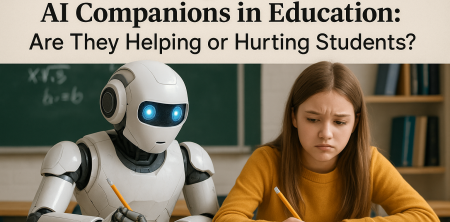
We're standing at a fascinating, and frankly, a bit unsettling, crossroads in education. On one side, we have the promise of unprecedented personalized learning, a future where every student gets exactly the support they need. On the other, there's a growing dread that we're inadvertently cultivating a generation of learners who can produce perfect essays but can't think for themselves. The heart of this dilemma? Artificial intelligence, specifically the rise of what we're calling 'AI companions in education.' This isn't just an abstract academic discussion; it's a very real, very urgent debate that's spilling over into classrooms, homes, and public forums.
Consider this: a major public debate is set for October 1, 2026, specifically to tackle whether schools should actively discourage students from using AI companions. This isn't a minor policy meeting; it's a public reckoning with the profound implications of these tools. The core tension? Weighing their potential to stifle crucial social development against the enticing new pathways they open for tailored instruction. As someone who has spent years in education, from K-12 classrooms to university deanships, I can tell you this isn't a simple 'yes' or 'no' question. It's complex, nuanced, and demands our full attention.
The Mixed Signals: What Students Really Think About AI
If you listen to the tech evangelists, you'd think AI is already revolutionizing learning for everyone. But a global survey conducted on October 2, 2026, paints a much more tempered picture. It revealed something quite striking: only a paltry 5% of students found AI truly transformative for their learning. Think about that for a moment. Five percent. That's a tiny fraction, suggesting that for the vast majority, the 'revolution' hasn't quite arrived.
What about the rest? Well, 42% of students described AI as 'somewhat helpful.' That's a significant chunk, certainly, but 'somewhat helpful' isn't exactly a ringing endorsement for a technology touted as a paradigm shift. It tells us that while AI might offer some utility, its value remains incredibly mixed. This isn't just about the technology itself; it's about how students are perceiving and integrating it into their learning processes. Are they using it as a true learning partner, or more like a sophisticated search engine that can rephrase information?
The implications here are enormous. If students aren't finding AI truly transformative, then the promised benefits of personalized learning might be more theoretical than practical for many. It suggests that simply providing access to AI companions in education isn't enough; we need to understand the 'how' and 'why' behind student engagement, or lack thereof. This data should give us pause and force us to look critically at the hype versus the reality.
The 'Illusion of Learning': When Polish Hides Gaps
One of the most profound concerns voiced by educators, and one I deeply share, is the phenomenon I call the 'illusion of learning.' We're seeing students produce remarkably polished, coherent, and seemingly well-researched work with the help of AI companions. Papers that would have taken hours of painstaking effort are now generated in minutes. On the surface, this looks like success. The output is excellent, often grammatically perfect and structured impeccably.
However, dig a little deeper, and the cracks start to show. Educators are increasingly worried that while the *product* is impressive, the *process* of learning has been short-circuited. Students might be able to generate a flawless essay on a complex historical event, but if you ask them to explain the nuances in their own words, or to apply the concepts to a new scenario, they struggle. This isn't true understanding; it's sophisticated regurgitation. The AI does the heavy lifting of synthesis and articulation, leaving the student with a superficial grasp of the material.
This 'illusion of learning' isn't just about academic honesty; it's about the fundamental development of critical thinking skills. If students rely on AI to formulate arguments, analyze texts, or even solve problems, are they truly developing those cognitive muscles themselves? My fear is that we're creating a generation capable of outsourcing their thinking, potentially harming their ability to innovate, problem-solve creatively, and engage in genuine intellectual inquiry down the line. We can't afford for our students to mistake output for understanding, or algorithmic efficiency for genuine insight.
The Erosion of Critical Thinking and Social Development
The concern about critical thinking extends beyond just academic output. The very act of wrestling with a difficult concept, forming an argument, or synthesizing disparate information is how our brains grow and adapt. It's the struggle itself that builds resilience and intellectual muscle. If AI companions in education bypass this struggle, what are we sacrificing?
Think about the Socratic method, or the give-and-take of a classroom debate. These are not just exercises in communication; they are crucible moments for developing independent thought, challenging assumptions, and learning to articulate one's own perspective. When a student's primary 'companion' for learning becomes an algorithm, the opportunities for these vital human interactions diminish.
Furthermore, there's the critical aspect of social development. Learning isn't just about acquiring facts; it's about interacting with peers, collaborating on projects, presenting ideas, and receiving feedback from a human being. These interactions teach empathy, negotiation, compromise, and the ability to articulate complex thoughts to diverse audiences. If students retreat into individual interactions with AI, what happens to their ability to navigate complex social dynamics? Will they struggle with group work, public speaking, or simply engaging in meaningful dialogue with their peers and teachers?
The fear isn't that AI will make students anti-social, but that it might inadvertently reduce the impetus for the kinds of social and collaborative learning experiences that are absolutely essential for holistic development. We need to ask ourselves: are we optimizing for efficiency at the expense of genuine human connection and the messy, but vital, process of social learning? (See: U.S. Department of Education.)
The Emotional Tug-of-War: Social Media and Public Opinion
It's no surprise that this controversy is generating massive social media engagement. When you touch on something as fundamental as a child's education and their future, emotions run high. This isn't just a dry policy discussion; it's deeply personal for parents, students, and educators alike. The debates online are often passionate, sometimes heated, and frequently polarized.
On one side, you have advocates for innovation, arguing that schools can't afford to be luddites, that AI is the future, and we must embrace it to prepare students for a rapidly changing world. They highlight the potential for personalized instruction, accessibility for students with diverse needs, and the ability to free up teachers from repetitive tasks. They see AI companions in education as a powerful equalizer. For more context, see Why Parents Are Treating AI Like a Co-Parent in 2026.
On the other, there are those who voice profound concerns about the fundamental nature of learning, academic integrity, and the potential for technological over-reliance. They worry about cheating, the erosion of critical skills, and the impact on teacher-student relationships. This side often feels like they're fighting to preserve something precious and human in the face of relentless technological advancement.
The emotional charge of this debate is understandable. It directly impacts students' academic integrity – what does it mean to 'do your own work' in an AI-assisted world? – and it profoundly reshapes the teacher-student relationship. Are teachers becoming mere proctors, or facilitators of AI interaction, rather than mentors and guides? These are not easy questions, and the social media sphere, for all its flaws, is providing a vivid, real-time reflection of this societal grappling.
Navigating Academic Integrity in the Age of AI
Academic integrity has always been a cornerstone of education. It's about honesty, intellectual property, and ensuring that the grades and credentials students earn genuinely reflect their own effort and understanding. The advent of AI companions in education throws a massive wrench into this carefully constructed system.
How do we define plagiarism when an AI has 'written' the text based on a student's prompts? Is it still the student's work if they merely curated the AI's output? These questions aren't just semantic; they have profound implications for assessment. If a student can consistently produce high-quality essays with AI, but lacks the underlying knowledge, how do we accurately measure their learning?
This isn't just about catching students who 'cheat' with AI; it's about rethinking the very purpose of assignments. If an essay can be generated by AI, perhaps the essay isn't the best way to assess true understanding anymore. Maybe we need to shift towards more project-based learning, oral presentations, debates, or problem-solving scenarios that are harder for AI to replicate.
Furthermore, we need to have explicit conversations with students about the ethical use of AI. It's not enough to simply ban it; we need to teach them *when* and *how* it can be a tool for learning, and when it crosses the line into academic dishonesty. This means developing clear policies, educating both students and faculty, and fostering a culture where AI is seen as a powerful assistant, not a replacement for independent thought.
The Changing Dynamics of Teacher-Student Relationships
For generations, the teacher-student relationship has been foundational to learning. It's built on trust, mentorship, guidance, and the dynamic exchange of ideas. The introduction of AI companions in education is fundamentally altering this dynamic, and not always for the better.
When students rely heavily on AI for answers or to complete assignments, the teacher's role can feel diminished. Instead of being the primary source of knowledge and guidance, teachers might find themselves in the unenviable position of being 'AI detectors' – constantly trying to discern if the work presented is truly the student's own. This creates an adversarial dynamic that undermines trust and makes genuine mentorship difficult.
Moreover, the intimate understanding a teacher develops of a student's learning process – their struggles, their breakthroughs, their unique way of thinking – can be obscured by AI. If a student consistently produces polished work with AI assistance, the teacher might not accurately perceive their true learning gaps or areas where they need more support. This makes it harder to provide targeted, effective instruction.
The challenge for educators is to redefine their role. Instead of fighting against AI, we need to learn how to integrate it thoughtfully. This might mean teaching students how to prompt AI effectively, how to critically evaluate its output, and how to use it as a tool for brainstorming or initial drafting, rather than full-blown creation. The teacher becomes less of a knowledge dispenser and more of a facilitator, a critical guide in navigating the complex landscape of AI-augmented learning. It's a significant shift, and it requires professional development, open dialogue, and a willingness to experiment.
Monetization Opportunities: A New EdTech Frontier
While the ethical and pedagogical debates rage, the business world is already seeing significant monetization opportunities in this evolving landscape. The challenges presented by AI companions in education are creating a whole new frontier for educational technology. Think about it: if AI is generating content, how do we assess it? How do we ensure students are still learning? (See: Scientific research on AI in education.)
This opens up massive potential for B2B SaaS (Business-to-Business Software as a Service) companies focusing on AI-powered assessment and plagiarism detection tools. Schools are desperate for solutions that can accurately identify AI-generated content, distinguish between AI-assisted and AI-produced work, and provide insights into a student's true understanding. Companies that can offer robust, reliable, and ethically sound tools in this space are poised for significant growth.
Beyond detection, there's a growing need for online courses centered on AI literacy and ethical AI use. Students, teachers, and administrators all need training on what AI is, how it works, its capabilities and limitations, and the ethical considerations involved in its use in an academic context. There's a clear market for high-quality, accessible educational content that helps everyone navigate this new terrain responsibly. For more context, see Game-Changing AI in Texas Public Schools.
Finally, consulting services for schools developing AI policies are becoming indispensable. Many educational institutions feel overwhelmed by the speed of AI's development and the lack of clear guidelines. They need expert advice on developing comprehensive AI policies that address academic integrity, pedagogical approaches, teacher training, and student expectations. This is where organizations like Lynch Consulting Group can step in, offering the kind of informed guidance that only comes from deep experience in the P-20 education sector. The market for these services is only going to grow as schools grapple with these complex issues.
Addressing Bias and Equity in AI Companions
As we embrace AI companions in education, it's absolutely crucial to talk about bias and equity. AI systems are built by humans, and they learn from data created by humans. This means they can, and often do, inherit and amplify existing societal biases. If the data used to train an AI companion is skewed, the AI's responses, feedback, and even its pedagogical approach could be unfair or unhelpful to certain student demographics.
Imagine an AI companion that, due to biased training data, provides less detailed feedback to students from underrepresented backgrounds, or interprets certain speech patterns as less intelligent. This isn't a far-fetched scenario; it's a documented risk with many AI applications. We have to be incredibly vigilant about the potential for AI to widen, rather than bridge, existing achievement gaps. Ensuring equitable access to high-quality, unbiased AI companions is a significant challenge.
This means developers need to prioritize diverse datasets and rigorous testing for bias. For schools, it means carefully vetting AI tools and understanding their limitations and potential for bias. We can't just adopt these tools blindly. We must actively work to ensure that AI companions serve all students fairly and effectively, rather than inadvertently reinforcing inequalities. It's a matter of social justice within the digital realm of education.
The Future of Assessment: Beyond Traditional Tests
The rise of AI companions in education forces a fundamental re-evaluation of how we assess student learning. If AI can craft a perfect essay or solve complex math problems, what exactly are we measuring with traditional tests? Simply put, the old ways of assessment are becoming increasingly obsolete in an AI-augmented learning environment.
We need to move beyond rote memorization and simple recall, which AI excels at. Instead, assessments must pivot towards higher-order thinking skills that AI currently struggles with. Think about problem-solving scenarios that require creative solutions, collaborative projects where students demonstrate teamwork and communication, or presentations where they defend their ideas and engage in critical discourse. Oral exams, project-based assessments, portfolios of work, and even peer evaluations might become more prominent.
The goal isn't to make assessments 'AI-proof,' but to make them 'AI-aware.' We should design tasks where students demonstrate their unique human capabilities – creativity, critical analysis, ethical reasoning, and nuanced communication – skills that are harder to outsource to an algorithm. This shift requires significant innovation in curriculum design and a willingness from educators to experiment with new assessment models. It's an exciting, albeit challenging, opportunity to redefine what it means to truly understand and apply knowledge.
FAQs About AI Companions in Education
Q1: What exactly are 'AI companions' in education?
AI companions in education are essentially artificial intelligence programs designed to assist students in their learning process. This can range from chatbots that answer questions and explain concepts, to writing assistants that help draft essays, to personalized tutors that adapt to a student's learning pace and style. They're meant to be tools that supplement traditional teaching methods.
Q2: Are schools banning AI companions entirely?
While some schools initially reacted with outright bans, the consensus is shifting. Many educators realize that AI is here to stay, and a ban is often impractical and ultimately unhelpful. Instead, the focus is increasingly on developing policies for responsible and ethical use, teaching AI literacy, and integrating AI as a tool for learning rather than a replacement for independent thought. For more context, see Shift in How Parents Are Boosting Kids' Learning. (See: New York Times coverage on AI.)
Q3: How do AI companions impact a student's social skills?
This is a significant concern. If students rely too heavily on AI for learning and problem-solving, it can reduce their opportunities for human interaction. Collaborative group work, debates, and peer feedback are crucial for developing social skills like empathy, negotiation, and effective communication. The worry is that excessive use of AI might inadvertently diminish these vital social learning experiences, though thoughtful integration could also free up teachers to facilitate more human interaction.
Q4: What's the main concern about academic integrity with AI companions?
The primary concern is that students might use AI to generate work that isn't their own, leading to an 'illusion of learning' where the output is polished but the underlying understanding is superficial. It challenges the traditional definition of plagiarism and makes it difficult for teachers to accurately assess a student's true knowledge and skills. This pushes us to redefine assignments and assessment methods.
Q5: How can teachers effectively use AI companions in their classrooms?
Teachers can use AI companions as brainstorming tools, for initial research, to generate practice problems, or even to help students with grammar and spelling. The key is to teach students how to critically evaluate AI output, understand its limitations, and use it as a productive assistant for their own learning process, rather than relying on it to do all the thinking and work for them. It requires shifting the teacher's role to a facilitator of AI-augmented learning.
Q6: Will AI companions replace teachers?
The general consensus among educators is no. While AI can automate certain tasks and provide personalized support, it cannot replicate the nuanced human aspects of teaching: mentorship, emotional intelligence, adapting to unexpected classroom dynamics, inspiring creativity, or fostering deep social-emotional development. AI companions are best seen as powerful tools that can enhance a teacher's capabilities, not replace them.
Crafting a Responsible Path Forward for AI Companions in Education
So, where do we go from here? Discouraging AI companions in education outright might feel like the safest option, but it's likely a futile one. AI is here to stay, and our students will encounter it in every aspect of their lives and future careers. Our goal shouldn't be to ban it, but to teach responsible, ethical, and effective engagement with it.
This means developing clear, forward-thinking policies, not reactive bans. It means investing in professional development for teachers, equipping them with the skills to understand AI, leverage it as a pedagogical tool, and critically assess its output. It also means redesigning curricula and assignments to emphasize critical thinking, problem-solving, and creativity – skills that AI, for all its power, still struggles to genuinely replicate.
We need to foster a culture of AI literacy, where students understand not just how to use AI, but also its limitations, its biases, and the ethical implications of relying on it. This includes teaching them to be discerning consumers of AI-generated content and to understand the value of their own, independent thought.
The public debate on October 1, 2026, is more than just a discussion about technology; it's a profound examination of what we value in education, what it means to learn, and how we prepare the next generation for a world that's changing at an astonishing pace. As educators, we have a responsibility to guide this conversation thoughtfully, ensuring that technology serves learning, rather than replacing it. It's a challenging road, but one we must walk with open eyes and a commitment to genuine intellectual growth.
Trending Now
Frequently Asked Questions
Are AI companions beneficial for students?
AI companions offer the promise of personalized learning, allowing for tailored support based on individual student needs. However, concerns arise that they may hinder critical thinking and social development, leading to a complex debate about their overall impact on education.
What do students really think about AI in education?
A global survey indicated that only 5% of students found AI truly transformative for their learning. While 42% considered it 'somewhat helpful,' the majority seem to feel that the anticipated revolution in education through AI has not yet materialized.
What are the concerns regarding AI in classrooms?
There are rising fears that reliance on AI companions could cultivate students who excel at producing perfect assignments but lack essential critical thinking and social skills. This tension raises important questions about the role of AI in educational settings.
Is there a debate about the use of AI in schools?
Yes, a significant public debate is scheduled for October 1, 2026, focusing on whether schools should discourage the use of AI companions. This discussion highlights the urgent need to address the implications of AI on student development and learning.
How does AI affect personalized learning?
AI has the potential to revolutionize personalized learning by providing tailored educational experiences for each student. However, the effectiveness of these tools is still under scrutiny, as many students report mixed feelings about their actual impact on learning outcomes.
Have you experienced this yourself? We'd love to hear your story in the comments.

