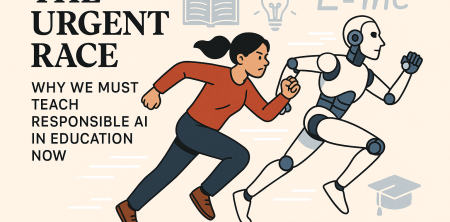
You've probably noticed it: artificial intelligence isn't just a futuristic concept anymore. It's here, it's now, and it's rapidly weaving itself into the fabric of our professional lives, especially in fields like software development. But with great power, as they say, comes great responsibility. And right now, we're at a pivotal moment, scrambling to figure out how to ensure this incredible power is used wisely, ethically, and, most importantly, securely. This isn't just about preventing a rogue AI from taking over the world; it's about the very practical, everyday dangers of insecure code, data breaches, and the unintended biases that can creep into our systems if we're not careful. That's why the push for responsible AI in education has become nothing short of an urgent race.
Think about it: every piece of software, every app, every digital service you use today likely has some AI component, or it soon will. Developers are increasingly relying on AI tools to write code, debug programs, and automate complex tasks. This is a massive leap forward in productivity, but it also introduces new vulnerabilities. If the AI itself generates insecure code, or if developers become overly reliant on these tools without understanding the underlying principles, we're setting ourselves up for some serious trouble. Cybersecurity threats are escalating at an alarming rate, and the rapid adoption of AI in every industry means we absolutely need a workforce that can navigate these AI-driven security challenges with confidence and competence. It's not just about teaching students how to code; it's about teaching them how to code responsibly with AI.
The Rising Tide of AI in Software Development
Let's be real: AI isn't just a fancy add-on anymore; it's becoming a foundational element in software development. From auto-completion tools that predict your next line of code to sophisticated systems that can generate entire functions or even debug complex applications, AI is transforming how developers work. Tools like GitHub Copilot, for instance, act as AI pair programmers, offering suggestions in real-time. This can dramatically speed up development cycles, allowing teams to deliver products faster and innovate more rapidly. For a busy developer trying to meet tight deadlines, these tools feel like a godsend, a way to offload tedious tasks and focus on higher-level architectural decisions.
But this integration isn't without its risks, and that's where the concept of responsible AI in education really takes center stage. While AI can be a powerful ally, it can also be a Trojan horse if not handled properly. Imagine an AI generating code snippets that contain subtle security flaws – perhaps an unvalidated input field or a weak encryption algorithm. If a human developer, perhaps in a hurry or lacking deep security knowledge, simply accepts these suggestions without thorough review, they've just introduced a vulnerability into their system. This isn't a theoretical concern; it's a very real possibility that we're already seeing manifest in various forms. The speed of development, while beneficial, can sometimes overshadow the meticulous attention to detail required for robust security.
George Mason University's Vision for AI Security Education
Thankfully, some institutions are taking these challenges seriously. George Mason University, for example, is at the forefront of this effort, spearheading initiatives to integrate secure AI practices into computing education. A fascinating article from September 24, 2026, details two National Science Foundation-funded projects that are specifically designed to address this growing need. These aren't just academic exercises; they're concrete steps towards building a more secure digital future. The university recognizes that simply teaching students how to use AI tools isn't enough; we need to teach them how to use these tools responsibly, with a keen eye on security and ethics.
This proactive approach is crucial because the current educational landscape often lags behind technological advancements. By the time a new technology is fully integrated into curricula, the industry has often moved on. GMU's efforts aim to bridge this gap, ensuring that students graduating today are equipped with the skills needed for the challenges of tomorrow. They're not just thinking about current threats but anticipating future vulnerabilities, understanding that the adversarial landscape will continue to evolve alongside AI itself. It's about instilling a mindset of continuous learning and critical evaluation when interacting with AI, rather than passive acceptance.
Project ERICA: Building Secure Coding Habits
One of the standout initiatives highlighted by GMU is Project ERICA. This project is a fantastic example of what responsible AI in education looks like in practice. ERICA isn't just about teaching students to identify bad code; it's about developing AI-powered assistants that can actively guide students toward secure coding practices. Think of it as a smart mentor that doesn't just correct mistakes but helps prevent them in the first place, fostering a deeper understanding of security principles.
The core idea behind ERICA is to prevent AI from generating harmful or insecure code. This means not only training AI models on secure codebases but also developing mechanisms within the AI itself to flag potential vulnerabilities. But it goes beyond just the AI; a crucial part of ERICA's mission is to ensure that students acquire foundational coding skills. We don't want a generation of developers who simply copy-paste AI-generated code without understanding its mechanics or potential pitfalls. The goal is to cultivate critical thinking, enabling students to evaluate AI suggestions, understand the 'why' behind secure practices, and ultimately, become masters of their craft, not just operators of AI tools. This balance between leveraging AI for efficiency and maintaining human oversight is absolutely paramount.
The Peril of Over-Reliance: Why Foundational Skills Still Matter
It's easy to get swept up in the excitement of AI and imagine a future where machines do all the heavy lifting. But here's the kicker: becoming overly dependent on AI tools, particularly in the foundational stages of learning, can be detrimental. If a student relies entirely on an AI to write their code, they might never truly grasp the underlying algorithms, data structures, or the nuances of secure design. This isn't just about a lack of theoretical knowledge; it impacts their ability to debug complex problems, innovate, or even identify errors in AI-generated code. Without those foundational skills, they're essentially flying blind. (See: AI and workplace safety guidelines.)
This is a significant concern that initiatives promoting responsible AI in education must address head-on. The goal isn't to replace human developers but to augment their capabilities. We need to ensure that AI tools serve as powerful assistants, not crutches. This means designing curricula that emphasize core programming concepts, software engineering principles, and, critically, cybersecurity fundamentals, even as students learn to integrate AI into their workflow. It's about empowering them to critically evaluate AI suggestions, understand potential biases or vulnerabilities, and make informed decisions, rather than blindly trusting the machine. A developer who truly understands the code can fix an AI's mistake; one who doesn't is at the mercy of the AI.
The Urgency of Cybersecurity Threats and AI's Role
Let's not mince words: cybersecurity threats are not just increasing; they're evolving at a terrifying pace. Nation-state actors, organized crime syndicates, and individual hackers are constantly finding new ways to exploit vulnerabilities. And guess what? AI is now a tool in their arsenal too. Malicious actors are already using AI to craft more sophisticated phishing attacks, identify system weaknesses, and even automate the exploitation of zero-day vulnerabilities. This makes the need for responsible AI in education even more pressing. For more context, see 8 Essential Steps to Ethically Implement AI Tools in Education.
On the flip side, AI also offers powerful defensive capabilities. AI-powered intrusion detection systems can spot anomalous behavior much faster than human analysts, and AI can help automate threat intelligence and vulnerability management. The challenge, then, is to train a workforce that understands both the offensive and defensive applications of AI in cybersecurity. We need developers who can build secure systems that resist AI-powered attacks and security professionals who can leverage AI to protect those systems. This isn't a game for the faint of heart; it requires a deep, nuanced understanding of how AI interacts with security at every layer of the stack.
Ethical Considerations: Beyond Just Secure Code
Beyond the technical aspects of secure code, responsible AI in education also encompasses a vast landscape of ethical considerations. AI systems are not neutral; they reflect the data they are trained on and the biases inherent in that data or in the humans who design them. This can lead to unintended consequences, from discriminatory algorithms in hiring or lending to unfair outcomes in predictive policing. Teaching students about these ethical dimensions is just as important as teaching them about secure coding.
We need to instill in the next generation of developers a strong sense of ethical responsibility. This means understanding concepts like fairness, transparency, accountability, and privacy in the context of AI. How do you design an AI system that minimizes bias? How do you ensure its decisions can be explained and justified? What are the implications for user privacy when an AI processes vast amounts of personal data? These aren't easy questions, but they are critical ones that every professional working with AI will face. Ignoring them isn't an option; it's a recipe for societal harm and a breakdown of trust in technology.
Developing Frameworks for Future-Proof Education
The work being done at institutions like George Mason University isn't just about individual projects; it's about developing comprehensive frameworks that can be adopted more broadly. These frameworks aim to standardize the teaching of secure AI use and responsible AI integration across computing education. This is absolutely essential because we can't have a patchwork approach; we need a consistent, high-quality standard for AI education across the board.
Such frameworks often include guidelines for curriculum development, recommendations for pedagogical approaches, and even tools for assessing student competency in secure AI practices. They might also suggest ways to incorporate real-world case studies of AI failures or successes, allowing students to learn from practical examples. The goal is to create a robust, adaptable educational infrastructure that can evolve as AI technology progresses, ensuring that the skills taught remain relevant and impactful for years to come. This proactive, structured approach is the only way to genuinely prepare a generation of professionals for an AI-driven world.
Monetization Opportunities: A Growing Market for AI Security Skills
From a practical standpoint, the urgency around responsible AI in education also translates into significant monetization opportunities. The demand for professionals skilled in AI security is skyrocketing, creating a robust market for specialized training and certification. Think about it: companies are desperate for employees who can navigate the complexities of AI development while simultaneously ensuring robust security measures. This isn't just a nice-to-have; it's a business imperative.
This translates into several lucrative niches. Specialized AI security certifications, for example, are becoming highly sought after, offering individuals a verifiable credential that can boost their career prospects. Cybersecurity bootcamps that focus specifically on AI-driven threats and defenses are also experiencing massive growth. And on the business-to-business side, there's a huge market for SaaS solutions that provide corporate AI security training, helping companies upskill their existing workforce. For educators, consultants, and entrepreneurs in the cybersecurity and online education spaces, this is a golden era. The need for expertise in responsible AI is creating entirely new avenues for growth and innovation.
The Path Forward: Integrating Responsible AI into Every Curriculum
Ultimately, the path forward is clear: responsible AI in education cannot be an afterthought or an optional elective. It needs to be integrated deeply into every computing curriculum, from introductory programming courses to advanced software engineering programs. This isn't just about adding a new topic; it's about shifting the paradigm of how we teach and learn about technology. (See: the ethics of AI in education.)
This integration needs to be multi-faceted. It means teaching students not just how to use AI tools, but how they work, their limitations, and their potential for harm if misused. It means emphasizing cybersecurity from day one, showing how AI can both create and mitigate vulnerabilities. It means fostering ethical reasoning and critical thinking, encouraging students to question assumptions and consider the broader societal impact of their creations. We need to move beyond simply churning out coders and instead cultivate a generation of thoughtful, ethical, and security-conscious innovators. The future of our digital world depends on it, and it's a responsibility we can't afford to take lightly.
Real-World Examples of Responsible AI in Action
It's one thing to talk about responsible AI in theory, but seeing it in practice really brings the concept home. Take, for instance, the healthcare sector. AI is being used to analyze medical images, predict disease outbreaks, and even assist in drug discovery. But imagine if an AI designed to diagnose cancer was trained on a biased dataset, leading it to misdiagnose certain demographics. That's a catastrophic ethical and security failure. Responsible AI in education means students learn how to scrutinize training data for biases, implement robust data privacy protocols, and ensure algorithmic transparency so doctors can understand why an AI made a particular recommendation. For more context, see 8 AI Tools Quietly Revolutionizing Student Learning.
Another area is autonomous vehicles. AI powers these cars, making split-second decisions that affect human lives. A security vulnerability in an autonomous system could have deadly consequences. Education here needs to cover not just secure coding for AI, but also redundancy in systems, fail-safes, and the ethical frameworks for decision-making in unforeseen circumstances. Students need to understand that the code they write today could be navigating real-world complexities tomorrow, and that places a tremendous burden of responsibility on them. It’s about more than just bugs; it's about life-or-death situations.
Even in simpler applications, like personalized learning platforms in education itself, responsible AI is vital. If an AI tutor adapts content based on student performance, but its algorithms are opaque or subtly reinforce existing inequalities, it could inadvertently widen achievement gaps. Students need to be taught how to design AI systems that are fair, provide understandable feedback, and respect user privacy, especially when dealing with minors' data. These examples illustrate that responsible AI isn't just an abstract concept; it's a practical necessity in almost every field.
The Role of Government and Industry Standards
While universities like George Mason are leading the charge, the broader ecosystem of government and industry standards also plays a critical role in shaping responsible AI in education. Regulatory bodies worldwide are beginning to draft guidelines and laws concerning AI ethics, security, and accountability. For instance, the European Union's AI Act aims to classify AI systems by risk level and impose stringent requirements on high-risk applications. Understanding these emerging legal frameworks is becoming an indispensable part of AI education.
Industry consortia are also stepping up, developing best practices and certification programs. Organizations like the AI Ethics Consortium or the Responsible AI Institute are creating guidelines for everything from data governance to bias detection. These standards often become de facto requirements for businesses, meaning future developers need to be familiar with them. Integrating this regulatory and compliance knowledge into curricula ensures that graduates are not only technically proficient but also legally and ethically prepared to build and deploy AI systems that meet societal expectations. It's about giving them a holistic view of the AI landscape, not just the code.
Measuring Success: Metrics for Responsible AI Education
How do we know if our efforts in responsible AI in education are actually working? We can't just hope for the best; we need concrete metrics to measure success. This isn't always straightforward, as ethical understanding and critical thinking are harder to quantify than coding proficiency. However, we can look at several indicators.
For one, assessment methods need to evolve. Beyond traditional coding assignments, students could be evaluated on their ability to identify and mitigate biases in AI models, design systems with privacy-by-design principles, or conduct ethical impact assessments for AI projects. Capstone projects could require a dedicated section on the ethical and security implications of their AI solutions. Another metric could be the demand for graduates with specific AI security certifications or roles in responsible AI teams within companies. If the industry is actively hiring for these skills, it suggests our educational pipeline is meeting a real need.
We might also track the incidence of AI-related security breaches or ethical failures linked to poor design choices by recent graduates. While harder to directly attribute, a decline in such incidents over time could be an indirect indicator of improved educational outcomes. Ultimately, success means producing a generation of AI professionals who instinctively prioritize security, ethics, and societal well-being in every AI system they create. For more context, see 8 Huge Misconceptions About AI in Education You Need to Stop Believing. (See: research on AI vulnerabilities.)
Frequently Asked Questions About Responsible AI in Education
What exactly does "responsible AI" mean in an educational context?
In education, "responsible AI" means teaching students not just how to build and use AI, but how to do so ethically, securely, and with an understanding of its societal impact. It covers topics like algorithmic bias, data privacy, transparency, accountability, and the prevention of AI-generated security vulnerabilities. It's about cultivating critical thinking and a sense of moral obligation in future AI professionals.
Why is responsible AI in education so urgent now?
The urgency comes from the rapid integration of AI into almost every aspect of life and industry. Without proper education, there's a high risk of developing insecure AI systems, perpetuating biases, or creating technologies with unintended negative consequences. Cybersecurity threats are also escalating, with AI being used by both attackers and defenders, making it crucial for the workforce to understand these dynamics.
How can educators integrate responsible AI into existing curricula?
Integration can happen in several ways. It can involve adding modules on AI ethics and security to existing computer science courses, using case studies of real-world AI failures, or redesigning projects to require ethical impact assessments. It also means emphasizing foundational coding skills and critical evaluation so students don't blindly trust AI tools. The goal is to weave responsible AI principles throughout the entire learning journey, not just treat it as a separate topic.
What are the biggest challenges in teaching responsible AI?
One challenge is keeping up with the fast pace of AI development. Another is the subjective nature of ethics, which can vary across cultures and contexts. It's also difficult to assess "ethical understanding" quantitatively. Over-reliance on AI tools by students without grasping core concepts is also a hurdle. Finally, securing resources and training for educators to teach these complex, interdisciplinary topics can be tough.
What career opportunities are there for students trained in responsible AI?
The demand for these skills is exploding. Graduates can pursue roles as AI ethics officers, AI security engineers, responsible AI consultants, data privacy specialists, or even policy advisors for governments and organizations. Companies are actively seeking professionals who can ensure their AI systems are not only effective but also fair, secure, and compliant with regulations. It's a high-growth area with significant impact potential.
Will AI replace human teachers in teaching responsible AI?
While AI tools can assist in teaching (e.g., providing feedback on code security, offering examples of ethical dilemmas), the nuanced and critical thinking required for responsible AI education still heavily relies on human teachers. Human educators are essential for facilitating discussions, understanding student perspectives, and guiding the development of ethical judgment, which AI currently struggles to do effectively.
Trending Now
Frequently Asked Questions
Why is teaching responsible AI important in education?
Teaching responsible AI in education is crucial because AI is increasingly integrated into various industries, including software development. Without proper guidance, students may inadvertently create insecure code or perpetuate biases within AI systems. Educating future developers on ethical AI practices ensures they can navigate the associated risks and contribute to safer, more reliable technology.
What are the risks of using AI in software development?
The risks of using AI in software development include the generation of insecure code, reliance on automated tools without understanding foundational principles, and potential biases in AI outputs. These issues can lead to significant cybersecurity vulnerabilities, data breaches, and ethical dilemmas, underscoring the need for responsible AI education.
How does AI impact software development today?
AI impacts software development by enhancing productivity through tools that assist with code writing, debugging, and automating complex tasks. However, this reliance on AI also introduces challenges, such as the need for developers to understand AI-generated code's implications and to maintain security and ethical standards in their work.
What role does AI play in cybersecurity threats?
AI plays a dual role in cybersecurity threats; while it can enhance security measures, it can also create new vulnerabilities if developers do not understand how to implement AI responsibly. As AI technologies evolve, so do the tactics of cybercriminals, necessitating a workforce trained to address these sophisticated challenges effectively.
How can we ensure AI is used ethically in technology?
To ensure AI is used ethically in technology, we must integrate responsible AI education into curricula, focusing on ethical considerations, security practices, and bias mitigation. This empowers future developers to create AI systems that prioritize safety, inclusivity, and fairness, ultimately benefiting society as a whole.
Agree or disagree? Drop a comment and tell us what you think.

