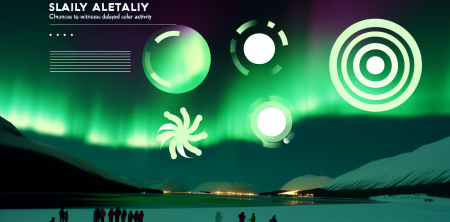
The celestial dance of the aurora borealis, commonly known as the northern lights, may be visible tonight, April 1-2, 2026, despite a slight delay in solar activity that has stirred excitement among sky watchers. This display is fueled by ongoing geomagnetic storms resulting from a coronal mass ejection (CME) and solar wind emanating from an Earth-facing coronal hole, creating a window of opportunity for those in northern regions to witness this stunning natural phenomenon.
Understanding the Solar Activity
The aurora borealis is primarily caused by interactions between solar particles and Earth's magnetic field. In this case, a recent CME—a significant eruption of solar plasma—has been responsible for heightened geomagnetic activity. Although the CME's arrival was delayed, the potential for aurora visibility remains intact, thanks to the continued influence of solar wind and the glancing blow from the CME.
A Look at Current Conditions
According to the U.K. Met Office and the National Oceanic and Atmospheric Administration (NOAA), conditions are currently classified as minor (G1) to moderate (G2). These classifications represent the intensity of geomagnetic storms, with G2 indicating a stronger storm capable of producing more vibrant auroras. As the night progresses, conditions are expected to ease gradually, likely returning to G1 levels as the CME's influence diminishes.
What to Expect Tonight
As the night unfolds, avid sky watchers and aurora enthusiasts may find themselves graced with the sight of shimmering greens, purples, and reds dancing across the night sky. The best chances for visibility will be in areas closer to the magnetic poles, including parts of Canada, Alaska, and northern Europe. However, the aurora may extend further south depending on the strength of the geomagnetic storm.
- Optimal Viewing Locations: Northern parts of the United States (Montana, North Dakota), Canada (Yukon, Northwest Territories), and northern Europe (Scandinavia) are prime locations for witnessing the aurora borealis.
- Best Viewing Conditions: Clear, dark skies away from city lights will improve chances of spotting the northern lights.
- Timing: The best time to view the aurora is typically between 10 PM and 2 AM local time, although this can vary.
Why the Delay?
Solar activity is inherently unpredictable, and delays in CME arrival can be a common occurrence. Factors influencing the timing include the speed of solar wind and the complexities of the solar eruption itself. The recent solar activity leading up to April 1 was characterized by a build-up of energy, which ultimately resulted in heightened expectations for aurora displays. However, the delayed impact of the CME has kept enthusiasts on their toes, underscoring the dynamic nature of solar phenomena.
Preparing for the Aurora
For those hoping to catch a glimpse of the northern lights, preparation is key. Here are some tips to enhance the viewing experience:
- Dress Warmly: Temperatures in northern regions can drop significantly at night, so wear layered clothing to stay comfortable while waiting for the auroras to appear.
- Use Appropriate Equipment: A camera with manual settings can capture the vibrant colors of the aurora. A sturdy tripod is essential for long-exposure shots.
- Check Local Forecasts: Keep an eye on local weather forecasts and aurora prediction tools to ensure optimal viewing conditions.
The Science Behind the Spectacle
The aurora borealis is not just a visual delight; it is also a fascinating intersection of solar physics and Earth’s magnetosphere. When charged particles from the sun collide with gases in Earth’s atmosphere, they excite these gases, leading to the beautiful light displays we see. The colors of the aurora depend on the type of gas involved and the altitude at which the collisions occur.
- Green: The most common color, produced by oxygen at lower altitudes (up to 150 km).
- Red: Less common, produced by high-altitude oxygen (above 150 km).
- Purple and Blue: Produced by nitrogen at varying altitudes.
Conclusion
While the expected solar storm has experienced a delay, the aurora borealis may still offer a spectacular display tonight. Those in northern latitudes should prepare for an evening of potential wonder as the geomagnetic activity continues to unfold. With the right conditions and a little bit of luck, sky watchers may find themselves captivated by the ethereal beauty of the northern lights, a reminder of the incredible forces at play within our solar system.

