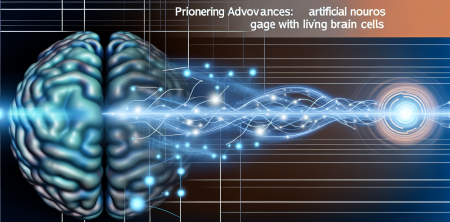
The intersection of technology and biology has long fascinated researchers, but recent developments at Northwestern University mark a significant leap forward in this realm. Engineers have successfully created printed artificial neurons capable of directly communicating with living brain cells, a breakthrough that promises to enhance brain-machine interfaces and neuroprosthetics.
The Breakthrough in Neural Communication
At the heart of this groundbreaking research is a team led by Hersam, whose work focuses on developing flexible and low-cost devices that can produce electrical signals mimicking those of real neurons. This innovation was recently detailed in a study set for publication on April 15 in Nature Nanotechnology.
Understanding the Technology
The artificial neurons developed by the team are designed to replicate the communication patterns of biological neurons. This is crucial because effective communication between artificial and natural systems requires synchronization in terms of timing and signal shape. The research demonstrated that these artificial neurons could successfully trigger responses in actual neurons within mouse brain slices, showcasing an unprecedented level of compatibility between electronic devices and biological systems.
Implications for Neuroprosthetics
The implications of this technology extend far beyond theoretical research. By achieving effective communication between artificial and biological neurons, the team opens new avenues for developing neuroprosthetics that can restore lost functions such as hearing, vision, or movement.
Restoring Vision
One of the most promising applications lies in the field of vision restoration. For individuals suffering from retinal degeneration or similar conditions, artificial neurons could potentially be integrated into existing visual pathways, allowing them to perceive light and images once again. The ability to recreate the neural signals that the brain expects can aid in the seamless integration of these devices.
Enhancing Hearing
Similarly, the technology holds potential for hearing restoration. Cochlear implants have already begun to bridge the gap between damaged auditory systems and sound perception. With the addition of artificial neurons that can communicate effectively with auditory neurons, these devices could become even more efficient, providing a richer auditory experience for users.
Facilitating Movement
In the realm of motor function, the artificial neurons could be utilized to create advanced neuroprosthetics that enable paralyzed individuals to regain control over their limbs. By interfacing with the remaining functional neurons in the spinal cord or brain, these devices could translate thoughts into action, facilitating movement in a manner akin to natural processes.
The Research Process
The research team employed a sophisticated approach to develop these artificial neurons. They utilized an advanced printing technique that allowed for the precise fabrication of neural structures. This method not only ensured the fidelity of the neuron shape but also facilitated integration with biological tissues.
Testing with Mouse Brain Slices
In experiments using mouse brain slices, the researchers monitored the interactions between the printed artificial neurons and the biological neurons. They found that the artificial neurons could effectively trigger action potentials in the living neurons, a clear indicator of successful communication. This was achieved by optimizing the timing and shape of the electrical spikes generated by the artificial neurons.
Future Directions
The success of this research paves the way for future studies aimed at refining the technology and expanding its applications. As researchers continue to explore the potential of artificial neurons, several key areas of focus will emerge.
Integration with Advanced Materials
Future iterations of artificial neuron technology may involve the use of advanced materials that enhance their conductivity and biocompatibility. By incorporating materials that better mimic the properties of biological tissues, researchers can improve the integration of artificial neurons within living systems.
Expanding Communication Capabilities
Another area of exploration will be the development of artificial neurons that can communicate with multiple types of neurons simultaneously. This could lead to more complex interactions and enable more sophisticated applications in neuroprosthetics.
Long-term Stability and Functionality
Ensuring the long-term stability and functionality of artificial neurons within living tissues is also a critical area for future research. Understanding how these devices can endure the biological environment over time will be essential for their practical use in clinical settings.
Conclusion
The research conducted at Northwestern University represents a remarkable advancement in the field of artificial intelligence and neurotechnology. The ability of artificial neurons to effectively communicate with living brain cells heralds a new era in brain-machine interfaces and neuroprosthetics.
As researchers continue to innovate and refine these technologies, the potential to restore lost functions becomes increasingly tangible. The dream of seamlessly integrating artificial devices with biological systems is no longer a distant possibility; it is rapidly becoming a reality.
With ongoing research and future developments, the possibilities for enhancing human capabilities through artificial neurons are boundless. As we stand on the brink of this new frontier, the collaboration between technology and biology promises to revolutionize how we understand and interact with the brain.

