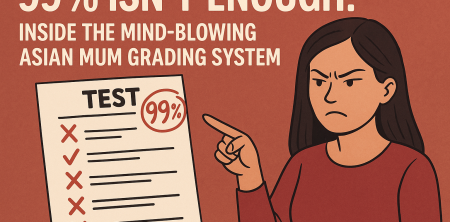
You've probably seen it floating around your social media feeds: a meme, a TikTok, a quick satirical sketch that nails a very specific, often hilarious, but sometimes unsettling, cultural phenomenon. We're talking about the viral sensation known as the "Asian mum grading system." It's a comedic take that suggests an 'A' isn't just a good grade, it's the bare minimum, the baseline, the academic equivalent of breathing. Get a 99%? Well, you better have a compelling explanation for that missing point. A 95%? Prepare for a full-scale parental interrogation. Anything less? Let's just say the consequences, in the meme world, range from losing internet privileges to facing the dreaded 'tsinelas' (slipper) or a grounded existence that feels like a prison sentence.
This trend, while clearly exaggerated for comedic effect, has struck a chord with millions. For many, it’s a moment of recognition, a shared chuckle over a cultural touchpoint that feels intimately familiar. For others, it sparks a more serious discussion about the intense academic pressure placed on children in certain Asian households and the broader implications for their well-being and development. Is it just harmless fun, a way to poke gentle fun at deeply ingrained expectations? Or does it inadvertently highlight a potentially problematic aspect of parenting culture that deserves closer scrutiny? Let's peel back the layers of this viral joke and explore the complex reality it reflects, and what it truly means for families navigating the high-stakes world of education.
The Anatomy of a Viral Phenomenon: Why the Asian Mum Grading System Resonates
The reason the "Asian mum grading system" has gone viral isn't just because it's funny; it's because it taps into a universally recognized truth for many, regardless of their cultural background. While the humor often focuses on Asian mothers, the underlying theme of parental expectations around academic achievement is something families worldwide grapple with. The specific cultural nuances, however, are what give the meme its sharp, relatable edge for those within the Asian diaspora.
Think about it: how many times have you heard a story, or perhaps even lived one, where a child brings home an excellent report card, only to be met with a question like, "Why not 100%?" or "What about your friend, did they do better?" The humor stems from this almost absurd level of expectation, where perfection isn't just hoped for, it's demanded, and anything less requires a thorough accounting. This isn't necessarily about a lack of love or appreciation; often, it comes from a place of deep parental sacrifice and a genuine desire for their children to have the best possible opportunities in life. Education is seen as the ultimate equalizer, the golden ticket to upward mobility, and parents, having perhaps overcome significant challenges themselves, want to ensure their children don't squander any advantage.
The shareability of these jokes lies in their ability to evoke both laughter and a knowing nod. It’s a shared cultural experience, a shorthand for a particular style of parenting that prioritizes academic excellence above almost all else. For those who grew up in such environments, it’s a way to process, with humor, experiences that might have felt overwhelming at the time. For outsiders, it offers a glimpse into a cultural dynamic that can seem simultaneously bewildering and admirable.
Beyond the Laughs: Understanding the Cultural Roots of Academic Pressure
To truly understand the "Asian mum grading system" and its widespread recognition, we need to delve a little deeper into the cultural bedrock that underpins these high academic expectations. It’s not simply a random phenomenon; it's rooted in centuries of tradition, historical context, and societal values that place immense importance on education and scholarly achievement.
In many Asian cultures, particularly those influenced by Confucianism, education has historically been revered as the primary path to social advancement, respect, and economic stability. The imperial examination system in ancient China, for instance, which lasted for over a thousand years, was a rigorous meritocratic system where success could elevate an entire family's status. This historical legacy has instilled a deep-seated belief that intellectual prowess and academic success are not just personal achievements but also bring honor to the family unit.
Furthermore, for many immigrant families, education often represents the realization of their hopes and dreams. Parents who may have faced hardships, discrimination, or limited opportunities in their home countries often see their children's academic success as the ultimate justification for their sacrifices. There's an unspoken, and sometimes explicit, understanding that the children carry the weight of their family's aspirations. This can manifest as intense pressure, where anything less than top grades is perceived not just as a personal failing, but as a failure to honor the family's sacrifices and fulfill their collective potential. This cultural narrative, while powerful and often inspiring, can also create an environment where the pressure to achieve becomes almost unbearable. (See: parenting styles and academic outcomes.)
The 'A' as Average: A Closer Look at the Baseline Expectation
One of the most defining characteristics of the "Asian mum grading system" satire is the notion that an 'A' grade is merely average. This isn't just a throwaway line; it encapsulates a fundamental difference in how academic success is often perceived and evaluated. In many Western educational contexts, an 'A' is considered excellent, a mark of high achievement. But within the framework of this particular cultural expectation, it's simply the starting point.
This perspective isn't about diminishing the effort required to earn an 'A'. Rather, it reflects a belief that competence and diligence should naturally lead to top marks. The focus isn't on celebrating the 'A' as an endpoint, but rather on what more could have been done to achieve perfection, or to excel even further. If an 'A' is achieved, the next question might be about how to maintain it, or how to surpass it in more challenging subjects. This relentless pursuit of improvement, while admirable in its intent, can inadvertently send a message that one's best is never quite good enough.
The implications of this baseline expectation are significant. Children grow up internalizing the idea that anything less than perfection, or near-perfection, is a sign of underperformance. This can lead to a constant state of anxiety, a fear of failure, and a reluctance to take risks or explore subjects where they might not immediately excel. The joy of learning can be overshadowed by the pressure to perform, transforming education from an exciting journey of discovery into a high-stakes competition where every point counts.
The 99% Conundrum: When Perfection Isn't Perfect Enough
Perhaps the most iconic and frequently cited example within the "Asian mum grading system" lore is the 99% scenario. It's the moment when a child proudly presents a near-perfect score, only to be met not with praise, but with a question: "What happened to that one missing point?" This isn't just a joke; it speaks to a deep-seated parental mindset that often values flawlessness above all else, even when the difference is infinitesimally small.
Think about the psychological impact of this. A child works incredibly hard, dedicates countless hours, and achieves a score that, by any objective measure, is outstanding. Yet, the focus immediately shifts to the single point that was lost. This isn't necessarily about being ungrateful or unappreciative of the effort; often, it stems from a belief that every single point represents a missed opportunity, a detail overlooked, or a moment of insufficient effort. It's a manifestation of the idea that there's always room for improvement, always a higher bar to reach.
However, while the intent might be to push children to their absolute best, the unintended consequence can be devastating. It can foster an unhealthy relationship with achievement, where external validation becomes tied to an unrealistic standard of perfection. Children might learn that their efforts are only truly valued when they are flawless, leading to feelings of inadequacy, burnout, and a constant fear of making mistakes. It also often neglects the broader picture: the learning process, the resilience built, and the inherent value of effort regardless of the numerical outcome.
The Dark Side of Pressure: Resilience, Mental Health, and Well-being
While the memes are funny, the real-world implications of such intense academic pressure are anything but. The constant demand for perfection, epitomized by the "Asian mum grading system," can have significant detrimental effects on a child's resilience, mental health, and overall well-being. It's a topic that deserves serious consideration, moving beyond the comedic lens.
One of the most concerning aspects is the impact on mental health. Children subjected to unrelenting pressure can experience high levels of stress, anxiety, and even depression. The fear of disappointing parents, the exhaustion from relentless studying, and the feeling that their self-worth is solely tied to their grades can be incredibly heavy burdens. We're seeing rising rates of anxiety and stress among students globally, and while it's a multifaceted issue, academic pressure is undoubtedly a major contributing factor in many communities. (See: cultural expectations in Asian families.)
Furthermore, this kind of environment can hinder the development of true resilience. Resilience isn't just about bouncing back from failure; it's about learning from mistakes, adapting to challenges, and developing coping mechanisms. If every mistake is met with criticism rather than constructive guidance, or if the bar is always set impossibly high, children may never learn to see failure as a learning opportunity. Instead, they might view it as catastrophic, leading them to avoid challenges or become paralyzed by the fear of not meeting expectations. This can stifle creativity, critical thinking, and the willingness to explore unconventional paths, ultimately limiting their potential in the long run.
Stereotype or Reality? The Debate Around the Asian Mum Grading System
The viral nature of the "Asian mum grading system" has inevitably sparked a lively debate: is this a harmless, relatable joke, or does it perpetuate harmful stereotypes? It's a complex question with valid arguments on both sides, and one that highlights the nuances of cultural representation.
On one hand, many within the Asian community embrace the humor, seeing it as an inside joke that accurately reflects a shared experience. They argue that it's a way to bond over commonalities, to laugh at the intensity of their upbringing, and to acknowledge the unique cultural dynamics at play. For these individuals, the memes are a form of self-deprecating humor, a way to process and lighten the weight of expectations that might have been part of their childhood. They might point out that while exaggerated, the core sentiment — the immense value placed on education and the high bar set by parents — is indeed a reality for many.
However, critics argue that while intended as humor, these jokes can inadvertently reinforce stereotypes about Asian parents being overly strict, emotionally distant, or solely focused on academic achievement to the exclusion of other aspects of a child's development. There's a concern that such portrayals can flatten the rich diversity within Asian cultures, painting a monolithic picture that doesn't account for the vast differences in parenting styles, socio-economic backgrounds, and individual family values. They worry that it might contribute to a narrative that overlooks the many Asian parents who prioritize holistic development, emotional well-being, and a balanced approach to education. The danger, as with any stereotype, is that it can lead to mischaracterizations and a lack of understanding of the full spectrum of experiences.
Beyond Grades: Fostering a Holistic Approach to Child Development
Moving beyond the viral jokes and the cultural debates, there's a crucial conversation to be had about fostering a more holistic approach to child development. While academic achievement is undoubtedly important, it's just one piece of a much larger puzzle. The "Asian mum grading system", in its exaggerated form, serves as a powerful, albeit comedic, reminder of the potential pitfalls of an overly narrow focus on grades.
What does a holistic approach entail? It means recognizing that children are complex individuals with diverse talents, interests, and emotional needs. It means valuing creativity, critical thinking, problem-solving skills, and emotional intelligence just as much as, if not more than, rote memorization and test scores. It involves encouraging children to explore their passions, even if those passions don't immediately translate into a high-paying career or perfect grades. It's about teaching them resilience, adaptability, and the importance of learning from mistakes, rather than fearing them.
Parents, regardless of their cultural background, can benefit from reflecting on their own expectations. Are we celebrating effort, growth, and curiosity, or are we solely focused on the numerical outcome? Are we providing a safe space for children to fail, learn, and try again, or are we inadvertently creating an environment where perfection is the only acceptable standard? Shifting the focus from simply "what grade did you get?" to "what did you learn today?" or "how did you challenge yourself?" can make a world of difference.
Finding Balance: Parental Aspirations and Child Well-being
Ultimately, the core challenge illuminated by the "Asian mum grading system" is finding that delicate balance between parental aspirations and a child's well-being. Parents, driven by love and a desire for their children to succeed, often project their own hopes and dreams onto them. This is a natural human tendency, but it becomes problematic when those aspirations overshadow the child's individual needs, personality, and capacity.
There's a critical distinction to be made between high expectations and unreasonable pressure. High expectations, when communicated with support and encouragement, can be incredibly motivating. They can inspire children to strive for excellence, to work hard, and to discover their full potential. Unreasonable pressure, however, often comes with a sense of conditional love or worth, where a child feels that their value is tied to their performance. This is where the harm lies.
Open communication is key. Creating an environment where children feel comfortable discussing their struggles, their fears, and their own aspirations, even if they differ from their parents', is vital. It requires parents to listen more than they lecture, to empathize more than they criticize, and to understand that a child's success is not solely defined by their academic record. True success encompasses happiness, resilience, strong relationships, and a sense of purpose – qualities that no grading system, however rigorous, can truly measure.
The Evolving Landscape of Education and Parenting
The conversation around the "Asian mum grading system" also reflects a broader, ongoing evolution in both education and parenting philosophies. The world that today's children are growing up in is vastly different from that of their parents or grandparents. The traditional pathways to success are diversifying, and the skills needed to thrive in the 21st century extend far beyond rote academic knowledge.
Modern educators and child development experts increasingly emphasize skills like creativity, collaboration, critical thinking, digital literacy, and emotional intelligence. They recognize that a narrow focus on standardized test scores and traditional academic subjects, while still important, might not adequately prepare children for a rapidly changing global landscape. Parents, too, are grappling with how to adapt their parenting styles to these new realities. While the desire for children to be academically strong remains, there's a growing awareness of the need to cultivate a broader set of skills and a healthier mindset.
This cultural dialogue, sparked by something as seemingly simple as a meme, offers a valuable opportunity for introspection. It allows parents to consider whether their own deeply ingrained beliefs about success are still serving their children's best interests in a world that demands adaptability and holistic well-being. It's a chance to re-evaluate what truly constitutes a good education and a fulfilling life, moving beyond the strictures of a grading system to embrace a richer, more nuanced vision of childhood and success.
Trending Now
- the complete explanation
- our breakdown of one brutal truth about screen time effects on children that parents can no longer ignore
- This One Case Could Upend Religious…
- our breakdown of the staggering cost of student loan forgiveness uncertainty: what you need to know
- our breakdown of the disturbing truth: are schools unwittingly becoming ai’s next big lab?
Frequently Asked Questions
What is the Asian mum grading system?
The Asian mum grading system is a humorous cultural phenomenon suggesting that high academic grades, like a 99%, are often met with scrutiny rather than praise. It satirizes the intense expectations placed on children in some Asian households, where anything less than perfection can lead to significant consequences.
Why has the Asian mum grading system gone viral?
The Asian mum grading system has gone viral because it resonates with many people, tapping into shared experiences of parental pressure regarding academic performance. The humor highlights a cultural touchpoint that many find relatable, making it a popular topic on social media platforms.
What are the consequences of not meeting expectations in the Asian mum grading system?
In the comedic portrayal of the Asian mum grading system, consequences for not meeting academic expectations can range from losing internet privileges to facing strict punishments like being grounded. These exaggerated responses reflect the perceived pressures children face in achieving high grades.
Does the Asian mum grading system reflect real parenting issues?
Yes, while the Asian mum grading system is exaggerated for comedic effect, it highlights real issues surrounding academic pressure in certain cultures. It raises important discussions about the impact of high expectations on children's well-being and development.
Is the Asian mum grading system just a joke?
While the Asian mum grading system is primarily a joke, it also serves as a commentary on the serious topic of parental expectations in education. It invites reflection on how these cultural norms can affect children's mental health and their approach to learning.
Have you experienced this yourself? We'd love to hear your story in the comments.

