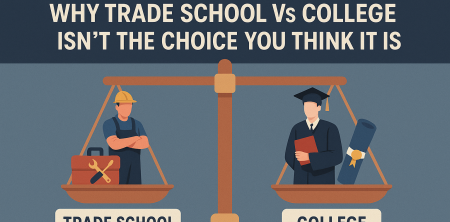
For generations, the "trade school vs college" debate has been a cornerstone of career planning. It's often framed as a fork in the road, a binary decision between a four-year degree and vocational training. You're either destined for the ivy-covered halls of academia or the hands-on world of skilled trades, right? Well, a fascinating new report from the Federal Reserve Bank of Philadelphia is here to tell us that this deeply ingrained notion is, frankly, outdated. It’s not just challenging the traditional narrative; it’s practically flipping it on its head.
As someone who’s spent years in education, from K-12 classrooms to university deanships, I can tell you this conversation is long overdue. We’ve pushed the idea that one path is inherently superior, often leading students down routes that don’t align with their true calling or financial realities. But what if these two pathways aren't competing choices at all? What if they're actually interconnected, even complementary? The research suggests just that, revealing a surprising overlap between apprenticeships and postsecondary education. This isn't just academic hair-splitting; it has profound implications for how we advise students, address workforce shortages, and build robust career paths for the future. Let’s dive into why the old "trade school vs college" dichotomy needs a serious rethink.
1. The Interconnected Reality: Beyond the Binary Choice
The most striking finding from the Federal Reserve Bank of Philadelphia’s report is how intertwined apprenticeships and higher education truly are. We've always viewed them as distinct, almost mutually exclusive, paths. You go to college, or you learn a trade. But the data shows a different story, a much more nuanced one: many apprentices actually attend college at some point in their journey. This isn't a small minority either; we're talking about nearly half of all apprentices having some college experience, and a significant 32% already holding a college credential when they even begin their apprenticeship.
This reality completely upends the traditional "trade school vs college" argument. It suggests that individuals are leveraging both systems to build their careers, rather than choosing one over the other. Think about it: someone might start with a few college courses, realize a hands-on trade is a better fit, and then enter an apprenticeship, perhaps even using their college credits toward related technical instruction. Or, an apprentice might complete their training and then pursue an associate's or bachelor's degree to advance into management or specialized roles. This flexibility and integration are far more reflective of modern career trajectories than the rigid pathways we often present to students.
2. Apprenticeships as a Stepping Stone or a Capstone: Flexible Pathways
The report highlights that apprenticeships aren't just an alternative to college; they can function as a powerful stepping stone into higher education or, conversely, as a valuable capstone experience after some college coursework. Imagine a student who isn't quite ready for a four-year university but wants to gain marketable skills. An apprenticeship offers structured training, on-the-job experience, and often a living wage, all while providing a clear career path. They might then decide to pursue further education, perhaps a degree that complements their trade skills, giving them a significant advantage in the job market.
On the flip side, consider someone who has already earned an associate's degree in a related field, say, mechanical engineering technology. An apprenticeship could be the perfect way for them to gain practical, industry-specific experience that makes their academic credentials truly shine. This blend of theoretical knowledge and practical application is incredibly potent. It’s not about choosing "trade school vs college" but rather strategically combining elements of both to maximize career potential and earnings. There's a fuller look at higher wages and education.
3. Addressing Workforce Shortages: A Strategic Imperative
Policymakers are increasingly looking to apprenticeships as a critical tool for addressing pervasive workforce shortages, particularly in skilled trades and high-demand technical fields. We hear constantly about the need for more electricians, plumbers, HVAC technicians, and IT specialists. The traditional college pipeline often struggles to fill these gaps directly, partly because many college programs are geared towards different outcomes, and partly because the cost and time commitment can be a barrier for students who want to enter the workforce sooner.
By promoting apprenticeships, especially those integrated with postsecondary education, we can create more direct and efficient pathways to these essential careers. This isn't just about getting people into jobs; it's about getting them into well-paying jobs that offer long-term stability and growth. When considering "trade school vs college" from a societal perspective, it becomes clear that a robust apprenticeship system is vital for economic health and competitiveness.
4. The Growing Role of Community Colleges: Bridging the Divide
Community colleges are emerging as absolute powerhouses in this integrated educational landscape. They are uniquely positioned to bridge the historical divide between academic and vocational training, and the report underscores their growing importance in apprenticeship programs. Many apprenticeships now include a component of related technical instruction, which is often delivered through community colleges. These institutions provide the classroom learning, lab work, and theoretical foundations that complement the hands-on training received on the job.
This collaboration is a win-win. Apprentices get high-quality instruction that's directly relevant to their trade, and community colleges reinforce their role as vital workforce development hubs. Furthermore, the credits earned in these related instruction courses can often be applied toward an associate's degree, giving apprentices the option to pursue further credentials seamlessly. This integration makes the "trade school vs college" debate far less rigid and far more practical for students. (See: Federal Reserve report on education pathways.)
5. Financial Implications and ROI: Beyond Sticker Price
When students and parents weigh "trade school vs college," financial considerations are almost always at the forefront. The cost of a four-year degree can be astronomical, leading to significant student loan debt. Trade schools and apprenticeships, by contrast, often come with lower upfront costs, and apprenticeships frequently pay apprentices from day one, meaning they earn while they learn. This immediate earning potential can be a game-changer for many individuals and families. For more context, see new student loan limits could crush your dreams.
However, it's not just about the sticker price. We need to look at the return on investment (ROI) over a career. While some four-year degrees can lead to very high-paying jobs, many trade careers also offer excellent wages and strong job security, often without the crushing debt. The integrated model suggested by the research — where college credits complement an apprenticeship – could offer the best of both worlds: marketable skills, earning potential, and the option for advanced credentials without necessarily incurring massive debt all at once. It forces us to reconsider what "value" truly means in education.
6. Evolving Perceptions and Stigma: A Cultural Shift
Part of the reason the "trade school vs college" debate has been so entrenched is the lingering societal stigma associated with vocational training. For too long, trade schools were seen as the fallback option for students who weren't deemed "college material." This perception is not only inaccurate but also incredibly damaging, pushing many bright, capable students away from fulfilling and lucrative careers in the trades.
The increasing recognition of apprenticeships as sophisticated, integrated pathways is slowly but surely chipping away at this stigma. When a report from the Federal Reserve highlights that many apprentices have college degrees, it sends a powerful message: these aren't lesser paths; they are legitimate, often demanding, and highly valued career routes. As educators, we have a responsibility to challenge these outdated perceptions and present all viable pathways with equal respect and enthusiasm.
7. Career Advancement and Specialization: The Long Game
Thinking about "trade school vs college" also needs to encompass the long-term view of career advancement and specialization. While an apprenticeship gets you into a trade quickly, further education, whether an associate's or bachelor's degree, can open doors to supervisory roles, project management, business ownership, or highly specialized technical positions. For example, an apprentice electrician might eventually pursue an electrical engineering technology degree to design complex systems or manage large-scale projects.
The integrated model allows individuals to stack credentials, building expertise layer by layer. This modular approach to education and career development is far more adaptable to a rapidly changing economy. It means that an initial choice between "trade school vs college" doesn't have to define your entire career arc; instead, it's a flexible starting point from which you can continue to learn, grow, and specialize.
8. Skill Development and Employability: What Employers Really Want
Employers consistently tell us they need workers with both technical skills and soft skills. Apprenticeships excel at developing the former through hands-on experience and mentorship, while college programs often focus more on critical thinking, problem-solving, communication, and collaboration. The integrated approach suggested by the research demonstrates that combining elements of both can produce incredibly well-rounded and highly employable individuals.
An apprentice who also has some college coursework, or even a degree, brings a unique blend of practical know-how and theoretical understanding to the workplace. This makes them not just good at their specific tasks, but also adaptable, innovative, and capable of taking on new challenges. When we consider the "trade school vs college" decision, we should really be asking: how can we best equip students with the full spectrum of skills that employers are desperately seeking?
9. The Future of Education and Work: A Blended Approach
The Philadelphia Fed report isn't just providing data; it's offering a glimpse into the future of education and work. The lines between vocational and academic learning are blurring, and for good reason. The demands of the modern economy require a more flexible, competency-based approach to skill development. The old "trade school vs college" paradigm feels increasingly anachronistic in a world where continuous learning and adaptability are paramount.
We're moving towards a model where credentials can be stacked, pathways can converge, and learning happens not just in classrooms but also on the job. This blended approach acknowledges that different people learn in different ways and that a single, linear path isn't suitable for everyone. As educators and policymakers, our job is to facilitate these diverse journeys, not to force students into outdated boxes. (See: Bureau of Labor Statistics on education and employment.)
10. Actionable Advice for Students and Parents: Making Informed Decisions
So, what does all this mean for you, whether you're a student weighing your options or a parent guiding your child? First, abandon the rigid "trade school vs college" mindset. Instead, think about your interests, learning style, financial situation, and long-term career goals. Are you someone who thrives with hands-on learning and wants to earn money quickly? An apprenticeship might be an excellent starting point, perhaps with an eye toward future college credits.
Are you drawn to academic exploration but also want practical skills? Consider community college programs that feed into apprenticeships or offer associate's degrees with strong vocational components. Explore programs where credits from apprenticeships can transfer to a degree. Don't be afraid to mix and match. The most important thing is to research thoroughly, talk to professionals in fields that interest you, and understand that your educational journey doesn't have to be a one-time, all-or-nothing choice. It can be a dynamic, evolving process that leverages the best of both worlds. For more context, see unprecedented Supreme Court case could upend college admissions.
Ultimately, the conversation isn't about choosing between "trade school vs college" anymore. It's about strategically combining educational opportunities to build a robust, resilient, and rewarding career. The research is clear: the most successful individuals are often those who aren't afraid to forge their own unique path, drawing from all the incredible learning resources available to them.
11. The Role of Government and Industry Partnerships: Building a Stronger Ecosystem
To truly dismantle the "trade school vs college" dichotomy and foster these integrated pathways, we need strong partnerships between government agencies, educational institutions, and industry. Governments can provide funding and incentives for businesses to establish and expand apprenticeship programs, particularly those that offer college credit or pathways to further degrees. For instance, federal and state grants can help cover the costs of related technical instruction at community colleges, making these programs even more accessible.
Industry also has a massive role to play. Businesses need to actively collaborate with community colleges and universities to design apprenticeship programs that meet their specific needs while also incorporating academic components. This means creating curricula that are both practical and theoretically sound, ensuring that apprentices are not just learning how to do a job, but also understanding the underlying principles. Think about the manufacturing sector: a machinist apprentice could benefit immensely from college courses in materials science or computer-aided design, making them a more valuable and versatile employee. When industry champions these blended learning models, it sends a clear signal that both hands-on skills and academic knowledge are highly valued.
12. Global Perspectives on Integrated Learning: Learning from Others
It's worth noting that the U.S. isn't alone in grappling with the "trade school vs college" debate. Many European countries, particularly Germany and Switzerland, have long-established and highly respected dual education systems where apprenticeships are deeply integrated with formal education. In these systems, vocational training is not seen as a lesser alternative but as a rigorous, high-quality path to a professional career, often leading to excellent earning potential and social mobility. Students in these countries often spend days at a company learning a trade and other days at a vocational school receiving academic instruction, culminating in recognized qualifications that are respected by both employers and universities.
What can we learn from this? Firstly, that a strong cultural acceptance of vocational pathways is crucial. When society values all forms of skilled work, students are more likely to pursue paths that truly align with their talents. Secondly, these models demonstrate the effectiveness of tight coordination between educational institutions and employers. They show that it's entirely possible to create systems where practical experience and academic knowledge reinforce each other, producing highly skilled and adaptable workforces. We're starting to see similar integrated models gain traction here, and looking at successful international examples can provide valuable blueprints for our own evolution.
13. The Impact of Technology: New Skills for New Trades
The rapid pace of technological advancement is also fundamentally reshaping both college and trade school education, making the "trade school vs college" distinction even less relevant. Modern trades aren't just about manual labor; they increasingly involve sophisticated technology, data analysis, and automation. An HVAC technician today needs to understand complex control systems and smart home technology. An automotive technician works with advanced diagnostics and hybrid vehicle systems. Even traditional construction trades are incorporating robotics and advanced materials.
This means that vocational training programs are becoming more technologically advanced, often incorporating elements that were once exclusive to college engineering or computer science curricula. Similarly, many college programs are adding more hands-on, project-based learning to prepare students for real-world applications. The demand for "tech-savvy tradespeople" and "practically-minded engineers" is blurring the lines. This convergence means that a blend of academic theory and practical application is becoming essential for success in almost any field, reinforcing the idea that integrating rather than choosing between these paths is the smartest move. For more context, see student loan forgiveness just got harder for millions.
14. Addressing Equity and Access: Expanding Opportunities for All
The traditional "trade school vs college" paradigm often exacerbates existing inequities. Students from lower socioeconomic backgrounds might feel pressured into college even if it means accumulating massive debt for a degree that doesn't guarantee a job, simply because it's perceived as the "better" option. Conversely, some might be steered away from higher education entirely, despite their academic potential, because of financial constraints or a lack of information about integrated pathways.
By promoting integrated apprenticeship and college pathways, we can create more equitable access to high-quality education and well-paying careers. Apprenticeships, with their earn-while-you-learn model, can significantly reduce financial barriers. When these apprenticeships are structured to offer college credit, they provide a tangible pathway to higher credentials without requiring students to stop working or go into deep debt. This opens up opportunities for individuals who might not have considered college otherwise, or who might have struggled with the traditional college model. It's about ensuring that every student, regardless of their background, has a clear and supported path to economic stability and personal fulfillment.
Frequently Asked Questions about Trade School vs College
Q1: Is a trade school or college better for high earners?
It's a common misconception that college automatically leads to higher earnings. While some college degrees do open doors to very high-paying careers, many skilled trades also offer excellent wages, often without the significant student loan debt associated with a four-year degree. Some trades, like welding, plumbing, or specialized IT roles, can easily out-earn entry-level positions for many college graduates. The key is to look at the specific field, demand for the skill, and the potential for advancement, rather than making a blanket assumption about "trade school vs college." The integrated model, combining elements of both, often offers the best of both worlds for earning potential.
Q2: Can I go to trade school after college, or vice versa?
Absolutely! The old "trade school vs college" binary is precisely what the new research refutes. Many individuals are doing exactly that. You might pursue a college degree, then realize a specific trade offers a more direct career path, or perhaps you want to add hands-on skills to your academic knowledge. Conversely, many trade school graduates or apprentices later pursue associate's or bachelor's degrees to advance into management, engineering, or specialized technical roles. The pathways are increasingly flexible and interconnected, allowing you to stack credentials and adapt your education to your evolving career goals.
Q3: Do employers prefer trade school graduates or college graduates?
This really depends on the job! For roles requiring specific hands-on skills, like an electrician, welder, or automotive technician, employers will typically prefer trade school graduates or those who have completed an apprenticeship because they have the direct, practical experience needed. For roles requiring theoretical knowledge, research skills, or broad analytical abilities, a college degree might be preferred. However, as the report shows, the most sought-after candidates often possess a blend of both: practical skills from vocational training combined with the critical thinking and communication abilities gained from college. Employers are increasingly looking for well-rounded individuals who can hit the ground running but also adapt and innovate. For more on this, see job prospects for graduates.
Q4: What are the main financial differences between trade school and college?
The primary financial difference is often the upfront cost and the earning potential during your education. Traditional four-year colleges tend to have much higher tuition fees, leading to significant student loan debt. Trade schools generally have lower tuition and shorter program durations. Apprenticeships often pay you a living wage from day one, meaning you earn money while you learn, significantly reducing or eliminating the need for loans. While the long-term ROI can vary for both, the lower debt burden and immediate earning potential of trade schools and apprenticeships are major financial advantages for many individuals.
Q5: How do I decide which path is right for me?
Forget the "trade school vs college" debate and focus on yourself. Start by honestly assessing your interests, learning style, and career aspirations. Do you love hands-on work and seeing tangible results? Are you eager to enter the workforce quickly? A trade or apprenticeship might be a great fit. Do you enjoy theoretical learning, research, and a broader academic exploration? College might be more suitable. Consider your financial situation and tolerance for debt. Talk to people in various professions, visit trade schools and college campuses, and explore programs that offer integrated learning or pathways for transferring credits. The best path is the one that aligns with your unique strengths and goals, not a preconceived notion of what you "should" do.
Trending Now
Frequently Asked Questions
Is trade school better than college?
The debate between trade school and college is outdated. Research shows that both paths can be interconnected and complementary. Many apprentices also attend college, indicating that neither option is inherently superior, but rather they can enhance each other and align with individual career aspirations.
What are the benefits of trade school?
Trade schools offer hands-on training and often lead to high-demand jobs with good salaries. The recent findings suggest that trade school can also be a stepping stone to further education, allowing individuals to gain both practical skills and academic qualifications.
Can you go to college after trade school?
Yes, many individuals pursue college education after attending trade school. In fact, nearly half of all apprentices have some college experience, highlighting that both educational paths can coexist and provide valuable skills for the workforce.
What is the connection between trade school and college?
The connection lies in the overlap of skills and education. Many apprentices attend college at some point, which suggests that trade school and college are not mutually exclusive but can work together to prepare students for diverse career opportunities.
How do I choose between trade school and college?
Choosing between trade school and college should depend on your career goals and interests. Consider exploring both options, as they can complement each other. Research shows that many successful professionals have benefited from a combined approach to education and training.
What did we miss? Let us know in the comments and join the conversation.

