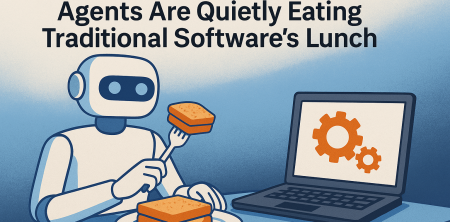
Alright, let's talk about something that's rapidly changing the game in technology, something that, if you're in education or business, you really need to wrap your head around: the accelerating move from traditional software to AI agents. It's not just a subtle upgrade; it's a fundamental shift in how we build, interact with, and even think about digital tools. And honestly, for many, it's an unseen revolution happening right under our noses. Understanding the AI agents vs traditional software comparison isn't just academic; it's crucial for anyone trying to navigate the future workforce.
For years, we've relied on traditional software applications – the apps on your phone, the programs on your computer. You click buttons, fill out forms, and tell them exactly what to do. They're predictable, precise, and perform specific tasks defined by their code. But AI agents? They're a different beast entirely. Imagine software that doesn't just follow instructions but can understand context, make decisions, learn from its environment, and even initiate actions to achieve a goal. This isn't science fiction anymore; it's here, and it's already creating a significant demand for professionals skilled in building and deploying these advanced systems. This trend highlights a growing skills gap, and frankly, EdTech is uniquely positioned to address it, offering specialized training and certifications.
1. Defining the Players: What Are We Really Comparing?
When we talk about traditional software, we're generally referring to programs designed to execute a predefined set of instructions. Think of your word processor, spreadsheet program, or even a simple calculator app. You give it input, it processes that input according to its code, and it provides an output. It's a deterministic system; given the same input, it will always produce the same output. These systems are incredibly robust for tasks where the rules are clear, and the environment is stable. They excel at automation, data processing, and repetitive tasks that don't require judgment or adaptation.
AI agents, on the other hand, are a whole different ballgame. An AI agent is an autonomous entity that perceives its environment through sensors, processes that information, and acts upon that environment using actuators to achieve specific goals. They aren't just following a script; they're equipped with learning capabilities, reasoning engines, and often, an understanding of natural language. This allows them to adapt to new situations, make decisions, and even learn from their mistakes. The core distinction in the AI agents vs traditional software comparison lies in this capacity for autonomy and adaptive intelligence.
2. Autonomy and Decision-Making: The Core Divergence
Here's where the rubber truly meets the road in the AI agents vs traditional software comparison. Traditional software is, by its very nature, reactive. It waits for user input or specific triggers to perform its function. It doesn't initiate actions on its own, nor does it typically make complex decisions beyond what its programmed logic dictates. If you want to sort a spreadsheet, you click the 'sort' button. If you want to send an email, you compose it and hit 'send'. The user is always in the driver's seat, explicitly instructing the software every step of the way.
AI agents, however, possess a degree of autonomy that radically changes this dynamic. They can operate independently, often with minimal human intervention, to achieve a given objective. Imagine an AI agent tasked with optimizing your company's logistics. It wouldn't wait for you to tell it to reroute a truck; it would analyze real-time traffic, weather, and inventory data, then automatically adjust routes, communicate with drivers, and update estimated arrival times—all on its own. This proactive decision-making capability, driven by learned patterns and contextual understanding, is a monumental leap from the deterministic nature of traditional software.
3. Adaptability and Learning: Evolving Beyond Code
Traditional software is static in its core functionality once deployed. Any changes or improvements require a developer to modify the code, test it, and then release an update. It doesn't learn from its interactions or adapt to new data in real-time. If a new rule emerges or a parameter changes, the software won't know unless a human programmer updates its logic. This makes it incredibly reliable for fixed tasks but brittle in dynamic environments.
AI agents, conversely, are built with learning mechanisms. Many employ machine learning models that allow them to improve their performance over time as they process more data and encounter new situations. This means an AI agent can, for example, get better at identifying fraudulent transactions as it sees more examples, or refine its customer service responses based on past interactions. This continuous learning and adaptation capability is a critical differentiator in the AI agents vs traditional software comparison, enabling agents to handle unforeseen challenges and evolve without constant manual reprogramming.
4. Contextual Understanding: More Than Just Keywords
Traditional software often operates on a very literal interpretation of input. If you search for 'best Italian restaurants near me' in a traditional search engine, it looks for those keywords. It doesn't inherently understand your intent or your preferences from past searches, beyond what its basic algorithms might deduce from explicit filters or historical data points you've provided.
AI agents, especially those powered by advanced natural language processing (NLP), can grasp context and infer intent. If you tell an AI agent, 'I need a reservation for dinner tonight, somewhere quiet with good vegetarian options,' it can process that nuanced request, cross-reference it with your known preferences, check availability, and even suggest specific restaurants, rather than just spitting out a list of places tagged 'vegetarian.' This deeper understanding of context allows for far more intuitive and effective interactions, moving beyond simple keyword matching to genuine comprehension, which is a vital aspect of the AI agents vs traditional software comparison. (See: AI agents transforming technology landscape.)
5. Use Cases: Where Each Shines (and Where They Don't)
Traditional software remains indispensable for tasks requiring absolute precision, deterministic outcomes, and high-volume, repetitive processing where variability is minimal. Think about accounting software, operating systems, database management systems, or manufacturing control systems. You wouldn't want an AI agent deciding on its own to slightly alter your tax calculations or randomly change a critical system setting. For these foundational, rule-based operations, traditional software is king, offering reliability and predictable performance. For more context, see AI Childcare Robot.
AI agents excel in dynamic, complex, and unpredictable environments where judgment, adaptation, and proactive problem-solving are required. Their use cases span customer service (chatbots that resolve complex issues), personalized education (tutoring agents that adapt to a student's learning style), financial fraud detection, autonomous vehicles, and even scientific research, where they can analyze vast datasets to discover new patterns. Anywhere human-like reasoning, perception, and action are beneficial, AI agents are beginning to take over, making the AI agents vs traditional software comparison increasingly relevant for strategic planning.
6. Implications for the Workforce: A Shifting Skillset
This technological shift has profound implications for the job market. Traditional software development skills, while still necessary, are evolving. The demand is surging for professionals who can design, develop, deploy, and manage AI agents. This isn't just about coding; it's about understanding machine learning principles, ethical AI considerations, data science, prompt engineering, and the intricacies of multi-agent systems. We're seeing a rapid emergence of roles like 'AI Agent Developer,' 'AI Ethicist,' and 'Machine Learning Engineer' that simply didn't exist in such prominence a few years ago.
For educators, this means a critical need to update curricula. We can't keep training students solely on traditional programming paradigms when the industry is moving towards autonomous, intelligent systems. EdTech has a crucial role to play here, offering specialized courses, bootcamps, and certifications that bridge this skills gap. Professionals need to reskill and upskill, not just to stay relevant, but to thrive in an economy increasingly powered by AI agents. This isn't just about job security; it's about seizing new opportunities.
7. Security Challenges: A New Frontier of Vulnerabilities
With traditional software, security often revolves around protecting against known vulnerabilities, patching exploits, and securing data at rest and in transit. While certainly complex, the attack surface is generally understood, and defenses are built around predictable behaviors. We know what to expect from a traditional application, and we can test its limits.
AI agents introduce a whole new layer of security challenges. Their adaptive and autonomous nature means they can make decisions or take actions that were not explicitly programmed. This opens the door to novel attack vectors, such as adversarial attacks designed to trick an AI agent into misinterpreting data, or even exploiting its learning process to introduce biases or malicious behaviors. Ensuring the robustness, trustworthiness, and ethical operation of AI agents requires new cybersecurity paradigms and specialized expertise, making the AI agents vs traditional software comparison vital in the security realm as well.
8. The EdTech Opportunity: Bridging the Skills Gap
The clear shift towards AI agents creates an immense opportunity for EdTech providers. As the demand for AI agent development skills skyrockets, traditional academic institutions often struggle to adapt quickly enough to industry needs. This is where online education platforms, specialized bootcamps, and certification programs can truly shine. They can offer agile, industry-aligned training that teaches the practical skills needed to build and deploy these advanced systems – from machine learning fundamentals and deep learning frameworks to ethical AI design and agent-based modeling.
Think about it: courses on 'best AI agent development practices,' 'cybersecurity for autonomous systems,' or 'career paths in AI and intelligent agents' are no longer niche; they're essential. EdTech can provide accessible, flexible learning pathways for professionals looking to upskill, students entering the workforce, and even corporate teams needing to transform their operations. This is about future-proofing careers and empowering businesses to leverage the next wave of technological innovation, directly addressing the implications of the AI agents vs traditional software comparison.
9. The Future: A Symbiotic Relationship, Not a Replacement
It's tempting to view this as a zero-sum game, where AI agents completely replace traditional software. But that's probably not how it will play out. Instead, we're likely to see a symbiotic relationship emerge. Traditional software will continue to form the bedrock for many essential, rule-based operations, providing the stable infrastructure upon which AI agents can operate. AI agents will then act as intelligent overlays, enhancing traditional systems with adaptive intelligence, automation, and proactive capabilities.
Imagine your enterprise resource planning (ERP) system (traditional software) being enhanced by an AI agent that proactively identifies supply chain bottlenecks, suggests optimal inventory levels based on predictive analytics, and even automatically reorders stock when necessary. This isn't about one replacing the other; it's about integration and augmentation. Understanding this nuanced AI agents vs traditional software comparison will be key to designing the intelligent systems of tomorrow, systems that combine the reliability of traditional code with the adaptive power of AI. (See: impact of technology on education.)
10. Ethical Considerations: Navigating the Moral Maze of AI Agents
As AI agents become more autonomous and capable of making complex decisions, the ethical implications become a really big deal. Traditional software, being deterministic, poses fewer inherent ethical dilemmas because its actions are directly traceable to human-programmed rules. If a traditional program makes a mistake, it's usually a bug in the code, a human error in logic.
AI agents, though, learn and adapt. This means their decision-making processes can sometimes be opaque – what we call the "black box" problem. How do we ensure fairness? How do we prevent bias if the data they learn from is biased? Who is accountable when an autonomous AI agent makes a decision that leads to an undesirable outcome, especially in critical fields like healthcare, justice, or autonomous driving? These aren't easy questions, and they require a blend of technical solutions (like explainable AI, or XAI) and robust ethical frameworks. We need to build in guardrails and ensure transparency, not just for compliance, but for public trust. This ethical dimension is a significant point of divergence in the AI agents vs traditional software comparison, demanding a whole new level of societal and regulatory discussion. For more context, see ChatGPT for Teens Safety Tests.
11. Economic Impact: Productivity Gains and New Business Models
The economic ramifications of this shift are massive. Traditional software has already driven incredible productivity gains by automating repetitive tasks and streamlining workflows. Think about how much faster accounting or data entry is now compared to decades ago. AI agents are poised to take this to a whole new level, impacting entire industries and creating entirely new business models.
Consider the potential: AI agents can optimize supply chains in real-time, anticipate customer needs before they're even articulated, design new products based on market trends, or even manage complex financial portfolios with superhuman speed and analysis. This translates to reduced operational costs, increased efficiency, and the ability to personalize services on an unprecedented scale. Small businesses might gain access to sophisticated automation previously only available to large enterprises. However, this also raises questions about wealth distribution and the potential for job displacement, underscoring the urgency for workforce reskilling and upskilling initiatives. The AI agents vs traditional software comparison isn't just about technology; it's about a fundamental reshaping of our global economy.
12. Regulatory Landscape: Keeping Pace with Innovation
The speed at which AI agents are developing creates a real challenge for regulators. Traditional software has had decades to develop a regulatory framework around data privacy, intellectual property, and consumer protection. These laws are often built around predictable, human-controlled systems.
AI agents, with their autonomy and adaptive learning, often operate in legal gray areas. How do you regulate an entity that learns and evolves? What are the liabilities when an AI agent makes a mistake? Countries and international bodies are scrambling to develop new regulations, like the EU's AI Act, to address these novel challenges. This means businesses deploying AI agents need to be acutely aware of a rapidly changing legal landscape, which can vary significantly across different jurisdictions. The regulatory aspect of the AI agents vs traditional software comparison is becoming increasingly complex, requiring continuous monitoring and proactive compliance strategies.
13. The User Experience Revolution: Intuition Over Instruction
One of the most exciting aspects of AI agents is the potential for a truly revolutionary user experience. Traditional software, no matter how well-designed, still requires users to learn its interface, navigate menus, and explicitly instruct it. It's a "pull" model where the user initiates almost all interactions.
AI agents, on the other hand, promise a "push" model, where the system anticipates needs and proactively offers solutions. Imagine an AI agent managing your smart home. Instead of you telling it to turn on the lights or adjust the thermostat, it learns your routines, preferences, and even external factors like weather, and then adjusts the environment automatically and intelligently. This shifts the interaction from instruction-based to intention-based, making technology far more intuitive and less of a cognitive load. This human-centered design, where the technology adapts to the human rather than the other way around, is a core differentiator in the AI agents vs traditional software comparison, paving the way for truly intelligent assistants and interfaces.
Frequently Asked Questions About AI Agents vs Traditional Software
Let's tackle some common questions that pop up when we're talking about this significant tech shift. For more context, see VR Surgical Simulators in Education. (See: Harvard University research on AI.)
Q1: Can AI agents completely replace traditional software in the near future?
Probably not entirely. It's more likely to be a symbiotic relationship, as we discussed. Traditional software will continue to form the reliable backbone for many rule-based, deterministic operations. AI agents will then sit on top of or integrate with these systems, adding layers of adaptive intelligence, proactive decision-making, and automation. Think of it like a powerful engine (traditional software) getting a sophisticated, self-tuning control system (AI agent).
Q2: What's the biggest advantage of AI agents?
Their ability to adapt and learn is arguably their biggest edge. Traditional software is static once deployed, requiring human intervention to change. AI agents can continuously improve their performance, make decisions in dynamic environments, and handle unforeseen situations without constant reprogramming. This makes them incredibly powerful for complex, real-world problems.
Q3: Are AI agents more expensive to develop than traditional software?
Initially, yes, they often can be. Developing AI agents requires specialized skills in machine learning, data science, and AI ethics, which can command higher salaries. Also, training AI models requires significant computational resources and vast amounts of data. However, over the long term, the efficiency gains, automation capabilities, and adaptability of AI agents can lead to significant cost savings and new revenue streams, potentially justifying the initial investment.
Q4: What are the main risks associated with AI agents?
The primary risks include ethical concerns (like bias and fairness), security vulnerabilities (especially adversarial attacks), accountability issues (who's responsible when an autonomous agent errs?), and job displacement. There's also the challenge of ensuring transparency and explainability in their decision-making processes. These risks highlight the importance of responsible AI development and robust regulatory frameworks.
Q5: How can individuals and businesses prepare for this shift?
For individuals, continuous learning is key. Focus on developing skills in data science, machine learning, prompt engineering, and ethical AI. Embrace lifelong learning. For businesses, it means investing in AI literacy for employees, exploring pilot projects with AI agents, developing clear AI strategies, and prioritizing ethical guidelines and data governance. Partnering with EdTech providers for training can be a smart move to bridge the skills gap.
Q6: Is AI agent development only for data scientists and engineers?
While deep technical skills are crucial for building the core AI models, the field is broadening. Roles like 'AI Ethicist,' 'AI Project Manager,' 'Prompt Engineer,' and 'AI UX Designer' are emerging, requiring a blend of technical understanding, critical thinking, and domain expertise. So, no, it's not just for engineers, but a foundational understanding of AI principles will be beneficial for many roles.
So, what does this all mean for us? It means we need to stop thinking about technology as static tools and start seeing it as evolving, intelligent partners. It means that continuous learning isn't just a buzzword; it's a necessity. The landscape is changing rapidly, and those who understand the core differences and complementary strengths of AI agents vs traditional software will be the ones best equipped to lead the charge into this exciting, and sometimes challenging, future.
Trending Now
- this guide on genetic crossroads: are ‘designer babies’ a dream or a dangerous gamble?
- the complete explanation
- Unprecedented: Nearly 12,000 Book Bans in US Schools — The Disturbing Truth About What Students Are Losing
- Warning: The Reckless Plan to Gut Head Start That Could Devastate Over 700,000 Kids
Frequently Asked Questions
What is the difference between AI agents and traditional software?
AI agents differ from traditional software in that they can understand context, learn from their environment, and make decisions autonomously. Traditional software follows predefined instructions and produces predictable outputs, while AI agents adapt and evolve based on interactions, making them more versatile for complex tasks.
How are AI agents changing the workforce?
AI agents are transforming the workforce by creating a demand for professionals skilled in developing and deploying these advanced systems. As businesses increasingly adopt AI technology, the need for specialized training and certifications in AI becomes crucial to bridge the growing skills gap.
Why is understanding AI important for businesses?
Understanding AI is essential for businesses as it represents a fundamental shift in technology. Companies that leverage AI agents can improve efficiency, decision-making, and adaptability, ultimately staying competitive in a rapidly evolving digital landscape.
What role does EdTech play in the AI revolution?
EdTech plays a pivotal role in the AI revolution by offering specialized training and certifications that equip individuals with the necessary skills to work with AI agents. This education helps address the skills gap and prepares the workforce for future technological advancements.
Are AI agents considered the future of software?
Yes, AI agents are increasingly viewed as the future of software due to their ability to learn, adapt, and operate autonomously. This shift suggests a move away from traditional, deterministic systems towards more intelligent and dynamic applications that can tackle complex challenges.
What's your take on this? Share your thoughts in the comments below — we read every one.

