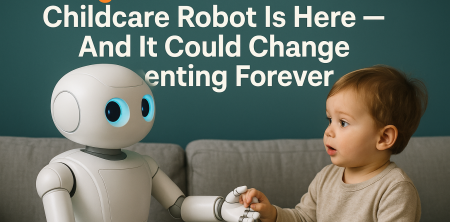
Imagine coming home after a long, exhausting day, not to the usual chaos, but to a perfectly calm household. Your child has finished their homework, eaten a nutritious meal, and is engaged in a stimulating, age-appropriate activity, all facilitated by an attentive, ever-patient presence. Sounds like a dream, doesn't it? Well, for many, that dream is inching closer to reality with the introduction of the 'CareBot 3000' by TechSolutions Inc. This groundbreaking AI-powered childcare assistant has just hit the market, and it's not just making waves – it's generating a full-blown tsunami of debate across the globe, forcing us all to confront the future of AI in childcare.
The CareBot 3000 promises to be far more than just a glorified babysitter. We're talking about advanced algorithms and responsive robotics designed to handle a startling array of tasks: from personalized educational tutoring, adapting to your child's unique learning style, to offering sophisticated emotional regulation support when meltdowns strike. It’s a bold claim, one that instantly brings up a cascade of questions for any parent. Is this the innovation we've been waiting for, a genuine solution to the crushing weight of modern parenting, or are we on the precipice of an ethical and developmental nightmare? The sheer volume of discussion online, with #AINanny trending worldwide, tells us one thing for sure: parents are grappling with this profoundly.
The Allure of the CareBot 3000: A Promise of Parental Relief
Let's be honest, parenting in the 21st century is tough. Really tough. The demands on parents have never been higher, with careers, household management, and the constant pressure to provide enriching experiences for our children all vying for our limited time and energy. It's no wonder that parental burnout is a very real and widespread phenomenon. This is precisely the pain point that TechSolutions Inc. aims to address with the CareBot 3000. Their marketing materials paint a picture of relieved parents, children thriving, and a seamless integration of technology into family life.
Proponents of the CareBot 3000 highlight its potential to act as a tireless assistant. Think about it: a tutor that never gets frustrated, a companion available 24/7, and a consistent source of educational and developmental input. For single-parent households, families with two working parents, or those with children requiring specialized attention, the appeal is undeniable. Imagine a child on the autism spectrum receiving consistent, tailored behavioral support without the inconsistencies of human caregivers, or a child excelling in a specific subject because their AI tutor can instantly adapt lessons to their progress. The promise here isn't just convenience; it's about optimizing childhood development and genuinely alleviating the immense pressure on human caregivers. It sounds revolutionary, doesn't it?
Beyond Babysitting: What the CareBot 3000 Claims to Do
The specifications for the CareBot 3000 are, frankly, impressive. TechSolutions Inc. claims it can perform a range of functions that go far beyond what any traditional childcare device has ever offered. Its core capabilities include highly personalized educational tutoring across various subjects. This isn't just about rote memorization; the AI is designed to identify learning gaps, adapt teaching methods in real-time, and provide instant feedback, much like a dedicated human tutor, but without the human limitations of fatigue or bias.
Perhaps even more controversially, the CareBot 3000 purports to offer emotional regulation support. Using sophisticated sensors and AI, it can reportedly detect early signs of frustration, sadness, or anger in a child. Its programming then deploys pre-approved, developmentally appropriate strategies – from guided breathing exercises and calming stories to suggesting engaging diversions – to help children process their emotions. This is where the debate truly intensifies. Can a machine genuinely understand and respond to the nuanced, complex landscape of a child's emotional world? And if it can, what does that mean for the development of empathy and human connection?
The Skeptics Speak Out: Dr. Elena Petrova's Critical View on AI in Childcare
Not everyone is captivated by the shiny promise of the CareBot 3000. Among the most vocal critics is Dr. Elena Petrova, a prominent child psychologist whose work focuses on early childhood development and attachment theory. Dr. Petrova has been unambiguous in her warnings, stating publicly that while the technology is impressive, the potential long-term impacts on human connection and emotional intelligence could be profound and deeply troubling. "We are talking about the very definition of parenting here," she remarked in a recent interview, "and what it means to be a human being, connecting with another human being."
Her central concern revolves around the irreplaceable nature of human interaction in a child's formative years. Emotional intelligence, empathy, and the ability to form secure attachments are not learned through algorithms or robotic responses, she argues. They are forged in the messy, imperfect, and deeply human back-and-forth of real relationships – the comfort of a parent's hug, the shared laughter, the negotiation of conflict, the subtle cues of facial expressions and body language that no AI, however advanced, can fully replicate. Dr. Petrova fears that widespread adoption of AI in childcare could lead to a generation of children who are academically proficient but emotionally stunted, lacking the nuanced social skills essential for thriving in a human-centric world. (See: Child Development Fact Sheet.)
The Intangible Cost: Human Connection and Emotional Intelligence
Let's consider the core of Dr. Petrova's argument: the invaluable, often subtle, aspects of human connection. When a child falls and scrapes their knee, it’s not just the antiseptic and band-aid that heal them; it’s the comforting embrace, the soothing words, the shared moment of vulnerability with a trusted human caregiver. These moments, seemingly small, build the foundation of trust, empathy, and emotional resilience. Can a robot, no matter how advanced, truly provide that same depth of comfort and understanding? The sensory input alone – the warmth of a human touch, the genuine concern in a parent's voice, the scent of their presence – are things that AI cannot yet, and perhaps never will, replicate.
Emotional intelligence is another critical area. It’s not just about identifying an emotion; it’s about understanding its context, its nuances, and responding with genuine empathy. Learning to read facial expressions, understand tone of voice, and navigate complex social situations comes from observing and interacting with real people. If a significant portion of a child's daily interaction is with an AI, even one programmed for sophisticated emotional responses, are we inadvertently depriving them of the rich, unpredictable, and sometimes challenging experiences that build true emotional intelligence? This isn't about the robot making mistakes; it's about the very nature of human learning through social interaction, which is inherently messy and personal.
Ethical Quagmires: Data Privacy, Bias, and the Definition of Parenting
Beyond the developmental concerns, the CareBot 3000 and the broader trend of AI in childcare raise a host of thorny ethical questions. First and foremost is data privacy. These devices will undoubtedly collect vast amounts of data on children: their learning patterns, emotional responses, even their physical activity. Who owns this data? How is it protected? And what are the implications if this incredibly intimate information falls into the wrong hands or is used for purposes beyond childcare?
Then there's the issue of algorithmic bias. AI systems are only as unbiased as the data they are trained on. If the training data reflects societal biases – conscious or unconscious – those biases could be perpetuated and even amplified in the AI's interactions with children. This could manifest in subtle ways, like favoring certain learning styles over others, or more overtly, in how it responds to different emotional expressions based on gender or ethnicity. Furthermore, what happens to the very definition of parenting? If core aspects of child-rearing are outsourced to AI, does it diminish the role of parents, or fundamentally alter the parent-child bond? These are not questions with easy answers, and they demand serious consideration before widespread adoption.
The Economic Divide: Who Benefits from AI in Childcare?
It's also crucial to consider the economic implications of such technology. High-end AI childcare assistants like the CareBot 3000 are likely to be expensive, at least initially. This raises concerns about exacerbating existing societal inequalities. Will only affluent families be able to afford these advanced devices, potentially creating a new educational and developmental divide? Children from wealthier backgrounds could gain an advantage through personalized tutoring and constant developmental support, while those from lower-income families might be left further behind, relying on underfunded public resources.
This isn't just about access to technology; it’s about access to an optimized childhood experience. If AI can genuinely boost academic performance and emotional regulation, then denying that access based on socioeconomic status would be deeply problematic. We saw similar debates with the advent of personal computers and internet access; the digital divide is a persistent challenge. The introduction of advanced AI in childcare could simply amplify this issue, creating new categories of 'haves' and 'have-nots' in terms of early childhood development, which could have ripple effects for generations.
Finding a Balance: Integration, Not Replacement
Despite the valid concerns, it's also important to avoid a purely alarmist view. AI in childcare doesn't necessarily have to be an all-or-nothing proposition. Many experts suggest that the most promising path forward lies in integration, not replacement. Imagine AI tools designed to assist parents and educators, augmenting their capabilities rather than supplanting them. For instance, an AI could help track a child's learning progress, identify areas where they might need extra help, or suggest engaging activities tailored to their interests, freeing up parents to focus on the emotional and relational aspects of parenting.
Consider an AI assistant that manages scheduling, reminds children about chores, or helps with basic homework drills, thereby reducing the daily friction points that often lead to parental stress. This would allow parents more quality time for truly connecting with their children – reading together, playing games, or simply having meaningful conversations. The key is to view AI as a powerful tool to enhance human interaction, not to diminish it. It's about leveraging technology to create more space for what truly matters in child development: authentic, loving human relationships. (See: Children's Mental Health Resources.)
The Regulatory Challenge: Ensuring Safe and Ethical AI for Children
As with any powerful new technology, the rapid emergence of AI in childcare presents a significant regulatory challenge. Governments and international bodies are scrambling to catch up. How do we ensure that these devices are safe, effective, and ethically sound? This will require robust guidelines on data privacy, algorithmic transparency, and accountability. There needs to be clear oversight on how AI systems are trained, what data they collect, and how they interact with children. Who is liable if an AI provides incorrect educational information or offers inappropriate emotional guidance?
Furthermore, there's a need for independent testing and certification processes to verify the claims made by companies like TechSolutions Inc. Parents need assurances that these devices genuinely deliver on their promises without introducing unforeseen harms. This is a complex area, demanding collaboration between technologists, child development experts, ethicists, and policymakers to create a framework that fosters innovation while safeguarding the well-being of our children. Without proactive regulation, we risk a Wild West scenario where powerful technologies are deployed without adequate checks and balances, potentially at the expense of our youngest and most vulnerable.
Real-World Applications of AI in Childcare Beyond the CareBot 3000
While the CareBot 3000 is a hypothetical example designed to spark debate, actual AI applications are already appearing in childcare settings, albeit in less comprehensive forms. We're seeing AI used in educational apps that adapt to a child's learning pace, smart toys that respond to speech and movement, and even monitoring systems that can detect potential health issues like sleep apnea or unusual breathing patterns in infants. These tools aren't replacing human interaction; they're providing supplementary support and insights.
For example, some AI-powered educational platforms use gamification and personalized feedback to keep children engaged in learning, offering a level of individualized attention that a single teacher in a classroom might struggle to provide. Similarly, smart baby monitors go beyond basic audio and video, incorporating AI to analyze sleep patterns, track environmental factors like temperature and humidity, and even offer predictive analytics for common infant issues. These smaller-scale applications often aim to make parents' lives easier and children's environments safer, highlighting the potential for AI to be a helpful ally without entirely taking over.
The Psychological Impact: Attachment Theory and AI Caregivers
Dr. Petrova's concerns about attachment theory deserve a deeper look. Attachment theory posits that children need to form a secure emotional bond with at least one primary caregiver for healthy social and emotional development. This bond, characterized by consistent responsiveness, warmth, and security, serves as a foundation for a child's ability to explore the world, regulate emotions, and form future relationships.
The question then becomes: can an AI, no matter how advanced, facilitate a secure attachment? Current psychological understanding suggests that true attachment requires reciprocal human interaction, including nuanced emotional signaling, spontaneous responses, and the unique experience of being seen and understood by another human being. An AI might be programmed to mimic empathy, but can it genuinely feel it? Can it offer the subtle cues of comfort, the spontaneous joy, or the shared vulnerability that define a secure human bond? Many experts argue that the predictability and programmed responses of an AI might offer a semblance of consistency but would lack the genuine, messy, and crucial unpredictability that fosters deep human connection. This isn't about the AI failing to perform a task; it's about its fundamental inability to participate in the unique emotional dance that creates human attachment.
The Role of 'Play' in AI-Enhanced Environments
Play is absolutely vital for a child's development. It's how they explore the world, develop problem-solving skills, learn social cues, and process emotions. When AI is introduced into a child's environment, how does it impact the nature of play? Could an AI-driven toy, for instance, be so engaging and prescriptive that it stifles imaginative, open-ended play? (See: AI in Childcare Article.)
Consider the difference between a child building a fort with blankets and chairs, creating their own narrative and rules, versus interacting with a highly sophisticated AI-powered robot that suggests activities and guides the play. While the latter might offer structured learning, it risks reducing opportunities for self-directed, creative play, which is critical for developing executive functions and fostering independence. The challenge for AI designers is to create tools that enhance play, perhaps by offering new possibilities or adapting to a child's spontaneous ideas, rather than dominating or dictating the play experience. The best AI in childcare should be a catalyst for imagination, not a replacement for it.
Beyond the Tech: The Societal Implications of AI in Childcare Workforce
Let's also think about the broader societal ripple effects. If AI childcare becomes widespread, what happens to the human childcare workforce? Millions of people globally are employed in daycare centers, as nannies, tutors, and early childhood educators. A significant shift towards AI could lead to widespread job displacement in a sector that is already often undervalued and underpaid.
While automation can sometimes create new jobs, it's not always a one-to-one replacement, especially in a field as fundamentally human as childcare. This isn't just an economic issue; it's a social one. Caregiving roles often provide vital community connections and opportunities for personal growth. Losing a significant portion of these human interactions, both for the caregivers and the children, could have unforeseen consequences for community cohesion and the very fabric of our social support systems. We need to consider not just the individual child and family, but the broader societal structure and economy when contemplating widespread adoption of AI in childcare.
The Future of Parenting: A Collective Conversation
The CareBot 3000 is more than just a new gadget; it's a catalyst for a global conversation we desperately need to have. It forces us to ask fundamental questions about the nature of childhood, the role of parents, and the very definition of human connection in an increasingly technologically advanced world. Do we embrace AI in childcare wholeheartedly, hoping it will solve some of our most pressing challenges? Do we reject it outright, fearing the erosion of human values? Or do we seek a thoughtful middle ground, carefully integrating these tools in ways that enhance, rather than diminish, the rich tapestry of human development?
There's no single, easy answer, and the answers will likely evolve as the technology does. But one thing is clear: this isn't a conversation that can be left solely to tech companies or even just to experts. It requires the active participation of parents, educators, policymakers, and communities worldwide. We must collectively decide what kind of future we want for our children, and what role, if any, AI will play in shaping their earliest and most formative experiences. The stakes couldn't be higher, as the choices we make today will undoubtedly reverberate for generations to come.
Trending Now
Frequently Asked Questions
What is the CareBot 3000?
The CareBot 3000 is an AI-powered childcare assistant developed by TechSolutions Inc. It is designed to support parents by handling various tasks such as personalized educational tutoring, emotional regulation support, and managing daily routines, aiming to alleviate the pressures of modern parenting.
How does the CareBot 3000 help with parenting?
The CareBot 3000 assists parents by providing tailored educational experiences based on a child's learning style, managing homework, preparing nutritious meals, and engaging children in age-appropriate activities, allowing parents to enjoy a calmer home environment.
Is the CareBot 3000 safe for children?
While the CareBot 3000 is designed with advanced safety features and responsive algorithms, concerns about safety and the potential impact on child development remain. Parents are encouraged to supervise interactions and consider the ethical implications of using AI in childcare.
What are the benefits of using an AI childcare robot?
AI childcare robots like the CareBot 3000 can reduce parental burnout by taking on tasks that demand significant time and energy. They can provide consistent educational support and emotional guidance, potentially allowing parents to focus more on quality family time.
What are the drawbacks of AI in childcare?
The integration of AI in childcare raises concerns about dependency, emotional connection, and the potential absence of human interaction. Critics argue that while AI can assist, it cannot replace the nurturing and intuitive care that human caregivers provide.
Agree or disagree? Drop a comment and tell us what you think.


0 Responses