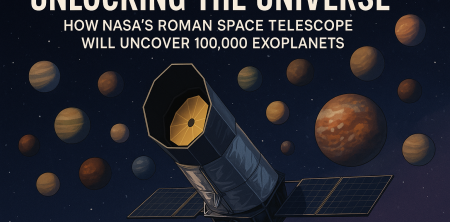
```html
The search for extraterrestrial life has captivated humanity for centuries, but recent advancements in technology are set to transform our understanding of the cosmos. At the forefront of this exploration is NASA's Nancy Grace Roman Space Telescope, a groundbreaking mission expected to uncover approximately 100,000 exoplanets beyond our solar system. This ambitious endeavor promises to redefine astronomy and deepen our understanding of the Milky Way, providing tantalizing insights into potentially habitable worlds. In this article, we will explore the capabilities of the Roman Space Telescope, the significance of its discoveries, and what this means for our quest to answer the age-old question: Are we alone in the universe?
The Roman Space Telescope: A Leap into the Future
Scheduled for launch in the mid-2020s, the Roman Space Telescope is a revolutionary project that aims to expand our knowledge of the universe. Named after the pioneering astrophysicist Nancy Grace Roman, who was instrumental in the development of the Hubble Space Telescope, this mission will focus on the detection and analysis of exoplanets. With an expected inventory of around 100,000 new worlds, the Roman Space Telescope is poised to propel the field of astronomy into new frontiers.
The telescope's primary instrument will be a wide-field camera that provides a panoramic view of the sky, allowing astronomers to observe large swathes of the Milky Way simultaneously. This capability sets the Roman Space Telescope apart from its predecessors and will enable the identification of exoplanets at an unprecedented scale and efficiency. This innovative approach represents a significant leap in our ability to survey the cosmos, making it an exciting time for both scientists and space enthusiasts alike.
Unveiling the Hidden Worlds of the Milky Way
Historically, the search for exoplanets has been a challenging endeavor due to their distant nature and the overwhelming brightness of their host stars. NASA's Kepler mission, which discovered nearly 2,400 exoplanets, relied on a method known as the transit method, where astronomers detected the dimming of a star as a planet passed in front of it. While this technique has proven successful, it has its limitations and can only survey a small fraction of the sky at any given time.
The Roman Space Telescope will utilize a combination of the transit method and gravitational microlensing to uncover new worlds. Gravitational microlensing occurs when a massive object, such as a star or planet, passes in front of another distant star, causing a temporary increase in brightness. This method allows scientists to detect planets that may have previously gone undetected, especially those located in the habitable zones of their stars.
The Anticipated Impact on Exoplanet Research
The Roman Space Telescope's mission will dramatically increase the number of known exoplanets, opening up new avenues for research and discovery. The estimated 100,000 exoplanets will provide a wealth of data that can help scientists understand the diversity of planetary systems, including those that may resemble our own. This expansive dataset will enable researchers to draw comparisons between various planetary environments, enhancing our knowledge of planetary formation and evolution.
Moreover, understanding the composition and atmospheres of these newfound exoplanets could shed light on the potential for life beyond Earth. As we identify more Earth-like planets situated in the habitable zones of their stars, we inch closer to answering the enduring question of extraterrestrial life.
Preparing for Launch: The Technical Specifications
The Roman Space Telescope is set to launch aboard a Falcon Heavy rocket, one of the most powerful launch vehicles available. It will be positioned at the second Lagrange point (L2), approximately 1.5 million kilometers from Earth. This location provides a stable vantage point for observing the cosmos while minimizing interference from Earth's atmosphere and light.
With a primary mirror measuring 2.4 meters in diameter—comparable to the Hubble Space Telescope—the Roman Space Telescope is equipped to capture high-resolution images across a wide field of view. Its wide-field instrument will cover an area 100 times larger than that of Hubble, allowing astronomers to survey vast regions of the Milky Way efficiently.
The Broader Implications of Discovering 100,000 Exoplanets
As we anticipate the launch of the Roman Space Telescope, the implications of discovering 100,000 exoplanets extend far beyond mere numbers. Such discoveries will prompt essential questions about planetary habitability, the potential for life, and the formation of solar systems. By comparing the characteristics of these new exoplanets with our own, scientists can gain insights into the conditions that foster life. (See: NASA's Roman Space Telescope mission.)
Additionally, the findings from the Roman Space Telescope are expected to foster collaboration among international research teams, enhancing our collective understanding of the universe. As astronomers analyze data and share findings, the global scientific community will work towards unraveling the mysteries of the cosmos together.
Challenges and Opportunities in Exoplanet Exploration
While the Roman Space Telescope presents exciting opportunities for discovery, it also faces challenges. The sheer volume of data generated by the telescope will require sophisticated algorithms and computational power to analyze. Researchers will need to develop new methods to sift through the vast datasets, identifying potential exoplanets while filtering out noise and false positives.
Moreover, the telescope's ability to detect exoplanets will be influenced by the qualities of the stars within the regions it surveys. Some stars may present unique challenges for detection, such as variability in brightness or proximity to other celestial bodies. Nonetheless, these challenges also represent opportunities for innovation in observational techniques and data analysis methods.
The Quest for Earth-like Planets
The Roman Space Telescope's primary objective includes the search for Earth-like planets that reside in the habitable zones of their host stars. The habitable zone is defined as the region around a star where conditions may be right for liquid water to exist—a critical ingredient for life as we know it. The discovery of such planets could have profound implications for our understanding of life's potential in the universe.
Identifying Earth-like exoplanets, particularly those that are similar in size and mass to our planet, enables scientists to assess their atmospheres and surface conditions. These analyses will provide critical insights into the chemical makeup of these worlds and their potential for sustaining life. The Roman Space Telescope will enhance our understanding of the distribution of Earth-like planets across the galaxy, potentially reshaping our perspective on where life might exist.
Future Missions and the Legacy of the Roman Space Telescope
As we look ahead, the Roman Space Telescope is expected to lay the groundwork for future missions and initiatives aimed at exploring exoplanets and their atmospheres. Its findings will contribute valuable data to upcoming space observatories, including the James Webb Space Telescope, which aims to study the atmospheres of selected exoplanets in detail.
The legacy of the Roman Space Telescope will extend beyond its mission duration, influencing the next generation of scientists and explorers. By providing a wealth of knowledge about the cosmos and our place within it, this mission will inspire young astronomers and ignite curiosity about the universe in the hearts of many.
Community Engagement and Public Interest
With such monumental discoveries on the horizon, public engagement and interest in the Roman Space Telescope are crucial. NASA will continue to share updates and findings throughout the mission, ensuring that the public remains informed and excited about the latest developments in exoplanet research. Engaging the public through outreach programs, educational initiatives, and interactive platforms will foster a deeper understanding of the universe and inspire future generations of scientists.
Moreover, as the Roman Space Telescope identifies new exoplanets, the potential for public participation in naming these worlds could generate excitement and foster a sense of connection with the discoveries being made. Initiatives that encourage citizen science, such as data analysis and exoplanet detection, will allow the public to contribute to our understanding of the cosmos.
Frequently Asked Questions about the Roman Space Telescope and Exoplanets
What is the primary mission of the Roman Space Telescope?
The primary mission of the Roman Space Telescope is to discover and study exoplanets, particularly those in the habitable zones of their stars. It aims to uncover around 100,000 new exoplanets, significantly expanding our knowledge of the cosmos.
How does the Roman Space Telescope detect exoplanets?
The Roman Space Telescope employs a combination of the transit method and gravitational microlensing. The transit method detects dips in star brightness caused by planets passing in front of them, while gravitational microlensing identifies planets when a massive object distorts the light from a distant star. (See: Nancy Grace Roman's contributions.)
What makes the Roman Space Telescope different from previous missions?
The Roman Space Telescope boasts a wide-field camera that allows it to survey large portions of the sky simultaneously. This is a significant enhancement compared to its predecessors, such as Kepler, which could only observe small portions of the sky at one time.
What are the implications of discovering Earth-like exoplanets?
Discovering Earth-like exoplanets could shed light on the conditions required for life, enabling scientists to assess the potential for existing life beyond Earth. This knowledge can help guide future missions aimed at studying these distant worlds in more detail.
How will the Roman Space Telescope contribute to our understanding of planetary formation?
The vast dataset generated by the Roman Space Telescope will allow scientists to analyze the characteristics of numerous planetary systems. By comparing these new worlds to our solar system, researchers can gain insights into the processes that lead to planetary formation and evolution.
What are the expected challenges in analyzing data from the Roman Space Telescope?
The challenges include managing the enormous volume of data generated and developing advanced algorithms to filter out noise and false positives in exoplanet detection. Researchers will need to innovate continuously to extract meaningful information from the datasets.
How can the public engage with the findings of the Roman Space Telescope?
NASA plans to involve the public through educational initiatives, outreach programs, and potentially through citizen science projects. This could include opportunities for the public to help analyze data or contribute to naming newly discovered exoplanets.
Comparative Analysis: Roman Space Telescope vs. Hubble and Kepler
To fully appreciate the advancements offered by the Roman Space Telescope, it is beneficial to compare its capabilities with those of previous missions, particularly the Hubble Space Telescope and the Kepler mission. Each of these missions has played a pivotal role in advancing our understanding of the universe, but they operate using different methodologies and with varying scopes.
The Hubble Space Telescope, launched in 1990, is renowned for its ability to capture high-resolution images of distant celestial objects. Its observations have provided insights into the age of the universe, the behavior of black holes, and the formation of galaxies. However, Hubble primarily focuses on a narrower field of view, limiting the number of stars and planets it can observe at one time. This means that while Hubble excels in detail, it cannot survey the vast regions of the sky that the Roman Space Telescope will.
On the other hand, the Kepler mission was specifically designed to find exoplanets using the transit method. Launched in 2009, Kepler focused on a small patch of the sky, monitoring approximately 150,000 stars for transiting planets. Despite its significant contributions, including the discovery of thousands of exoplanets, Kepler's limited field of view restricted its ability to provide a broader census of exoplanets across the entire Milky Way.
In contrast, the Roman Space Telescope's wide-field capability allows it to survey areas 100 times larger than Hubble, making it a powerful tool for discovering a multitude of exoplanets. By combining both the transit method and gravitational microlensing, the Roman Space Telescope can detect not only the larger exoplanets but also the smaller, potentially habitable ones that might be missed by its predecessors. (See: Scientific insights on exoplanets.)
Expert Perspectives on the Roman Space Telescope
Leading astronomers and astrophysicists have expressed enthusiasm about the potential of the Roman Space Telescope to revolutionize exoplanet research. Dr. Sarah Ballard, an astrophysicist at the Massachusetts Institute of Technology (MIT), emphasizes the telescope's capability to survey a significant volume of space. “The Roman Space Telescope will change the way we approach the search for life beyond Earth by providing a catalogue of exoplanets that we can study in detail,” she states. "We anticipate that it will help us identify targets for future missions, such as those aimed at characterizing atmospheres.”
In addition to Ballard, Dr. Jessie Dotson, the project scientist for the Roman Space Telescope, highlights the importance of collaboration facilitated by this mission. “The wealth of data will not only benefit individual researchers but also encourage collaborative efforts that can lead to groundbreaking discoveries,” she notes. This sentiment reflects the broader scientific community’s excitement about the opportunities for international cooperation created by the massive datasets produced by the telescope.
Statistics and Projections: The Exoplanet Landscape
Astrophysical data suggests that there may be billions of exoplanets in our galaxy alone, with estimates indicating that roughly 50% of all stars have at least one planet orbiting them. With the Roman Space Telescope expected to discover about 100,000 new exoplanets, we can anticipate a significant leap in our understanding of planetary systems.
According to recent statistics from the NASA Exoplanet Archive, prior missions have confirmed around 5,500 exoplanets to date. With the Roman Space Telescope’s capabilities, scientists project that the number of known exoplanets could increase tenfold, offering a more comprehensive picture of planetary diversity. This influx of data will not only enhance our understanding of the prevalence of Earth-like planets but also help identify other candidates that may harbor life.
The Potential for New Discoveries
As we consider the implications of the Roman Space Telescope's mission, we can also speculate about types of discoveries that could reshape our understanding of the cosmos. For instance, the potential discovery of exomoons—moons that orbit exoplanets—could introduce new dimensions to our search for life. Research indicates that some moons may possess the right conditions for life, particularly those that are located within the habitable zones of their host planets.
Additionally, the identification of different planetary compositions and atmospheric conditions will help scientists understand the spectrum of potential habitats available across the galaxy. By analyzing atmospheres for biosignatures—chemical indicators of life—scientists could narrow down targets for future exploration and study, especially when considering the next generation of telescopes aimed at direct imaging of these distant worlds.
Conclusion: A New Era in Astronomy
The Roman Space Telescope is set to usher in a new era in astronomy, with its potential to uncover approximately 100,000 exoplanets reshaping our understanding of the universe. By expanding the known census of worlds beyond our solar system, this mission will provide insights into planetary formation, habitability, and the potential for extraterrestrial life. As we eagerly await its launch and the discoveries that lie ahead, the Roman Space Telescope stands as a beacon of hope in our quest to understand our place among the stars.
```
Trending Now
Frequently Asked Questions
What is NASA's Roman Space Telescope?
NASA's Roman Space Telescope is a groundbreaking mission set to launch in the mid-2020s, designed to discover approximately 100,000 exoplanets beyond our solar system. Named after astrophysicist Nancy Grace Roman, it will utilize a wide-field camera to survey large areas of the Milky Way, enhancing our understanding of the universe.
How will the Roman Space Telescope find exoplanets?
The Roman Space Telescope will employ a wide-field camera to capture panoramic views of the sky, allowing it to detect and analyze exoplanets more efficiently than previous telescopes. This capability will enable astronomers to observe vast regions of the Milky Way simultaneously, uncovering new worlds at an unprecedented scale.
Why is the Roman Space Telescope important for astronomy?
The Roman Space Telescope is significant because it will revolutionize our understanding of the cosmos by potentially uncovering 100,000 exoplanets. Its advanced technology will allow for more extensive surveys of the Milky Way, providing insights into potentially habitable worlds and the search for extraterrestrial life.
What are exoplanets and why do they matter?
Exoplanets are planets located outside our solar system. They are crucial to the study of astronomy as they may harbor conditions suitable for life. The discoveries made by missions like the Roman Space Telescope could help answer fundamental questions about our existence and the possibility of life elsewhere in the universe.
When will the Roman Space Telescope be launched?
The Roman Space Telescope is scheduled for launch in the mid-2020s. This mission aims to significantly advance our knowledge of exoplanets and the Milky Way, marking a new era in astronomical research and exploration.
What's your take on this? Share your thoughts in the comments below — we read every one.

