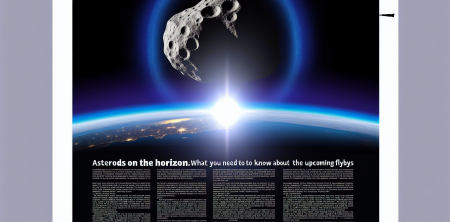
On April 29, 2026, Earth will experience a remarkable celestial event as two sizable asteroids, designated as 2026 HL3 and 2026 HP3, will skim past our planet. NASA has confirmed that these asteroids will pass at distances of 1.6 million miles and 3.68 million miles respectively, a safe margin that poses no threat to life on Earth.
Understanding Near-Earth Objects
Near-Earth Objects (NEOs) are asteroids and comets that have been nudged by the gravitational attraction of nearby planets into orbits that allow them to enter the Earth's neighborhood. The monitoring of NEOs has become a significant focus for space agencies worldwide, particularly NASA, as we strive to understand and mitigate potential risks posed by these celestial bodies.
Asteroid Details
The two asteroids set to pass by our planet in 2026 are described as being approximately the size of an airplane. This comparison helps to contextualize their size for the general public, facilitating a better understanding of their scale in relation to familiar objects.
- 2026 HL3: This asteroid will pass at a distance of approximately 1.6 million miles from Earth.
- 2026 HP3: This larger asteroid is expected to come closer, at a distance of around 3.68 million miles.
The Science Behind Monitoring Asteroids
NASA and other space agencies utilize advanced telescopes and radar systems to track the orbits and physical characteristics of NEOs. This monitoring allows scientists to predict the trajectories of these objects and assess any potential threats they may pose. In the case of 2026 HL3 and 2026 HP3, scientists have confirmed their paths and distances, leading to a collective sigh of relief in the scientific community.
Why No Alarm?
Despite the size of these asteroids, astronomers are not alarmed. The vast distances at which these asteroids will pass indicate that they will not interact gravitationally with Earth. Furthermore, the trajectory of these bodies has been established with high precision, thanks to ongoing observations and predictive modeling.
Public Interest and Awareness
Events like the upcoming flyby of 2026 HL3 and 2026 HP3 serve to engage the public's interest in space and astronomy. They highlight the importance of planetary defense and the continuous efforts to track and study NEOs. The fact that these asteroids will pass at a safe distance can also help to alleviate public fear regarding asteroid impacts, which can often be sensationalized in media.
International Collaboration in Space Observation
The tracking and monitoring of asteroids are not solely the responsibility of NASA. Many countries have established their own space agencies, and international collaborations have become increasingly important in this field. Organizations such as the European Space Agency (ESA), Japan's JAXA, and India's ISRO contribute valuable data and resources, enhancing our collective understanding of NEOs and improving our global response capabilities.
What Happens Next?
As the date draws nearer, scientists will continue to observe 2026 HL3 and 2026 HP3. This includes studying their composition and physical characteristics, which can provide insights into the early solar system and the formation of planetary bodies. Understanding these asteroids is crucial, as it can inform future missions aimed at asteroid mining or even deflection strategies should a potentially hazardous object be identified.
Continued Monitoring and Research
NASA's Near-Earth Object Observations Program plays a vital role in the detection and tracking of asteroids. This program is responsible for identifying new NEOs and monitoring known ones. The information gathered helps to refine our models of their orbits, ensuring that any potential threats can be identified well in advance.
Broader Implications of Asteroid Studies
Understanding asteroids is not only about planetary defense; it also has implications for space exploration and resource utilization. Many scientists believe that asteroids could serve as valuable sources of materials for future space missions, including water and metals crucial for sustaining life and building infrastructure in space.
Potential for Future Missions
As technology advances, the feasibility of future missions to asteroids increases. The success of missions such as NASA's OSIRIS-REx and Japan's Hayabusa2 has sparked interest in returning samples from asteroids to Earth for analysis. These missions have the potential to unlock secrets about the origins of our solar system and the building blocks of life.
Conclusion
The upcoming flyby of asteroids 2026 HL3 and 2026 HP3 on April 29, 2026, is an exciting event that underscores the importance of continuous monitoring of near-Earth objects. With no cause for alarm, scientists and astronomers remain vigilant, ensuring that we are prepared for any future encounters. As we enhance our understanding of these celestial bodies, we also lay the groundwork for the future of space exploration and the potential utilization of extraterrestrial resources.
In the realm of space and astronomy, knowledge is power. The more we learn about asteroids and their behavior, the better equipped we become to protect our planet and explore the cosmos beyond.

