```html
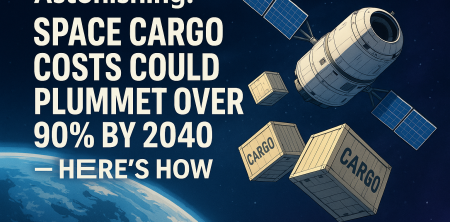
The landscape of space exploration is on the verge of a seismic shift. A new study led by researchers at Cambridge University has revealed that space cargo costs are projected to fall by over 93% by the year 2040. This study challenges long-held assumptions about the financial barriers to entry in space, providing a compelling glimpse into a future where access to the cosmos may not be a privilege reserved for a select few.
The Current State of Space Cargo Costs
As of last year, the cost to transport cargo to low Earth orbit (LEO) stood at a staggering $3,868 per kilogram. This figure may seem insurmountable, especially to those outside the aerospace sector. However, the projected fall in costs is not just a minor adjustment; it represents a fundamental reconfiguration of our economic relationship with space. By 2030, costs are expected to decrease to $1,569 per kilogram, marking a reduction of more than 58% within a decade.
Such drastic reductions could open up space to commercial enterprises and scientific research in ways we have not yet fully imagined. Think of the possibilities: larger satellite constellations, more frequent resupply missions to the International Space Station, and even burgeoning industries like space tourism and asteroid mining.
A Deep Dive into the Cambridge Study
The Cambridge study, which has gained traction on social media due to its surprising conclusions, draws on a combination of advancements in technology, economies of scale, and increased competition among providers. The study's authors have meticulously calculated the various factors that will contribute to this decline in costs, each one supported by real-world examples.
For instance, advancements in reusable rocket technology, as pioneered by companies like SpaceX, have already begun to drive costs down. When rockets can be reused multiple times, the per-launch cost diminishes significantly. This is just one of several mechanisms that will facilitate the anticipated drop in space cargo costs.
Driving Factors Behind Cost Reduction
So, what are the main drivers that will contribute to the anticipated decrease in space cargo costs? Here are several key factors:
- Technological Advancements: Innovations in propulsion systems, materials science, and spacecraft design will all play crucial roles in reducing costs.
- Increased Competition: As new players enter the market, existing companies will be compelled to innovate and reduce prices.
- Economies of Scale: With more launches occurring, the fixed costs of launch infrastructure can be spread across more missions.
- Government Initiatives: Supportive policies and funding from governments can spur private sector growth and innovation.
The Implications for Space Tourism
One of the most exciting implications of falling space cargo costs is the potential for space tourism to become a reality for more than just the ultra-wealthy. Companies like Blue Origin and Virgin Galactic are already making strides in this area, but high launch costs have limited their reach. If costs continue to spiral downward as predicted, we might soon see vacation packages to orbit or even stays in space hotels.
Imagine being able to book a trip to low Earth orbit for the price of a luxury vacation. The dream of seeing Earth from space could soon become attainable for a much broader audience. This could ignite a new era of exploration, innovation, and inspiration for generations to come. We covered Countdown to ISS retirement in more detail.
Asteroid Mining: A New Frontier
Another fascinating aspect of the study's implications is the prospect of asteroid mining. With the cost of sending equipment and personnel to asteroids expected to decrease dramatically, the feasibility of extracting valuable resources from these celestial bodies is becoming more realistic. Asteroids contain a wealth of minerals, including precious metals and rare earth elements, that are increasingly sought after on Earth.
As the space cargo costs decline, companies could envision fleets of robotic miners scouring the asteroid belt, extracting resources that could be brought back to Earth or used in space construction projects. This would not only revolutionize resource availability but could also alleviate some of the environmental pressures we face on our planet by reducing the need for mining on Earth.
Global Satellite Networks and Connectivity
As we look toward the future, falling space cargo costs could also facilitate the expansion of global satellite networks. Companies like Starlink are already working to provide internet access to remote areas around the globe through satellite constellations. With significantly reduced launch costs, these companies can deploy more satellites, enhancing coverage and bandwidth. (See: International Space Station missions.)
The implications for global connectivity are profound, especially in rural or underserved areas. Enhanced internet access can lead to improved education, healthcare, and economic opportunities for communities that previously lacked reliable connectivity.
Challenges and Considerations
While the projections from the Cambridge study are optimistic, the road to significantly lower space cargo costs is not without its challenges. For every technological advancement, there are regulatory hurdles, safety concerns, and environmental impacts that need to be addressed.
For instance, as more rockets are launched, the issue of space debris becomes increasingly pressing. The more we utilize space, the greater the risk that we will encounter or create debris that could pose a threat to operational satellites and crewed spacecraft. How will the industry balance growth with sustainability? This question remains largely unanswered.
Investor Interest and the Commercial Landscape
The implications of decreasing space cargo costs also extend to the investment landscape. With the prospect of dramatically reduced costs, investors are likely to take a renewed interest in aerospace technologies and companies. This influx of capital could spur innovation and accelerate the timeline for various projects.
Moreover, the shift in public perception about space being accessible to the average person could lead to an explosion of entrepreneurial ventures aimed at capitalizing on new opportunities. From satellite-based applications to tourism experiences, the market could become saturated with diverse options, each vying for consumer attention.
Public Engagement and Awareness
As the narrative around space cargo costs begins to change, public engagement is more important than ever. Educating the broader public about the possibilities of space exploration and the decreasing costs associated with it can foster interest and support for future initiatives.
Outreach efforts, public events, and educational programs can help demystify space travel and inspire the next generation of scientists, engineers, and explorers. The more we collectively understand and engage with the possibilities of space, the more likely we are to see continued progress in this field.
Innovative Approaches to Space Cargo Transport
As space travel becomes more accessible, unconventional methods of cargo transport are being explored. One such method is the concept of space elevators. While still in the realm of theoretical engineering, a space elevator could dramatically reduce the cost of transporting goods to orbit. By using a cable anchored to the Earth and extending into space, cargo could be lifted into orbit without the need for traditional rockets, potentially slashing space cargo costs even further.
Another innovative approach involves space tethers, which utilize the principles of momentum transfer to propel spacecraft. By deploying long, strong ropes (or tethers) in space, payloads can be accelerated without heavy propulsion systems, reducing fuel needs and overall transport costs. These emerging technologies could redefine how we think about moving goods in and out of Earth's gravitational influence.
International Collaboration and Space Policy
As the costs of accessing space decline, the importance of international collaboration will become increasingly significant. Countries around the world may form partnerships to share resources, technology, and research, leading to a more unified approach to space exploration. Collaborative missions could reduce costs even further and make ambitious projects, like establishing lunar bases or Mars colonies, more feasible.
However, this collaboration will require robust space policy frameworks to ensure that activities in space are conducted responsibly and sustainably. Establishing diplomatic agreements regarding resource utilization, debris management, and governance of orbital paths will be crucial to maintaining a positive international climate in space.
Statistics on Space Launch Growth
The space launch industry has seen exponential growth in recent years. According to the Satellite Industry Association, there were over 140 commercial launches in 2021, a significant increase from previous years. As launch costs continue to decrease, forecasts suggest that this number could triple by 2040, with potential for even higher rates of growth as new companies emerge and technologies mature. (See: NASA's new spacecraft developments.)
This increase in launch frequency will inherently lead to a greater understanding of space dynamics and the development of better technologies, creating a feedback loop that further drives down costs. Having more data and experience will also bolster safety and reliability, making space launches more appealing to investors and companies alike.
Space Cargo Costs' Impact on Scientific Research
Falling space cargo costs could revolutionize scientific research in ways that are currently hard to quantify. With lower costs, academic institutions and research organizations could send more experiments and equipment into orbit, enhancing our understanding of various scientific fields. For example, researchers could conduct long-term studies on the effects of microgravity on biological systems or materials, leading to breakthroughs in health sciences, materials science, and more.
Moreover, as the International Space Station (ISS) nears the end of its operational life, new platforms for scientific research in space will need to arise. If costs are manageable, private companies might build and operate their own research facilities in space, democratizing access to space for scientific inquiry.
Potential Future Scenarios
Imagining the future of space cargo costs invites us to consider various scenarios. One possibility is a thriving economy in low Earth orbit. With reduced costs, we might see a bustling market for not only scientific research, but also manufacturing. Companies could produce goods in space that benefit from the unique conditions found there, such as pharmaceuticals developed in microgravity. The potential for profit could drive even more innovation and investment.
Another scenario includes the establishment of space stations or habitats that serve multiple purposes, from research to tourism to industry. These facilities could become self-sustaining ecosystems, where the costs of transporting necessary cargo are minimized through efficient logistics and innovative technology.
FAQs about Space Cargo Costs
What are the current costs of launching cargo into space?
As of now, the cost to transport cargo to low Earth orbit is approximately $3,868 per kilogram. However, this figure is expected to drop significantly in the coming years.
What factors are contributing to the decrease in space cargo costs?
Key factors include technological advancements, increased competition, economies of scale, and supportive government initiatives. These elements collectively enable companies to lower their prices and make space more accessible.
How will lower cargo costs affect space tourism?
With falling space cargo costs, space tourism could become a viable option for a larger segment of the population. As costs decrease, more companies may enter the market, leading to competitive pricing for consumers and potentially making trips to space as common as luxury vacations.
What environmental concerns arise from increased space launches?
As more rockets are launched, the issue of space debris becomes a significant concern. Additionally, the environmental impact of rocket launches on Earth's atmosphere and ecosystems must be carefully managed to ensure that space exploration is sustainable.
How might international collaboration shape the future of space exploration?
International collaboration can facilitate shared resources, technology, and information, leading to more ambitious space missions and reduced costs. However, it will also require robust policies to ensure equitable use of space resources and sustainable practices.
Future Impacts on Global Economies
The reduction in space cargo costs is not just a technical or scientific breakthrough; it has the potential to reshape global economies. Imagine countries that were previously economically disadvantaged suddenly having access to space-based resources. Developing nations could leverage cheaper access to space to build satellite-based services, providing them with a competitive edge in the global market.
Furthermore, as space becomes more accessible, we may witness the emergence of new industries dedicated to space logistics, manufacturing, and services. The potential for job creation in these sectors could lead to an economic boom, especially in regions that invest in education and infrastructure related to space technologies.
Emerging Technologies and Their Role
New technologies are crucial in the drive to lower space cargo costs. For example, advancements in additive manufacturing (3D printing) could allow parts to be manufactured in space, reducing the need for transporting them from Earth. By producing components on-site at space stations or on lunar bases, the costs associated with transporting materials can be significantly reduced.
Additionally, the development of small satellite technologies is changing the game. CubeSats and other miniaturized satellites are cheaper to build and launch, making it feasible for more organizations to participate in satellite missions. This democratization of access can lead to greater innovation as a wider array of voices contribute to our understanding of space and its potential.
Space Policy and Regulation in a New Era
As the landscape of space exploration changes, so too must the policies governing it. The significant decrease in space cargo costs will likely lead to an increased number of participants in space activities. This necessitates updated regulations to prevent conflicts and ensure safe operations. For instance, establishing clear guidelines for satellite placement and end-of-life disposal will become increasingly important to avoid collisions and manage orbital debris.
Moreover, regulatory frameworks should adapt to encourage innovation while ensuring safety and sustainability. Policymakers will need to engage with scientists, engineers, and industry leaders to craft regulations that are flexible enough to accommodate rapid advancements in technology.
Conclusion: A New Era of Exploration Awaits
The findings of the Cambridge-led study paint an exhilarating picture of what the future could hold. The dramatic decrease in space cargo costs presents an opportunity not only for commercial enterprises but also for humanity as a whole. As we stand on the brink of this new era, we must embrace the possibilities and challenges that lie ahead, ensuring that space remains a domain for exploration, innovation, and, ultimately, human connection.
As we watch these changes unfold, it’s a thrilling time to be interested in space. The dreams of previous generations are quickly becoming a reality, and each step forward brings us closer to a future where space is not just a distant frontier but a part of everyday life.
```
Trending Now
Frequently Asked Questions
Why are space cargo costs expected to drop by 2040?
Space cargo costs are projected to drop by over 93% by 2040 due to advancements in technology, economies of scale, and increased competition among providers. Innovations in reusable rocket technology, as demonstrated by companies like SpaceX, are key factors in driving these cost reductions.
What is the current cost of transporting cargo to low Earth orbit?
As of last year, the cost to transport cargo to low Earth orbit (LEO) was approximately $3,868 per kilogram. This figure highlights the significant financial barriers currently faced in space exploration.
How will reduced space cargo costs impact commercial enterprises?
The drastic reduction in space cargo costs could open up new opportunities for commercial enterprises, enabling larger satellite constellations, more frequent resupply missions to the International Space Station, and the emergence of industries such as space tourism and asteroid mining.
What factors contribute to the decline in space cargo costs?
Several factors contribute to the decline in space cargo costs, including advancements in reusable rocket technology, increased competition among launch providers, and the scaling of operations which leads to economies of scale, all of which are supported by real-world examples.
What does the Cambridge study say about the future of space exploration?
The Cambridge study indicates that the future of space exploration could be dramatically transformed by 2040, as lower cargo costs may democratize access to space, allowing not only for scientific research but also for commercial ventures that were previously deemed too expensive.
What's your take on this? Share your thoughts in the comments below — we read every one.

