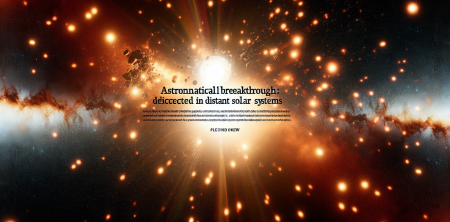
On March 14, 2026, a remarkable discovery emerged in the field of astronomy as researchers reported signs of exoplanets colliding in distant solar systems. This phenomenon, while not entirely new to scientists, provides fresh insights into the dynamic processes that govern planetary systems beyond our own. Such findings deepen our understanding of how celestial bodies interact and evolve over time, and they open new avenues for research into the complexities of planetary formation.
The Significance of Exoplanet Collisions
Exoplanets, or planets located outside our solar system, have been a focal point of astronomical research for several decades. The detection of exoplanet collisions is particularly significant as it offers a glimpse into the chaotic nature of planetary formation and migration. These collisions can occur due to gravitational interactions, leading to dramatic changes in the structure and composition of planetary systems.
While the details concerning the specific exoplanets involved in these collisions were not disclosed, the implications of such events are profound. Collisions between exoplanets can lead to:
- Planetary Disruption: Collisions can fragment planets, potentially creating debris fields that may form new moons or even other planets over time.
- Atmospheric Changes: The impacts can strip away atmospheres or alter the orbits of the involved bodies, affecting their potential for habitability.
- Insight into Formation Mechanisms: Studying the aftermath of collisions can provide clues about how planets form and evolve in various environments.
Previous Observations and Research
The study of planetary collisions is not new. Astronomers have previously observed similar events within our solar system, including the well-documented impact of a Mars-sized body, Theia, with the early Earth, leading to the formation of the Moon. These historical events serve as analogs for understanding how collisions might play out in other solar systems.
Prior research has indicated that collisions are more common in the early stages of planetary system development when the bodies are still in the process of gathering mass and forming stable orbits. As systems mature, the frequency of such catastrophic events generally decreases, but they can still occur, especially in crowded systems.
Current Research and Future Implications
The detection of exoplanet collisions is part of a broader effort to study the dynamics of planetary systems. Astronomers utilize various methods to detect and analyze these distant worlds, including:
- Transit Method: Observing the dimming of stars as planets pass in front of them.
- Radial Velocity Method: Measuring the wobble of stars caused by the gravitational pull of orbiting planets.
- Direct Imaging: Capturing images of exoplanets by blocking out the light from their parent stars.
These techniques have led to the discovery of thousands of exoplanets, many of which exist in multi-planet systems where interactions are more likely. As telescopes continue to improve and more data becomes available, researchers anticipate that they will uncover additional evidence of collisions and other dynamic processes.
The Broader Context of Exoplanet Studies
The study of exoplanets has immense implications for understanding the universe and our place within it. By studying collisions and other interactions between celestial bodies, scientists can:
- Explore Habitability: Determine how planetary environments can change over time and what conditions might support life.
- Examine Chemical Composition: Investigate the materials that make up these distant worlds, providing clues about their formation and evolution.
- Refine Models of Planet Formation: Enhance our theoretical frameworks for how planetary systems develop and change.
Conclusion
The detection of colliding exoplanets represents a significant advancement in our understanding of planetary systems beyond our own. As astronomers continue to unravel the complexities of these distant worlds, each discovery adds a piece to the puzzle of how planets form, evolve, and interact in the cosmos. The implications of such findings are vast, potentially reshaping our understanding of planetary dynamics and the conditions necessary for life.
As research progresses, we can expect to learn more about the specific exoplanets involved in these collisions and the broader context of their formations. The ongoing exploration of exoplanets not only enhances our knowledge of the universe but also fuels our curiosity about the potential for life beyond Earth.

