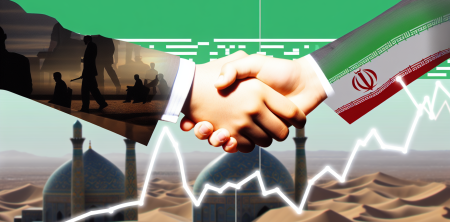
The ongoing conflict in Iran has drawn significant global attention, especially as recent signals from the Iranian president suggest a potential ceasefire. This development has sparked discussions about the implications for markets and economies, particularly in Asia and beyond. In the latest episode of Bloomberg's 'The China Show', analysts delve into these geopolitical shifts and their economic ramifications.
Shifting Tides: Ceasefire Signals from Iran
As of early April 2026, President Ebrahim Raisi of Iran has indicated a willingness to explore ceasefire options, marking a notable shift in Iran's approach to the ongoing conflict. This pivot has generated optimism among investors and analysts, who view it as a potential turning point that could lead to a broader stabilization of the region. The ceasefire signals have not only raised hope for peace but have also influenced global market sentiment.
The Impact on Global Markets
Market reactions to these developments have been significant. Analysts on 'The China Show' highlighted that the stock markets across Asia, notably in China, have shown positive movement following the news of a possible cessation of hostilities. The sentiment within these markets is driven by the prospect of increased trade and investment opportunities that could arise if the conflict comes to an end.
In particular, commodities markets have reacted with increased volatility, reflecting concerns about supply disruptions that have plagued the region throughout the conflict. A ceasefire could stabilize oil prices, which have seen extreme fluctuations due to geopolitical tensions.
Economic Implications for China
As the world's second-largest economy, China's economic stability is intricately linked to developments in the Middle East. With Iran being a significant player in global oil production, any resolution in the conflict could have substantial implications for China's energy imports. Analysts suggest that a stable Iran could allow China to negotiate better terms for oil imports, thus strengthening its energy security.
Moreover, improved relations with Iran could enhance China's Belt and Road Initiative (BRI), which aims to bolster trade and infrastructure development across Asia and beyond. With peace in Iran, the potential for increased investment flows could foster economic growth in both nations.
Geopolitical Dynamics and Economic Policy
The shift towards a potential ceasefire is not merely a local issue; it has broader geopolitical implications that affect global economic policy. Analysts argue that the international community, particularly Western powers, will be closely watching Iran's next moves. A successful negotiation could lead to a reevaluation of sanctions and trade restrictions, further influencing economic policies across Asia.
For instance, if the United States and European nations take steps to ease sanctions on Iran, it could lead to an influx of Iranian oil into the global market. This could significantly impact oil prices and overall economic stability in regions dependent on oil imports.
Risks and Uncertainties
Despite the optimistic outlook presented by the ceasefire signals, experts caution that uncertainties remain. The complexities of Iranian politics, regional rivalries, and the historical context of the conflict all contribute to a landscape fraught with potential setbacks. The peace process may be tenuous, with various factions within Iran and neighboring countries having differing interests and agendas.
- Internal Politics: Iran's internal political landscape could complicate efforts toward a lasting peace. Different factions within the government may have divergent views on how to proceed.
- Regional Tensions: Neighboring countries, particularly those with strained relations with Iran, may resist any agreements that could strengthen Iran's position in the region.
- Global Economic Factors: The global economy is still recovering from the impacts of the COVID-19 pandemic, which adds another layer of uncertainty to how quickly markets can stabilize following a ceasefire.
Conclusion: A New Chapter on the Horizon?
The signals from Iranian leadership regarding a possible ceasefire are creating ripples across global markets and economic policies. If peace can be achieved, the implications for trade, energy security, and geopolitical relations could be profound, particularly for China and other nations closely tied to the region.
However, as the analysts on Bloomberg's 'The China Show' emphasize, the path to a sustainable peace remains fraught with challenges. Stakeholders across sectors must remain vigilant and adaptive to the evolving situation, as the outcome of these geopolitical developments will undoubtedly shape the economic landscape in the years to come.

