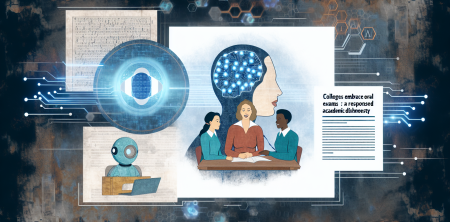
In an era where artificial intelligence (AI) tools are increasingly being utilized by students for completing assignments, colleges are rethinking their assessment strategies. To combat the rise of AI-driven cheating, educational institutions are adopting oral examinations as a robust alternative to traditional written assignments. This shift aims to foster genuine understanding and critical thinking among students, ensuring that they engage deeply with the material rather than relying on AI-generated answers.
The Challenge of AI in Education
As technology continues to advance, the accessibility and capabilities of AI tools have made it easier for students to obtain perfect solutions to their homework and projects. This phenomenon raises significant concerns regarding academic integrity, as many students may turn to these technologies rather than developing their own comprehension and analytical skills.
According to recent studies, many students are using AI applications to generate essays, solve complex problems, and even complete entire projects. While these tools can offer significant learning resources, the reliance on them can undermine the educational process. The emphasis on perfect answers produced by algorithms can lead to a superficial understanding of the subject matter, ultimately hindering academic growth.
The Shift Towards Oral Exams
In light of these challenges, colleges are increasingly implementing oral exams as a method to assess students' understanding and critical thinking abilities. Oral examinations involve students verbally expressing their knowledge and reasoning in response to questions posed by instructors. This format not only provides instructors with a clearer picture of a student's comprehension but also encourages students to articulate their thoughts and engage in meaningful dialogue about the subject.
Many educators believe that oral exams can serve as a powerful tool to counteract the potential for academic dishonesty associated with written submissions. By requiring students to explain concepts verbally, instructors can assess their depth of knowledge and their ability to think on their feet—skills that are often compromised when students rely solely on AI-generated content.
Benefits of Oral Exams
- Enhanced Understanding: Oral exams compel students to truly understand the material, as they cannot rely on written aids or external resources.
- Critical Thinking Development: Engaging in verbal assessments promotes critical thinking, as students must analyze and articulate their thoughts effectively.
- Immediate Feedback: Instructors can provide real-time feedback during oral exams, allowing for immediate clarification and learning opportunities.
- Personal Interaction: Oral assessments foster a more personal connection between students and instructors, enhancing the overall educational experience.
Implementing Oral Assessments
While the transition to oral exams may seem daunting for both students and instructors, many colleges are finding innovative ways to incorporate this assessment method into their curricula. Institutions are offering training sessions and resources for faculty to help them design effective oral examination formats. Additionally, some colleges are adopting blended approaches, where oral assessments complement traditional written exams, providing a more holistic evaluation of student performance.
Furthermore, schools are exploring technology-enhanced oral assessments, where students can use video conferencing tools to present their knowledge remotely. This flexibility can accommodate various learning styles and preferences while maintaining the integrity of the evaluation process.
Addressing Student Concerns
As with any significant change in assessment methods, there are concerns among students regarding the implementation of oral exams. Many students express anxiety about speaking in front of peers or instructors, fearing that their performance will be judged harshly. To alleviate these concerns, colleges are emphasizing the importance of preparation and practice in the lead-up to oral assessments.
Institutions are also encouraging a supportive environment where students can engage in mock oral exams or practice sessions. These initiatives aim to build confidence and reduce anxiety, ensuring that students view oral assessments as a valuable opportunity for learning rather than a source of stress.
The Future of Assessments in Higher Education
The shift towards oral examinations represents a broader trend in higher education as institutions seek to adapt to the challenges posed by AI and other technological advancements. As the landscape of academic integrity evolves, colleges are committed to finding innovative solutions that promote genuine learning and critical thinking.
In conclusion, the adoption of oral exams is a proactive measure to ensure that students are not only consuming information but are also engaging with it meaningfully. By emphasizing comprehension and articulation over rote memorization or reliance on AI tools, colleges aim to cultivate a generation of learners equipped with the skills necessary for success in an increasingly complex world.

