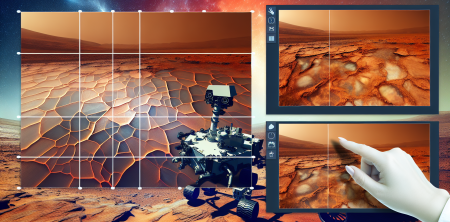
NASA's Curiosity rover continues to be a pioneering force in the exploration of Mars, providing invaluable insights into the planet's geological history. Recently, the rover captured images of intriguing spiderweb-like ridges, which are believed to be remnants of ancient water flows or seasonal gas eruptions beneath the Martian surface. These formations, visible from orbit, contribute significantly to our understanding of Mars’ wetter past and ongoing geological activity.
The Discovery of Spiderweb Ridges
Curiosity has been operating within the Gale Crater since its landing in August 2012, and it has been instrumental in analyzing the Martian landscape for signs of past habitability. The newly discovered ridges, which resemble a delicate spiderweb, are situated in a region that also shows evidence of dried riverbeds, suggesting that water once flowed in this area.
Understanding the Geological Significance
The spiderweb ridges are a fascinating aspect of Mars’ geological features. Their formation likely stems from either:
- Ancient Water Flows: These ridges may have been created by the movement of water across the surface, which would have left behind these distinctive patterns.
- Seasonal Gas Eruptions: Another possibility is that these structures were formed by gas eruptions from beneath the surface, which could occur periodically.
Both scenarios suggest a dynamic history for Mars, one that includes periods of water activity and geological shifts. The existence of these ridges aligns with other findings that point to a once more hospitable environment on Mars, further fueling interest in the planet's potential for past life.
Evidence of Water on Mars
Water is a crucial element in the search for life, and the discovery of these ridges enhances our understanding of Mars' hydrological history. The rover's findings complement previous studies that have indicated:
- Riverbeds and Lake Deposits: The Gale Crater itself is home to deposits that resemble ancient riverbeds and lake sediments, indicating that liquid water was present in the past.
- Mineral Indicators: Curiosity has found various minerals, such as clays and sulfates, that typically form in the presence of water.
These findings collectively suggest a complex interaction of water with the Martian environment, pointing to a time when the planet may have been more Earth-like.
The Role of Curiosity Rover
Since its arrival on Mars, the Curiosity rover has been equipped with a suite of scientific instruments designed to analyze the planet's surface and atmosphere. Its capabilities include:
- Imaging: High-resolution cameras that capture detailed images of the Martian landscape, including the newly discovered spiderweb ridges.
- Spectroscopy: Techniques to analyze the composition of rocks and soil, which help identify minerals and assess their origins.
- Environmental Monitoring: Instruments that measure atmospheric conditions, provide insights into weather patterns, and help understand seasonal changes.
These tools have allowed scientists to gather a wealth of data, contributing to a more comprehensive understanding of Mars’ history and its potential to support life.
Future Exploration and Research
The discoveries made by Curiosity not only deepen our understanding of Mars but also set the stage for future missions. NASA and other space agencies are planning additional explorations that will:
- Investigate the Gale Crater Further: Future missions may aim to explore other areas of Gale Crater to uncover more geological features that could provide insight into Mars’ climate history.
- Sample Return Missions: Plans for missions that would return Martian soil and rock samples to Earth are being developed, which could yield even more information about the planet’s past.
As technology advances, the ability to analyze and interpret Martian data will only improve, potentially leading to groundbreaking discoveries about our neighboring planet.
Conclusion
The discovery of spiderweb ridges by NASA's Curiosity rover is a significant addition to our understanding of Mars' geological history. These formations hint at ancient water flows and possible gas eruptions, reinforcing the idea that Mars once harbored conditions suitable for life. As Curiosity continues its mission, it will undoubtedly uncover more secrets of the Red Planet, fueling our curiosity about the universe and our place within it.

