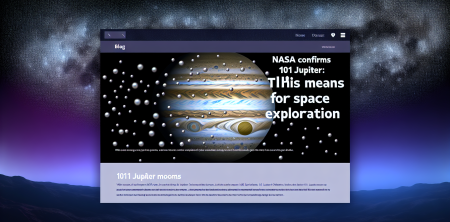
The exploration of our solar system has always been a source of fascination, captivating the minds of scientists and amateurs alike. Recently, NASA announced a groundbreaking update: as of March 2026, Jupiter is confirmed to have 101 officially recognized moons. This stunning revelation not only enhances our understanding of the largest planet in our solar system but also marks a significant achievement in space exploration.
The Fascinating World of Jupiter's Moons
Jupiter, a gas giant composed primarily of hydrogen and helium, has long been known for its spectacular features, including its Great Red Spot and a magnetic field that surpasses all others in the solar system. However, the recent discovery of its 101 moons has shifted the focus on Jupiter's satellite system. This update has revealed the complexity and richness of its moon system, making Jupiter the planet with the most moons in our solar neighborhood.
A Brief History of Moon Discoveries
Jupiter’s moons have been a subject of study since the early 17th century when Galileo Galilei first observed the four largest moons—Io, Europa, Ganymede, and Callisto—in 1610. These four moons, known as the Galilean moons, have intrigued scientists due to their unique characteristics and potential for hosting life. Over the centuries, astronomers have continued to discover smaller moons orbiting Jupiter, leading to the recent impressive figure of 101.
What Does This Mean for Astronomy?
The confirmation of 101 Jupiter moons is not merely a number; it signifies a deeper understanding of the dynamics of planetary systems. This milestone challenges previous assumptions about the formation and evolution of moons around gas giants.
Each moon has its own unique story and characteristics, which contribute to our understanding of celestial mechanics and planetary formation. Researchers are now faced with the exciting challenge of studying these moons to uncover their origins, compositions, and potential for supporting life.
Understanding the Diversity of Jupiter's Moons
The newly recognized moons vary greatly in size, shape, and composition. Some of them are larger and have been studied extensively, while others are smaller and less understood. Below are some key categories of Jupiter's moons:
- Galilean Moons: These are the four largest moons—Io, Europa, Ganymede, and Callisto. They have been the focus of many studies due to their geological activity and potential for life.
- Irregular Moons: Many of Jupiter's smaller moons fall into this category. They often have irregular orbits and are thought to be captured asteroids or fragments from larger moons.
- Inner Moons: These are smaller moons that orbit close to Jupiter and may be remnants of a larger moon that was torn apart by the planet's intense gravity.
The Implications of Ongoing Discoveries
The continuous identification of new Jovian moons highlights an essential aspect of contemporary astronomy: our understanding of the universe is not static. As technology advances and observational techniques improve, astronomers are able to detect smaller objects in the planetary systems more efficiently. This trend suggests that even more moons may be discovered in the future, which could reshape our understanding of Jupiter's extensive satellite system.
The Role of Technology in Discovering Jupiter Moons
Modern telescopes and imaging techniques have revolutionized our ability to explore distant celestial bodies. Instruments such as the Hubble Space Telescope and ground-based observatories have significantly enhanced our observational capabilities, allowing us to identify and confirm new moons with greater precision.
Furthermore, missions like NASA's Juno spacecraft, which has been studying Jupiter since 2016, have provided invaluable data about the planet and its moons. The information gathered by Juno has been pivotal in understanding Jupiter's atmosphere, magnetic field, and the dynamics of its moons.
Public Fascination and Educational Impact
The discovery of 101 Jupiter moons has captured the public imagination like few other astronomical milestones in recent history. This interest is driven by both the visual appeal of the planets and the inherent human curiosity about the universe. Understanding more about Jupiter and its moons can foster education and engagement with astronomy, making complex scientific concepts more accessible to a wider audience.
Engaging Future Generations
As the number of known moons around Jupiter increases, so does the potential for inspiring future generations of scientists and enthusiasts. Schools and educational programs can leverage this excitement to encourage interest in STEM (Science, Technology, Engineering, and Mathematics) fields. By showcasing the wonders of our solar system, educators can inspire students to explore the mysteries of space.
Conclusion: A New Era of Discovery
The confirmation that Jupiter has 101 officially recognized moons is a landmark achievement in the realm of space exploration. This milestone not only enriches our understanding of the gas giant and its satellite system but also prompts us to consider the broader implications for planetary science. With ongoing advancements in technology and exploration, the future holds immense potential for further discoveries that could unveil the secrets of our solar system.
As we continue to explore the cosmos, one thing is certain: the fascination with Jupiter and its moons will endure, driving us to seek answers to the questions that lie beyond our planet.

