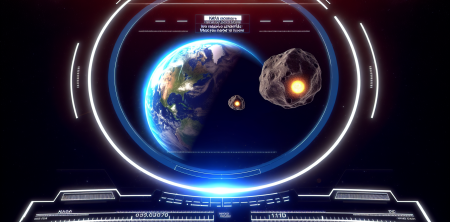
On April 2, 2026, two near-Earth asteroids are set to make their close approach to our planet, prompting NASA to issue alerts regarding their trajectories and sizes. While the asteroids will pass safely at a distance far beyond the Moon's orbit, their presence serves as a reminder of the dynamic nature of our solar system.
Meet the Asteroids: 2026 FD4 and 2026 FQ8
The first of the pair, asteroid 2026 FD4, measures approximately 31 feet (9.5 meters) in diameter, a size comparable to that of a large bus. Its trajectory will take it past Earth at a remarkable distance of about 1,890,000 miles, which is over seven times the distance between Earth and the Moon. In contrast, the second asteroid, 2026 FQ8, is significantly larger and will also be monitored closely during its flyby.
The Importance of Monitoring Near-Earth Objects
NASA's attention to these asteroids underscores the importance of tracking near-Earth objects (NEOs) for both scientific and safety reasons. According to experts, understanding the characteristics and behaviors of these celestial bodies is crucial for planetary defense. In the event of a future asteroid threat, knowledge gained from monitoring these flybys can help devise potential mitigation strategies.
What Do We Know About Asteroid 2026 FD4?
- Size: Approximately 31 feet (9.5 meters) in diameter
- Distance from Earth: About 1,890,000 miles (7 times the Earth-Moon distance)
- Classification: Near-Earth asteroid
Asteroid 2026 FD4 is categorized as a potentially hazardous object, but its upcoming flyby poses no actual threat to Earth. Instead, it presents an opportunity for scientists to collect data on its composition and structure, offering insights into the formation of our solar system.
Asteroid 2026 FQ8: The Larger Companion
While specific details about asteroid 2026 FQ8 are less publicly available, its classification as a near-Earth asteroid indicates that it, too, will be monitored vigorously. The presence of two asteroids passing Earth in such close succession is a rare occurrence, providing researchers with a unique opportunity to study multiple objects simultaneously.
How NASA Monitors Asteroids
Nasa employs a variety of advanced telescopes and radar systems to monitor the paths of near-Earth asteroids. The agency's Near Earth Object Observations (NEOO) program plays a pivotal role in identifying and tracking these celestial bodies. By utilizing ground-based telescopes and space-based observatories, NASA can gather crucial data regarding their orbits, sizes, and potential risks they may pose.
These monitoring efforts not only help ensure the safety of our planet but also contribute to ongoing research in planetary science and astronomy. Observing asteroids as they approach Earth allows scientists to refine their models of asteroid dynamics, which can be invaluable for future planetary defense strategies.
The Significance of Distance in Asteroid Monitoring
The distance of 1,890,000 miles between asteroid 2026 FD4 and Earth exemplifies a critical aspect of asteroid monitoring. Distances in space are vast, and while the term "close approach" may sound alarming, many asteroids pass by Earth at much greater distances.
For context, the average distance from the Earth to the Moon is about 238,855 miles. Therefore, the distance at which these asteroids will pass is comfortably beyond any immediate concern for collision. Nonetheless, the ongoing monitoring of such asteroids is essential as it helps scientists predict future encounters and develop appropriate response protocols.
Conclusion: A Reminder of Our Cosmic Neighborhood
The upcoming flybys of asteroids 2026 FD4 and 2026 FQ8 serve as an intriguing reminder of the many celestial bodies that share our solar system. With NASA's dedicated efforts in tracking these near-Earth objects, we gain invaluable insights into our cosmic neighborhood. As we continue to advance our understanding of asteroids, the research gleaned from these encounters can enhance our preparedness for potential future threats.
As we look to the skies on April 2, 2026, we can appreciate the enormous scale of space and the ongoing journey of discovery that lies ahead in our exploration of the universe.

