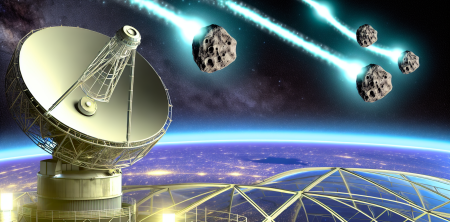
In a remarkable astronomical event, NASA has confirmed that three asteroids will safely pass by Earth on March 31, 2026. This rare occurrence presents an invaluable opportunity for scientists to enhance their understanding of near-Earth objects and improve tracking capabilities for future asteroid interactions.
The Asteroids in Question
The trio of asteroids—designated as 2026 FJ, 2026 FZ6, and 2026 FV3—vary in size and will approach Earth at considerable distances:
- 2026 FJ: Measuring approximately 36 feet (11 meters) in diameter, this asteroid will pass at a distance of 1.84 million miles (2.96 million kilometers).
- 2026 FZ6: At 45 feet (14 meters), this asteroid will come even closer, at a distance of 2.48 million miles (3.99 million kilometers).
- 2026 FV3: The largest of the trio, measuring 72 feet (22 meters), will pass by at a distance of 2.61 million miles (4.20 million kilometers).
Significantly, all three asteroids will be flying by at distances ranging from 7 to 11 times farther away than the Moon, ensuring that they pose no threat to our planet.
Importance of Tracking Near-Earth Objects
The flyby of these asteroids is not only a spectacle for sky-watchers but also a crucial moment for planetary scientists. As asteroid tracking has become increasingly important in the context of planetary defense, the data collected from these flybys will be instrumental in refining tracking systems for near-Earth objects (NEOs).
Even minor deviations in an asteroid's orbit can compound over time, potentially leading to significant changes in their trajectory. Thus, precise tracking and understanding of their composition are essential for assessing any future risks they may pose. By studying these asteroids, scientists can gather insights into:
- Composition: Analyzing the materials that make up the asteroids can provide clues about the early solar system.
- Trajectory Predictions: Improved models for predicting future paths can enhance safety measures for Earth.
- Impact Risk Assessment: Understanding the behavior of these smaller objects aids in evaluating potential threats from larger bodies.
NASA’s Ongoing Efforts in Planetary Defense
This upcoming flyby fits into a broader framework of NASA's ongoing efforts in planetary defense and asteroid research. The agency has implemented several programs aimed at identifying and tracking NEOs. Among these initiatives is the Near-Earth Object Observations (NEOO) program, which focuses on detecting, tracking, and characterizing asteroids and comets that come close to Earth.
NASA has also been involved in missions like OSIRIS-REx, which successfully collected samples from the asteroid Bennu, and the upcoming DART mission, which aims to test the viability of asteroid deflection techniques. These missions demonstrate a proactive approach to understanding and mitigating potential asteroid threats.
A Glimpse into the Future
As we approach March 31, 2026, astronomers and space enthusiasts alike will be eager to observe the paths of these three asteroids. While the asteroids will not be visible to the naked eye, they will be tracked by telescopes and radar, allowing scientists to gather valuable data.
Each flyby of near-Earth asteroids serves as a reminder of the dynamic nature of our solar system and the importance of space observation. The data gleaned from these events not only enhances our scientific knowledge but also aids in developing strategies for planetary defense.
Conclusion
The anticipated flyby of asteroids 2026 FJ, 2026 FZ6, and 2026 FV3 on March 31, 2026, offers an exciting opportunity for scientific advancement and public engagement. As NASA continues its mission to monitor and study near-Earth objects, each encounter strengthens our understanding of these celestial bodies and fortifies our readiness to address any future risks they may pose.
Stay tuned for updates as the date approaches, and prepare to witness this extraordinary event unfold in the cosmic theater.

