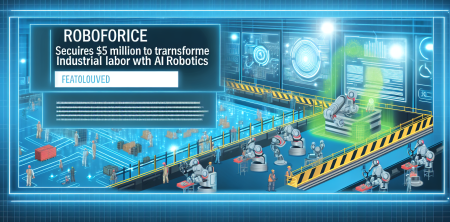
In a significant move for the industrial robotics sector, RoboForce has successfully raised $52 million in an oversubscribed funding round, elevating its total funding to $67 million. This influx of capital comes at a crucial time when many industries are grappling with labor shortages and are increasingly looking towards automation to handle hazardous and challenging tasks.
The Need for Automation
As industries recover from the disruptions caused by the pandemic, the demand for skilled labor has surged. However, many sectors are struggling to fill positions, particularly in roles that involve risky or strenuous work. This gap has prompted companies to seek innovative solutions that not only enhance productivity but also ensure employee safety.
RoboForce's Vision
Founded with the mission to revolutionize the way industrial tasks are performed, RoboForce is at the forefront of developing artificial intelligence (AI) robots that can take on the dirty and dangerous work often shunned by human laborers. With its latest funding, the startup aims to accelerate the deployment of its robotic solutions across various industries.
Investor Confidence in AI Robotics
The recent funding round demonstrates a growing confidence among investors in AI-powered robotics. The interest in RoboForce aligns with a broader trend projected to gain momentum through 2026, where physical AI applications are expected to become more prominent. Investors are increasingly shifting their focus from software-based AI solutions to companies that are capable of translating intelligence into real-world applications.
Transforming Industries through Robotics
With the new capital, RoboForce plans to enhance its product offerings and broaden its market reach. The company’s robots are designed to handle tasks that are not only physically demanding but also hazardous, such as:
- Heavy lifting in manufacturing settings
- Maintenance work in high-risk environments
- Inspection and monitoring in hazardous waste management
- Assembly tasks in tight spaces
By automating these tasks, RoboForce aims to improve safety and efficiency, allowing human workers to focus on more strategic and less dangerous functions.
Technological Innovations Driving Growth
RoboForce leverages cutting-edge technologies, including machine learning, computer vision, and advanced sensors to create robots that can adapt to various industrial environments. This adaptability is crucial, as it allows the robots to perform a wide array of tasks with precision and reliability.
The startup's robots are equipped to learn from their surroundings, making them not only efficient but also capable of handling unexpected challenges that may arise in dynamic work environments. This capability is essential as industries evolve and face new operational hurdles.
Addressing Labor Shortages
The labor shortage is not just a fleeting issue; it is projected to persist as the workforce ages and younger generations show less interest in certain labor-intensive jobs. RoboForce aims to bridge this gap by providing reliable robotic solutions that can operate continuously and efficiently.
Furthermore, as businesses increasingly prioritize sustainability and safety, the deployment of AI robots can lead to a reduction in workplace injuries and contribute to a more sustainable operational model. By automating the most dangerous tasks, companies can ensure that their human workforce is protected while maintaining productivity levels.
Future Prospects and Industry Impact
As RoboForce continues to expand its capabilities and product offerings, the impact of its solutions on various industries could be profound. The integration of AI robots into industrial processes not only enhances operational efficiency but also sets new standards for safety and reliability.
Moreover, the success of RoboForce may inspire other startups and established companies alike to explore the possibilities of AI in their operations. This could lead to a significant shift in the industrial landscape, with a greater emphasis on automation and smart technologies.
Final Thoughts
The $52 million funding round is a testament to RoboForce's potential to become a leader in the robotics industry. As the demand for automation solutions grows, RoboForce is well-positioned to meet these challenges head-on. With its innovative approach, the company is not only addressing current labor shortages but is also paving the way for a safer, more efficient future in industrial work.
In conclusion, as RoboForce gears up to deploy its AI-powered robots, it will be interesting to watch how these advancements will reshape the industrial sector and influence the way we think about labor in the coming years.

