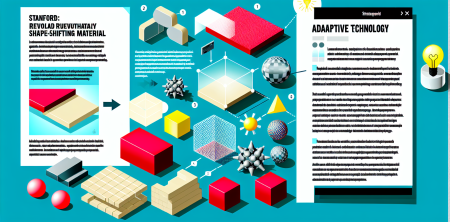
In a groundbreaking development, researchers at Stanford University have unveiled a remarkable shape-shifting material that emulates the extraordinary capabilities of octopuses. This innovative material can dynamically alter its color and texture, providing promising applications across fields such as camouflage, robotics, and soft materials. Announced on March 31, 2026, the material draws inspiration from cephalopod biology, showcasing a new frontier in adaptive surface technologies.
The Inspiration Behind the Innovation
Cephalopods, particularly octopuses, are renowned for their ability to change appearance almost instantaneously. This remarkable trait is not merely for aesthetic purposes; it serves critical functions in predation and defense. By rapidly altering their skin color and texture, octopuses can blend seamlessly into their surroundings, evade predators, or communicate with each other. The Stanford team sought to harness this biological ingenuity, translating it into a synthetic material capable of similar adaptive responses.
How It Works
The Stanford researchers have developed a material that utilizes a unique combination of metamaterials and smart polymers. This combination allows the material to respond to environmental changes in real-time. Although the detailed mechanisms are still under investigation, the fundamental principle involves the interplay between light manipulation and mechanical deformation.
- Metamaterials: These are engineered materials designed to control electromagnetic waves, including visible light. They can bend and manipulate light in ways that natural materials cannot.
- Smart Polymers: These polymers can change their properties in response to external stimuli, such as temperature, pH, or electric fields.
When combined, these materials enable the surface to modify its color and texture based on the surrounding environment. For instance, by employing specific light wavelengths, the material can mimic the colors of its background, effectively becoming invisible.
Applications of Shape-Shifting Materials
The implications of this technology are vast and varied. Here are a few potential applications:
- Camouflage: Military applications could benefit significantly, as soldiers and equipment could become nearly undetectable in diverse environments.
- Robotics: Robots equipped with this material could adapt their appearance and texture to better interact with their surroundings, enhancing functionality in various tasks.
- Wearable Technology: Fashion and personal gadgets could utilize this technology to change color and texture on demand, allowing for personalized aesthetics.
- Medical Devices: Adaptive surfaces could be employed in prosthetics or implants, providing better integration with body tissue and enhancing comfort.
The Future of Adaptive Materials
The research team at Stanford is optimistic about the future of this shape-shifting material. As they continue to refine the technology and explore its capabilities, the potential for transformation in various industries seems boundless. The next steps will involve rigorous testing to gauge the material's durability, responsiveness, and efficiency under different environmental conditions.
In addition, the team aims to explore how this technology can be scaled for practical use. The goal is to produce a commercially viable product that retains the unique qualities of the octopus-inspired design while being cost-effective for mass production.
Conclusion
Stanford's latest innovation represents a significant leap forward in the field of materials science. By mimicking the extraordinary capabilities of cephalopods, researchers have paved the way for a new class of adaptive materials that can revolutionize various sectors from military applications to consumer products. As we stand on the brink of this technological revolution, it is clear that the fusion of biology and engineering will continue to inspire future innovations.

