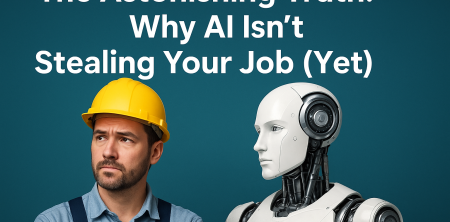
Remember all those dire warnings? The headlines screaming about robots taking over, algorithms rendering human labor obsolete, and a jobless future looming large? For years, the narrative around AI and jobs has been dominated by fear — the kind that keeps you up at night wondering if your career has an expiration date. Yet, here we are, in late 2026, and the predicted widespread job destruction simply hasn't materialized. It's a counterintuitive finding that's leaving many scratching their heads, and it's forcing us to fundamentally rethink how artificial intelligence is truly impacting the workforce.
New research, particularly from Stanford University, combined with fascinating data from the U.S. Census Bureau's March 2026 Household Trends and Outlook Pulse Survey (HTOPS), paints a very different picture than the one we've been conditioned to expect. Instead of mass unemployment, we're witnessing a profound transformation in the nature of work itself. It's less about jobs disappearing entirely and more about roles evolving, skills shifting, and a clear distinction emerging between those just starting out and those with years of experience under their belt. This isn't just an academic observation; it has real, tangible implications for your career, your financial planning, and the skills you'll need to thrive in the coming decade.
1. The Missing Carnage: The Unemployment Rate Holds Steady
Let's cut right to the chase: the much-hyped job apocalypse simply hasn't arrived. If you look at the unemployment rate for workers in occupations most exposed to AI, you'll see only a slight uptick. We're talking about a rise of just 0.77 percentage points since 2022. That's hardly the 'carnage' or 'widespread displacement' that so many experts and futurists were forecasting. It’s a number that defies the doomsday predictions and quietly suggests that the relationship between AI and jobs is far more nuanced than a simple zero-sum game.
This stability is a powerful indicator. It tells us that while AI is undoubtedly a disruptive force, its immediate impact on overall employment levels isn't what many feared. Instead of mass layoffs, companies appear to be integrating AI in ways that complement human work, or perhaps, the displacement is happening so slowly and subtly that it's being absorbed by broader economic growth. Either way, the grand narrative of AI as a job-killing machine needs a serious recalibration based on this hard data.
2. The Entry-Level Gap: A 19% Challenge for Newcomers
While the overall unemployment rate has remained relatively stable, a closer look reveals a significant and somewhat alarming trend impacting a very specific demographic: entry-level workers. New graduates and those aged 22-25, especially in occupations highly exposed to AI, are facing a widening employment gap of 19%. This isn't necessarily due to existing jobs being eliminated for them, but rather a reduction in new hiring for these roles.
Think about it: if an AI tool can now handle tasks that previously required a junior assistant or a new recruit, why would a company hire someone new for that precise role? This shift means that the traditional entry points into many industries are becoming narrower. Young professionals need to be acutely aware of this challenge and strategically adapt their skill sets and job search approaches. It's a clear signal that the path to a first job is changing, and simply having a degree might not be enough anymore. There's a fuller look at shifts in AI skills.
3. Experience Reigns Supreme: Why Seasoned Pros Are Safe
Contrast the struggles of entry-level workers with the relative stability of their more experienced counterparts. The research clearly indicates that experienced workers in AI-exposed occupations remain largely unaffected by the changes. Their employment rates haven't seen the same dip, and they're not reporting widespread job insecurity due to AI. What gives?
Experience, it turns out, is a powerful shield against AI-driven displacement. Seasoned professionals bring nuanced judgment, problem-solving skills, critical thinking, client relationships, and institutional knowledge that AI simply can't replicate—at least not yet. They understand the 'why' behind the 'what,' can handle exceptions, and navigate complex human interactions. AI becomes a tool in their arsenal, not a replacement for their expertise. This highlights the enduring value of human judgment and soft skills that take years to cultivate, suggesting that investing in long-term career development is more crucial than ever.
4. The AI Assistant: 55% of Workers Now Use AI
Here's a statistic that might surprise you: approximately 55% of U.S. workers are now actively using AI for various tasks in their jobs. That's more than half the workforce! This isn't some futuristic scenario; it's happening right now, across countless industries. From generating first drafts of emails and reports to analyzing data, managing schedules, and assisting with research, AI is steadily becoming an integrated part of daily work life for millions.
This widespread adoption isn't just about efficiency; it's about changing how tasks are performed. If you're not among that 55%, you might find yourself at a disadvantage sooner rather than later. Understanding and leveraging AI tools is rapidly moving from a 'nice-to-have' skill to a 'must-have,' irrespective of your industry. It's a clear indication that the future of work isn't about ignoring AI, but embracing it as a powerful co-pilot.
5. Time Saved, Productivity Gained: An Extra Hour or Two
What's the immediate benefit of all this AI integration? For about a third of the U.S. workforce using AI, it translates directly into time savings of one to two hours per week. Think about that for a moment. That's potentially an extra 40-80 hours a year, per person, freed up from mundane or repetitive tasks. This isn't just a minor improvement; it's a significant boost in individual and organizational productivity. (See: U.S. Census Bureau data.)
This saved time can be redirected towards more strategic thinking, complex problem-solving, creative endeavors, or even skill development. It allows employees to focus on the high-value aspects of their roles, transforming their job descriptions without necessarily eliminating the job itself. This subtle, incremental gain in efficiency is perhaps the most profound way AI is reshaping the workplace, making us more effective rather than simply redundant.
6. The Skill Shift: From Repetition to Collaboration
The core takeaway from these findings is not about job destruction, but about a fundamental shift in required skills. The tasks that AI is best at—repetition, data processing, pattern recognition, basic content generation—are precisely the ones that are being automated. This means that the skills humans need to cultivate are those that AI struggles with: critical thinking, creativity, emotional intelligence, complex problem-solving, strategic planning, and interpersonal communication.
This isn't just an abstract concept; it's a call to action. We need to move beyond simply executing tasks and learn how to collaborate effectively with AI. This involves knowing which AI tools to use, how to prompt them effectively, how to critically evaluate their outputs, and how to integrate them seamlessly into workflows. The future workforce won't just be 'using' AI; they'll be 'partnering' with it, and that requires a very different set of competencies than we've traditionally valued.
7. Monetizing the Transformation: New Opportunities Emerge
This evolving landscape of AI and jobs isn't just a challenge; it's a massive opportunity, particularly within online education and personal finance. The demand for new skills creates a fertile ground for those willing to provide guidance and tools.
- AI Skills Courses: There's a burgeoning market for courses that teach practical AI literacy. This isn't just about coding; it's about 'prompt engineering,' understanding AI ethics, learning specific AI tools (like generative AI for writing or image creation, or analytical AI for data insights), and integrating AI into various professional domains. Think about specialized courses for marketers, designers, project managers, or even HR professionals.
- Career Transition Guidance: With the entry-level job market shifting, there's a strong need for career counselors and platforms that offer guidance on adapting existing skills, identifying new career paths, and navigating the evolving job search process in an AI-driven world. This could include resume optimization for AI-driven applicant tracking systems or interview coaching focused on demonstrating AI fluency.
- Productivity Software & Job Platforms: Affiliate marketing opportunities abound for productivity software that leverages AI to save time, as well as job platforms that specifically cater to roles requiring AI proficiency or those that help individuals find opportunities where their human skills are amplified by AI. Imagine platforms that connect skilled human 'AI wranglers' with companies needing their expertise.
The monetization potential here is substantial because it addresses a very real and pressing need for millions of workers navigating this transformation. It's about empowering people to not just survive but thrive in the age of AI.
Rethinking the Narrative: From Threat to Tool
For too long, the conversation around AI and jobs has been framed almost exclusively as a threat. The fear of replacement has overshadowed the potential for augmentation. What these new findings from Stanford and the U.S. Census Bureau clearly demonstrate is that AI is, at its current stage, proving to be more of a sophisticated tool than an outright usurper. It's an accelerant, a force multiplier, and a highly efficient assistant that offloads the tedious, freeing us up for more complex and distinctly human endeavors. See also impact of AI in education.
This distinction is crucial. If we continue to view AI solely as a threat, we risk paralyzing ourselves with fear, missing out on the incredible opportunities it presents for personal and professional growth. The smart approach isn't to resist AI, but to understand its capabilities, learn to wield it effectively, and focus on developing the uniquely human attributes that will always remain beyond its grasp.
The Importance of Continuous Learning in the AI Era
If there's one overarching lesson from this shift, it's the paramount importance of continuous learning. The idea that you can learn a trade or skill once and rely on it for your entire career is rapidly becoming a relic of the past. In an era where AI is constantly evolving and reshaping job functions, lifelong learning isn't just a buzzword; it's a survival strategy.
For those entering the workforce, this means aggressively pursuing skills that complement AI, rather than competing with it. For experienced professionals, it means embracing upskilling and reskilling, viewing AI as an opportunity to enhance their capabilities and take on more challenging, higher-value work. Companies, too, have a vital role to play in providing training and fostering a culture of adaptability. The future belongs to the agile learner, the one who sees change not as an endpoint, but as a continuous journey.
Policy Implications and Future Outlook
These findings also carry significant implications for policymakers. If the primary challenge isn't mass unemployment but rather a widening gap for entry-level workers and a broad skill shift, then policy responses need to be tailored accordingly. Universal Basic Income, while a fascinating concept, might be less immediately relevant than robust investments in education, vocational training, and career counseling programs that focus on AI literacy and human-centric skills.
Furthermore, understanding the differential impact on various age groups is key. How do we ensure that young people are adequately prepared for a job market where traditional entry points are less accessible? What role can apprenticeships play in bridging this gap? These are complex questions, but the data provides a clearer roadmap for addressing them. The future of AI and jobs isn't a predetermined path; it's a trajectory we can collectively influence through thoughtful education and policy choices.
Beyond the Hype: Practical Steps for Your Career
So, what does all this mean for you, practically speaking? Don't panic, but do prepare. Here are some actionable steps: (See: Stanford University research.)
- Embrace AI Tools Now: Start experimenting with AI tools relevant to your field. Whether it's a generative AI for writing, a data analysis tool, or an AI-powered design assistant, get hands-on experience. The more comfortable you are, the more valuable you'll become.
- Double Down on Human Skills: Actively cultivate your critical thinking, creativity, emotional intelligence, and complex problem-solving abilities. These are the areas where human superiority will persist.
- Network and Collaborate: Strong professional networks and the ability to collaborate effectively with diverse teams (including AI-powered ones) are increasingly vital.
- Consider Career Mentorship: If you're entry-level, seek out mentors who can guide you through the evolving landscape. Their experience is invaluable.
- Market Your Adaptability: When looking for a job or promotion, emphasize your willingness to learn, adapt, and integrate new technologies into your workflow.
The narrative around AI and jobs is finally maturing, moving beyond simplistic fear-mongering to a more nuanced understanding of its actual impact. It's not about an AI takeover, but an AI augmentation. The challenge, and the opportunity, lies in how quickly and effectively we adapt to become master collaborators with these powerful new tools. The jobs aren't disappearing en masse, but the way we do them, and the skills we need to bring to the table, are fundamentally changing.
AI's Impact Across Industries: A Closer Look
While we've discussed general trends, it's worth examining how AI and jobs are specifically interacting in different sectors. The impact isn't uniform; some industries are seeing more rapid change than others, and the nature of that change varies wildly.
Healthcare
In healthcare, AI isn't replacing doctors, but it's becoming an indispensable diagnostic assistant. AI-powered tools can analyze medical images (X-rays, MRIs) with incredible speed and accuracy, often detecting anomalies that human eyes might miss. This frees up radiologists to focus on complex cases and patient consultations. AI also helps with drug discovery, personalizing treatment plans, and streamlining administrative tasks, allowing medical professionals more time for direct patient care. The skill shift here is towards interpreting AI outputs, understanding its limitations, and using it to enhance clinical decision-making.
Manufacturing
Manufacturing has been using automation for decades, but AI is taking it to the next level. We're seeing AI optimizing supply chains, predicting equipment failures before they happen (predictive maintenance), and improving quality control through computer vision. This doesn't necessarily mean fewer factory workers, but rather a shift in their roles. Workers are becoming overseers of AI-driven systems, requiring skills in robotics, data analysis, and troubleshooting complex automated processes. It's less about repetitive manual labor and more about managing intelligent machinery.
Creative Industries
Even traditionally "human" fields like graphic design, writing, and music are experiencing AI's touch. Generative AI can create initial drafts, produce variations of designs, or compose background scores. However, the human element of creative direction, nuanced storytelling, emotional resonance, and strategic vision remains paramount. AI becomes a tool for accelerating the creative process, allowing artists and designers to experiment more, iterate faster, and focus on the conceptual and emotional impact of their work. The skill here is prompt engineering, refining AI outputs, and integrating AI into a unique artistic workflow.
Customer Service
Chatbots and AI-driven virtual assistants are already handling a significant portion of routine customer inquiries. This might seem like a direct replacement, but it often isn't. Instead, AI frees up human customer service representatives to deal with more complex, emotionally charged, or unique customer issues that require empathy and nuanced problem-solving. The human role shifts from answering FAQs to becoming problem solvers and relationship builders, supported by AI that handles the mundane. It’s about leveraging AI for efficiency to enhance the human touch where it matters most.
The Ethical Dimension of AI in the Workforce
As AI becomes more deeply embedded in our professional lives, the ethical considerations surrounding its deployment in the workforce become increasingly critical. It's not just about efficiency and productivity; it's about fairness, transparency, and human dignity. (future of jobs by 2026)
Bias in AI Algorithms
One major concern is algorithmic bias. If AI models are trained on biased data sets, they can perpetuate and even amplify existing societal biases in hiring, performance evaluations, or even job allocation. For example, an AI designed to screen resumes might inadvertently favor certain demographics if the historical data it learned from showed a bias in past hiring practices. Addressing this requires diverse training data, rigorous testing for bias, and human oversight in decision-making processes where AI plays a role.
Data Privacy and Surveillance
AI's ability to collect and analyze vast amounts of data also raises privacy concerns. Companies might use AI to monitor employee productivity, communication patterns, or even emotional states. While some monitoring can improve efficiency, it also risks creating a surveillance culture that erodes trust and autonomy. Clear ethical guidelines and transparent policies are essential to balance productivity gains with employee privacy rights.
The 'Black Box' Problem
Many advanced AI models operate as "black boxes," meaning it's difficult for humans to understand how they arrive at their conclusions. This lack of transparency can be problematic in critical applications, like AI-assisted hiring or loan approvals. If an AI denies someone a job or a loan, the individual has a right to understand the reasoning. Developing explainable AI (XAI) is a crucial area of research to ensure accountability and trust in AI systems. (See: BBC on AI and jobs.)
Displacement and Social Safety Nets
While widespread job destruction hasn't materialized, the skill shift does mean some roles will change dramatically or become obsolete. Society needs to consider how to support individuals through these transitions. This includes robust retraining programs, potential income support for those in transition, and policies that encourage companies to invest in their workforce's adaptability rather than simply replacing them. The ethical imperative is to ensure that the benefits of AI are shared broadly and that vulnerable populations aren't left behind. For more on this, see AI writing tools in academia.
FAQ: Navigating AI and Your Career
You probably have a lot of questions about what AI means for your specific situation. Here are some common ones:
Q: Is my job safe from AI?
A: It's less about "safe" and more about "evolving." If your job involves highly repetitive tasks, data processing, or basic content generation, parts of it are likely to be automated. However, roles requiring critical thinking, creativity, emotional intelligence, complex problem-solving, and strategic decision-making are less susceptible to full automation and will likely be augmented by AI. Focus on developing those uniquely human skills.
Q: What are the most important AI skills to learn?
A: You don't necessarily need to become a programmer. Key skills include:
- AI Literacy: Understanding what AI is, how it works, and its capabilities/limitations.
- Prompt Engineering: Effectively communicating with AI tools to get the desired output.
- Data Interpretation: Critically evaluating AI-generated data and insights.
- Ethical AI Use: Understanding biases and responsible application.
- Tool Proficiency: Learning specific AI tools relevant to your industry (e.g., generative AI for marketing, AI for data analysis in finance).
Q: I'm an entry-level worker. How do I compete in an AI-driven market?
A: It's definitely a challenge, but not insurmountable.
- Acquire AI Skills: Make AI literacy and proficiency a top priority.
- Build a Portfolio: Show, don't just tell. Demonstrate how you've used AI to solve problems or enhance projects.
- Network Actively: Connections can open doors that traditional applications might not.
- Emphasize Soft Skills: Highlight your creativity, adaptability, communication, and teamwork – these are highly valued.
- Consider Apprenticeships/Internships: Gain practical experience and mentorship, often a direct path to employment.
Q: Should I be worried about AI taking my job completely?
A: The data suggests that for most experienced professionals, direct job replacement by AI isn't the immediate threat. The bigger shift is that your job will change. AI will likely take over the more mundane, repetitive aspects, freeing you up for higher-level, more engaging work. The concern is more about adapting to these changes rather than fearing outright elimination.
Q: How can companies best prepare their workforce for the AI era?
A: Companies have a critical role.
- Invest in Upskilling/Reskilling: Provide continuous training programs focused on AI literacy and human-centric skills.
- Foster a Culture of Learning: Encourage experimentation with AI tools and reward adaptability.
- Redesign Roles: Think about how AI can augment existing roles, rather than just replace them.
- Promote Ethical AI Use: Develop clear guidelines and ensure transparency in AI deployment.
- Support Mentorship: Connect experienced workers with newer employees to share knowledge and navigate changes.
Q: Will AI make certain professions completely obsolete?
A: While some highly specialized, repetitive tasks within professions might become fully automated (e.g., certain data entry roles, basic customer support), it's far less likely that entire professions will disappear overnight. Instead, the job descriptions within those professions will transform significantly, requiring a different blend of human and AI collaboration.
Trending Now
- this guide on the brutal truth about ai in education: it’s exposing our system’s biggest flaws
- read the full story
- This Game-Changing Act Could Finally Revolutionize Support for New Parents
- Shocking Truth: Why America’s Paid Leave System Is Failing Parents
- Why Your Child’s AI Tutor Choice…
Frequently Asked Questions
Is AI really going to take my job?
While there have been fears about AI taking over jobs, recent research shows that the job apocalypse many predicted has not materialized. Instead of mass unemployment, AI is transforming roles and requiring new skills, leading to a shift in the workforce rather than outright job loss.
What impact does AI have on employment?
AI is not causing widespread job loss but is transforming the nature of work. Roles are evolving, and there's a growing distinction between entry-level positions and those requiring experience. This evolution suggests a need for new skills rather than a simple reduction in job availability.
What does the unemployment rate look like in relation to AI?
Despite concerns about AI, the unemployment rate for occupations most exposed to it has only seen a slight increase of 0.77 percentage points since 2022. This indicates that the feared mass displacement has not occurred, defying doomsday predictions.
How should I prepare for the future job market with AI?
To thrive in the evolving job market influenced by AI, focus on acquiring new skills relevant to your industry, stay adaptable, and be open to changing roles. Understanding how AI impacts your field can help you remain competitive and ready for future opportunities.
Are there any jobs that are safe from AI?
While no job is completely immune to the influence of AI, roles that require human creativity, emotional intelligence, and complex decision-making are less likely to be fully automated. Jobs in healthcare, education, and creative industries are examples where human skills remain essential.
What's your take on this? Share your thoughts in the comments below — we read every one.

