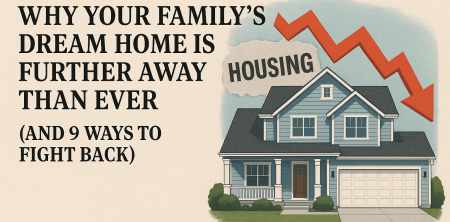
Right now, if you're a family dreaming of buying a home, you're likely feeling a sense of deep frustration, maybe even despair. And you wouldn't be alone. The housing market, particularly as we look ahead to 2026, has become a formidable beast, largely due to mortgage rates hovering stubbornly close to 7%. We're talking about a 30-year fixed-rate mortgage reaching 6.95% recently, the highest we've seen since January 2025. This isn't just a number; it's a barrier, a financial hurdle that's pushing countless families out of the market and forcing others to scale back their aspirations dramatically. It’s a financially and emotionally charged situation, and it demands a clear-eyed look at the best mortgage options for families 2026.
As an educator and someone deeply invested in helping people make informed decisions, I've seen firsthand how these economic shifts impact everyday lives. The current surge in rates isn't some random fluctuation; it's a direct consequence of ongoing inflation and global tensions, like the Iran war, creating a volatile economic landscape. This volatility translates directly into higher monthly payments, making what was once an achievable dream seem impossibly out of reach. It also creates a 'lock-in effect,' where homeowners with lower rates are understandably reluctant to sell, further constricting an already tight housing supply. So, what’s a family to do when facing such daunting prospects? Let's break down the mortgage options available and explore how to navigate this challenging environment.
1. The 30-Year Fixed-Rate Mortgage: The Traditional, But Costly, Choice
For decades, the 30-year fixed-rate mortgage has been the gold standard for families seeking stability and predictable payments. And honestly, it’s not hard to see why. You lock in an interest rate for the entire life of the loan, meaning your principal and interest payment remains the same, month after month, for three decades. This consistency is a huge comfort, especially when you're budgeting for a family with all its unpredictable expenses. Knowing exactly what your biggest monthly outgoing will be provides a foundation of financial security.
However, in the current high-rate environment, this traditional choice comes with a significant premium. With rates nearing 7%, a 30-year fixed mortgage means a substantially higher monthly payment compared to just a few years ago. This can push many families' debt-to-income ratios beyond what lenders will approve, even for those with stable employment. While it offers unparalleled peace of mind regarding future rate hikes, the initial sticker shock might be too much for some, making it crucial to explore if this long-term stability aligns with your immediate financial capacity and long-term goals. For many, finding the best mortgage options for families 2026 means balancing security with affordability.
2. The 15-Year Fixed-Rate Mortgage: Build Equity Faster, But Brace for Higher Payments
If you're in a strong financial position and can handle a higher monthly payment, the 15-year fixed-rate mortgage can be an incredibly powerful tool. The most obvious benefit is that you pay off your home in half the time compared to a 30-year loan. This means significantly less interest paid over the life of the loan, saving you tens, if not hundreds, of thousands of dollars. Plus, you build equity at a much faster pace, which is a fantastic way to build wealth and secure your family's financial future.
But let's be realistic: the monthly payments on a 15-year fixed mortgage are considerably higher than those on a 30-year loan, even with a slightly lower interest rate that's often offered. In a market where rates are already elevated, this option becomes even more challenging for most families. It demands a very robust income and a disciplined budget. While it's an excellent choice for those who can swing it, don't stretch yourselves too thin attempting this. The goal is sustainable homeownership, not financial strain. It's about finding the sweet spot among the best mortgage options for families 2026 that fits your unique circumstances.
3. Adjustable-Rate Mortgages (ARMs): A Risky Gamble or a Smart Play?
Adjustable-Rate Mortgages, or ARMs, have a bit of a checkered past, often associated with the housing crisis of 2008. However, modern ARMs are typically structured differently, offering an initial fixed-rate period before the rate adjusts periodically. Common examples include 5/1, 7/1, or 10/1 ARMs, where the first number indicates the years your rate is fixed, and the second number indicates how often it adjusts thereafter (usually annually).
In a high-rate environment, an ARM might initially offer a lower interest rate than a fixed-rate mortgage, making monthly payments more manageable in the short term. This can be particularly appealing if you anticipate your income will increase significantly in a few years, or if you plan to sell the home before the fixed-rate period expires. However, the inherent risk is that once the fixed period ends, your interest rate could adjust upwards, potentially leading to much higher monthly payments. It’s a calculated risk, one that requires a clear understanding of your financial trajectory and market predictions. It’s certainly one of the more complex best mortgage options for families 2026. (See: impact of housing on families.)
4. FHA Loans: A Lifeline for First-Time Buyers and Those with Lower Credit
For many families, especially first-time homebuyers or those with less-than-perfect credit, FHA loans are an absolute game-changer. Backed by the Federal Housing Administration, these loans are designed to make homeownership more accessible. They typically require a much lower down payment – as little as 3.5% – and have more lenient credit score requirements compared to conventional loans. This can be a huge relief when you’re struggling to save up a significant down payment while also dealing with rising living costs. For more context, see concerns about your family's future.
While FHA loans come with mortgage insurance premiums (both an upfront premium and an annual premium), the benefits often outweigh this cost, particularly if it's the only way for your family to get into a home. It's important to understand the full cost, but don't let the mortgage insurance deter you without a thorough investigation. For families who might otherwise be shut out of the market due to high down payment requirements or credit score hurdles, FHA loans truly represent one of the most vital and accessible of the best mortgage options for families 2026.
5. VA Loans: Exclusive Benefits for Veterans and Service Members
If you or your spouse are a veteran, active-duty service member, or eligible surviving spouse, a VA loan is almost always the superior choice. These loans, guaranteed by the U.S. Department of Veterans Affairs, offer unparalleled benefits that are simply not available with other mortgage products. The most significant advantage is the ability to purchase a home with no down payment, which can be an enormous relief for military families who often face frequent relocations and financial stressors.
Beyond the zero down payment, VA loans typically come with highly competitive interest rates, and they don't require private mortgage insurance (PMI), even with no down payment. While there is a VA funding fee, it can often be financed into the loan, and some veterans with service-connected disabilities are exempt from paying it altogether. These benefits make VA loans an incredibly powerful tool for eligible families, providing a clear path to homeownership that minimizes upfront costs and ongoing expenses. It's a non-negotiable consideration for those who qualify among the best mortgage options for families 2026.
6. USDA Loans: Rural Living Made Affordable
Often overlooked, USDA loans are another fantastic option for families looking to purchase a home in eligible rural and suburban areas. Guaranteed by the U.S. Department of Agriculture, these loans are designed to promote homeownership in less densely populated areas. Similar to VA loans, a major draw of USDA loans is that they typically require no down payment. This can be a huge boon for families who want to escape the high prices of urban centers but still struggle with saving a large down payment.
USDA loans also offer competitive fixed interest rates and have less stringent credit requirements than conventional loans. Like FHA loans, they do come with mortgage insurance, both an upfront guarantee fee and an annual fee, but these are generally lower than FHA premiums. The key limitation, of course, is that the property must be in an eligible rural area (which can include surprisingly close-to-city suburbs) and there are income limits for borrowers. If your family is open to a slightly more rural lifestyle and meets the income criteria, a USDA loan is definitely worth exploring as one of the best mortgage options for families 2026.
7. Conventional Loans with Private Mortgage Insurance (PMI): A Flexible Option with a Catch
Conventional loans are the most common type of mortgage not backed by a government agency. They offer a great deal of flexibility, with various down payment options, including as little as 3% for some programs. If you have a strong credit score and a stable income, a conventional loan can offer competitive rates and more streamlined underwriting compared to government-backed loans.
However, the catch for conventional loans, especially if you put down less than 20% of the home's purchase price, is Private Mortgage Insurance (PMI). PMI protects the lender in case you default on the loan, and it adds to your monthly payment. The good news is that unlike FHA mortgage insurance, PMI can eventually be canceled once you reach a certain level of equity in your home (typically 20-22%). This flexibility makes conventional loans a solid choice for families who might not qualify for government-backed programs but still need a lower down payment option. It’s a key part of understanding the best mortgage options for families 2026. (See: current housing market analysis.)
8. Jumbo Loans: For High-Value Properties
If your family is looking to purchase a high-value property that exceeds the conforming loan limits set by Fannie Mae and Freddie Mac (which vary by county but are typically over $766,550 in most of the U.S. for 2024, with higher limits in high-cost areas), you'll likely need a jumbo loan. These are non-conforming loans that lenders offer for larger loan amounts. Because they carry more risk for lenders, jumbo loans typically have stricter qualification requirements.
Expect to need an excellent credit score, a lower debt-to-income ratio, and a larger down payment (often 10-20% or more) to qualify for a jumbo loan. While the interest rates on jumbo loans can sometimes be slightly higher than conforming loans, they are often competitive, especially for well-qualified borrowers. For families targeting luxury homes or properties in very expensive markets, understanding jumbo loan requirements is essential. It’s a niche option, but vital for those considering higher-end properties among the best mortgage options for families 2026. For more context, see protecting children in a challenging environment.
9. Doctor Loans/Physician Loans: Specialized Options for Medical Professionals
For families where one or both parents are medical professionals, specialized 'doctor loans' or 'physician loans' can offer significant advantages. These unique mortgage products are designed to address the specific financial situations of doctors, dentists, and other medical professionals, who often carry substantial student loan debt but have high earning potential. Lenders offering these loans understand this dynamic and often relax some conventional lending standards.
Key benefits can include little to no down payment requirements, no private mortgage insurance (PMI) even with a low down payment, and more flexible debt-to-income ratio calculations that may exclude or defer student loan payments. These loans recognize the long-term financial stability of medical careers, making homeownership more accessible during residency or early career stages. If you're a medical professional, definitely investigate these specialized programs; they can significantly simplify your path to homeownership compared to traditional routes and are certainly among the best mortgage options for families 2026 for this demographic.
10. Understanding the Impact of Credit Scores on Mortgage Options
Your credit score is a critical piece of the puzzle when you're looking for a mortgage. Lenders use it to gauge your creditworthiness – essentially, how likely you are to pay back the loan. A higher credit score signals less risk to lenders, and that usually translates into better interest rates and more favorable loan terms. For example, a conventional loan typically requires a FICO score of 620 or higher, but to get the absolute best rates, you're generally looking at scores in the 740+ range.
If your credit score isn't where you'd like it to be, don't despair. FHA loans are much more forgiving, often accepting scores as low as 580 with a 3.5% down payment, and even lower with a larger down payment. VA and USDA loans also tend to have more flexible credit requirements, although lenders will still look at your overall financial picture. Understanding how your credit score impacts your options is step one. If you have time before buying, focusing on improving your credit by paying bills on time, reducing debt, and avoiding new credit inquiries can literally save you thousands of dollars over the life of your loan. It’s a vital factor in determining which of the best mortgage options for families 2026 are even on the table for you.
11. The Role of Down Payment Assistance Programs
Saving for a down payment is often the biggest hurdle for families, especially first-time homebuyers. With home prices continuing to rise, that 20% down payment for a conventional loan can feel insurmountable. This is where down payment assistance (DPA) programs can be a true lifeline. These programs, offered at federal, state, and local levels, can provide grants or low-interest loans to help cover your down payment and sometimes even closing costs.
The specifics of DPA programs vary wildly. Some are strictly for first-time buyers, others have income limits, and some are tied to specific professions like teachers or first responders. You might find programs that offer outright grants you don't have to repay, or deferred loans that only become due when you sell or refinance your home. It's absolutely worth researching what's available in your area. A local mortgage lender or housing counselor can often provide a comprehensive list of eligible programs. Combining a DPA with an FHA, VA, or USDA loan can significantly reduce your upfront costs and make homeownership a reality. These programs are a key component when researching the best mortgage options for families 2026, especially if initial cash is a concern. (See: mortgage rates and inflation trends.)
12. Navigating Closing Costs and Other Fees
Beyond the down payment, families often underestimate the impact of closing costs. These are the fees paid at the end of a real estate transaction and can easily range from 2% to 5% of the loan amount. We're talking about appraisal fees, origination fees, title insurance, attorney fees, recording fees, and more. It's a long list, and it adds up quickly.
Understanding and budgeting for closing costs is just as important as planning for your down payment and monthly mortgage payment. Sometimes, you can negotiate with the seller to cover a portion of these costs, or your lender might offer credits. Some down payment assistance programs also help with closing costs. If cash is tight, you might consider a "no-closing-cost" mortgage, but be aware that lenders typically roll these costs into a higher interest rate, meaning you pay more over the life of the loan. Always ask for a detailed breakdown of all closing costs well in advance so there are no surprises at the closing table. Being prepared for these costs is crucial for a smooth home-buying process and helps you accurately compare the true cost of the best mortgage options for families 2026.
Expert Perspective: The Current Market and What to Expect in 2026
From my vantage point as an educator and someone who follows these trends closely, the current market dynamics are a perfect storm of high demand, low inventory, and elevated interest rates. This isn't just a blip; it's a significant shift from the ultra-low rates we saw during the pandemic. The Federal Reserve's actions to combat inflation directly impact mortgage rates, and while there's always hope for rates to come down, significant drops are unlikely in the immediate future for 2026.
What does this mean for families? It means you have to be strategic and patient. Don't let the headlines paralyze you, but don't rush into a decision either. Focus on strengthening your financial profile: improve your credit, save as much as you can, and reduce other debts. Be realistic about what you can afford. Consider smaller homes, homes in slightly less desirable areas, or properties that need a little TLC to get your foot in the door. The goal should be sustainable homeownership, not just homeownership at any cost. Remember, you can always refinance when rates drop, or upgrade to a larger home later. The first step is often the hardest, but with a clear strategy and the right knowledge about the best mortgage options for families 2026, it's absolutely achievable.
The current mortgage landscape is undoubtedly challenging, with rates nearing 7% and creating widespread despondency among prospective homebuyers. This isn't just a financial hurdle; it's an emotional one, impacting families' dreams of stability and building wealth. But despair is not a strategy. Understanding the nuances of each mortgage option, from the traditional fixed-rate to the more specialized VA or doctor loans, empowers you to make an informed decision. Don't let the headlines deter you from exploring every avenue. Work with a trusted mortgage professional, assess your family's unique financial situation, and remember that even in a tough market, there are still paths to homeownership if you know where to look and what questions to ask. Your family's future home is worth fighting for, and with the right strategy, it's still within reach.
Trending Now
- This Crucial Statistic About Your Teen’s Future Is Far Worse Than You Think
- this guide on this game-changing eu kids act could finally make the internet safe for your children
- ‘It’s a huge concern’: Families of…
- our breakdown of schools don’t have to tell parents about student gender identity — unless they ask, judge rules – la times
- this guide on this elite private school’s radical new method will leave you speechless
Frequently Asked Questions
Why are mortgage rates so high right now?
Mortgage rates are currently high due to ongoing inflation and global economic tensions, including conflicts like the Iran war. These factors create a volatile market, pushing rates close to 7% and making homebuying increasingly difficult for families.
What is the lock-in effect in the housing market?
The lock-in effect occurs when homeowners with lower mortgage rates hesitate to sell their homes, fearing they won't find favorable rates again. This reluctance constricts housing supply, making it harder for families to find affordable homes.
What are the best mortgage options for families in 2026?
Families should consider various mortgage options, including the 30-year fixed-rate mortgage, which offers stability and predictable payments. Exploring alternatives and understanding the current market can help families navigate the challenges of buying a home.
How does inflation impact the housing market?
Inflation affects the housing market by increasing the cost of living and borrowing. As inflation rises, so do mortgage rates, making it more expensive for families to secure loans and purchase homes, thus pushing many out of the market.
What can families do to improve their chances of buying a home?
Families can improve their chances by exploring different mortgage options, saving for larger down payments, and staying informed about market trends. Additionally, considering alternative housing solutions or locations can help them find more affordable options.
What's your take on this? Share your thoughts in the comments below — we read every one.


0 Responses