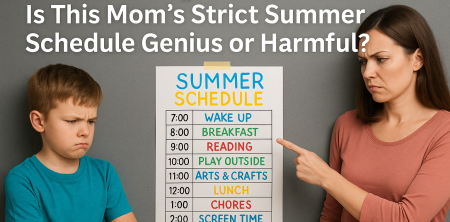
When it comes to parenting advice, you’d be hard-pressed to find a topic that sparks more passionate discussion than how to structure a child's day, especially during those long, languid summer months. For many of us, summer conjures images of endless sunshine, spontaneous play, and a blissful break from the relentless grind of school. But for one TikToker, @thebutanfam, her vision of summer looks a little different – a lot more structured, in fact. Her recent viral video, which has racked up nearly half a million likes and almost 20,000 comments, has thrown a spotlight on a deeply divisive question: how much scheduled activity is too much, and what’s the real cost of pushing our kids toward perceived success?
The mom in question, @thebutanfam, revealed her strict summer schedule for her children, mandating two hours of reading and two hours of sports practice every single day. Her rationale? She believes this intense routine is setting her kids up for greatness, instilling discipline and a work ethic that will pay dividends down the line. And honestly, she's not alone in that thinking. Plenty of parents, myself included, wrestle with the balance between giving our kids freedom and ensuring they're developing skills and good habits. But where do we draw the line? Is this kind of rigorous regimen a pathway to success or a fast-track to burnout? Let's unpack the core arguments and explore the nuances of this incredibly complex piece of parenting advice.
1. The 'Butan Fam' Approach: A Deep Dive into Structured Summer Days
The core of @thebutanfam’s viral parenting advice revolves around a non-negotiable daily regimen during the summer break: two hours dedicated to reading and another two hours committed to sports practice. This isn't just a suggestion; it’s a mandate. For her, summer isn't a time for children to simply 'unwind' in the traditional sense. Instead, it’s an extended period for focused development, a chance to get ahead, or at least maintain momentum, in areas she deems crucial for their future success.
This approach isn’t about idle screen time or unstructured play filling the bulk of the day. It’s about intentional, consistent effort. The reading component aims to foster literacy, critical thinking, and a love for learning, presumably preventing the dreaded 'summer slide' where academic skills can regress. The sports element, on the other hand, targets physical fitness, teamwork, discipline, and perhaps, competitive excellence. From her perspective, these four hours aren't a burden; they're an investment in her children's cognitive and physical capital. It’s a proactive stance against what some parents might see as the potential for children to become complacent or fall behind during the extended school break.
2. The Pro-Structure Argument: Discipline, Success, and Future Rewards
The comments section of @thebutanfam’s video quickly became a battleground, but a significant contingent rallied behind her. These supporters often champion the idea that strict, structured routines are not just beneficial, but essential for cultivating discipline and ultimately, success. They argue that childhood is a critical window for habit formation, and if children learn early on to commit to challenging activities, that dedication will serve them well into adulthood. One commenter, for instance, shared how a similar upbringing led to achieving Division I athletic status, highlighting the direct link they saw between early discipline and elite performance.
Another powerful anecdote came from someone who attributed their graduation from a top law school to the rigorous schedules their parents imposed during their formative years. These examples aren't just isolated incidents; they tap into a deeply held belief among many parents that grit, perseverance, and a strong work ethic are forged in the fires of structured challenges. For them, allowing children unfettered freedom during summer is a missed opportunity to build character and resilience. They view the 'Butan Fam's' parenting advice not as harsh, but as a loving, long-term strategy for ensuring their children can compete and thrive in an increasingly demanding world. It’s about delayed gratification and understanding that hard work now can lead to significant rewards later.
3. The Anti-Pressure Perspective: Childhood, Burnout, and Mental Health
On the flip side of the debate, a vocal group of critics expressed significant concern that such an intense daily schedule could place undue pressure on children, potentially fostering perfectionism, anxiety, or even burnout. Their primary argument centers on the idea that childhood should, at least in part, be a time for unstructured play, exploration, and simply *being* a child without the constant weight of performance expectations. They worry that a relentless focus on achievement, even in areas like reading and sports, can strip children of their intrinsic motivation and replace it with external pressure.
These critics often highlight the importance of mental well-being and the potential long-term negative impacts of a childhood devoid of genuine downtime. They argue that creativity, problem-solving skills, and social-emotional development often flourish during moments of spontaneous play, not just during scheduled activities. There's a fear that pushing children too hard, too early, could lead to resentment towards the very activities parents hope they will love, or worse, contribute to a generation grappling with high levels of stress and a diminished capacity for joy outside of accomplishment. The parenting advice they offer leans towards balance, advocating for space for children to simply exist and discover at their own pace.
4. The 'Summer Slide' vs. Summer Sanity: Balancing Academic and Recreational Needs
One of the driving forces behind structured summer activities, particularly reading, is the well-documented phenomenon known as the 'summer slide.' Research consistently shows that many students, especially those from lower-income backgrounds, experience a significant loss of academic skills, particularly in reading and math, over the long summer break. For some parents, including potentially @thebutanfam, a daily reading requirement is a direct countermeasure to this slide, ensuring their children maintain, or even advance, their literacy skills. (See: children's mental health and well-being.)
However, critics contend that preventing the summer slide doesn't necessitate a rigid, two-hour daily reading quota. They suggest that engagement with books can be fostered through more relaxed means, like library visits, audiobooks, or simply having a wide variety of appealing reading materials available. The argument here isn't against reading, but against the *mandated* nature and duration of it. They believe that turning reading into another chore can inadvertently kill a child's natural curiosity and love for stories, transforming a pleasurable activity into another item on a demanding to-do list. The debate then becomes about the *how* of academic maintenance: is it best achieved through strict mandates or through nurturing a genuine, unpressured engagement with learning?
5. The Role of Unstructured Play: A Missing Piece of the Puzzle?
Perhaps one of the most significant points of contention in this parenting advice debate is the perceived absence of unstructured play in such a rigorous schedule. Unstructured play, often called 'free play,' is characterized by its child-led nature, lack of specific rules (beyond safety), and absence of adult intervention. Think building forts, inventing games, or simply daydreaming in the backyard. Developmental psychologists and early childhood educators consistently emphasize the crucial role of unstructured play in fostering creativity, problem-solving skills, social competence, and emotional regulation.
When children are left to their own devices, they learn to negotiate, compromise, innovate, and entertain themselves. These are vital life skills that are difficult to teach in a structured, adult-directed environment. Critics of @thebutanfam’s approach worry that by filling almost every waking hour with mandated activities, children are being robbed of these invaluable opportunities for self-directed learning and development. They argue that while organized sports build discipline, they don't necessarily cultivate the same type of imaginative thinking or independent problem-solving that emerges during spontaneous, child-initiated play. It’s a fundamental difference in philosophy about what constitutes a truly 'enriching' childhood.
6. Parenting Styles and Cultural Context: Nature vs. Nurture in Summer
The @thebutanfam video also inadvertently opened up a broader discussion on varying parenting styles and their cultural underpinnings. The 'Tiger Mom' phenomenon, popularized by Amy Chua’s memoir, comes to mind – a style often associated with strict academic and extracurricular demands, particularly in some Asian-American communities, with the goal of fostering exceptional achievement. While not explicitly stated, @thebutanfam’s approach echoes some of these principles, emphasizing hard work and discipline over leisure.
However, Western parenting philosophies, particularly in recent decades, have often trended towards a more child-centered, nurturing, and less overtly authoritarian approach, emphasizing self-esteem, emotional expression, and intrinsic motivation. This clash of philosophies is evident in the TikTok comments. One perspective values the explicit shaping of a child's character through rigorous demands, while the other prioritizes a child's autonomy, emotional well-being, and the space to develop at their own pace. Neither is inherently 'wrong,' but they represent fundamentally different beliefs about the optimal path to raising well-adjusted, successful individuals. This debate on parenting advice often mirrors broader societal values and expectations for children.
7. The Long-Term Impact: What Does 'Success' Truly Mean?
Ultimately, the heart of this discussion on parenting advice comes down to differing definitions of 'success.' For many supporters of @thebutanfam, success is quantifiable: D1 scholarships, Ivy League degrees, high-powered careers. They see the structured summer as a direct pipeline to these achievements. For them, the temporary discomfort or lack of 'free time' is a small price to pay for a lifetime of opportunities and financial security.
However, critics often define success more broadly, encompassing emotional intelligence, creativity, resilience in the face of failure (not just success), strong relationships, and a genuine love for learning and life. They question whether a childhood singularly focused on performance metrics truly prepares individuals for the complex emotional and social challenges of adulthood. Could an overemphasis on structured achievement lead to individuals who struggle with uncertainty, lack intrinsic motivation outside of external validation, or sacrifice personal well-being for professional accolades? These are profound questions that don't have easy answers, highlighting the deeply personal and often philosophical nature of parenting choices.
8. Finding Your Own Balance: Tailoring Parenting Advice to Your Child
The viral debate surrounding @thebutanfam’s parenting advice serves as a powerful reminder that there's no single 'right' way to raise children. What works for one family, or one child, may be completely counterproductive for another. The critical takeaway here isn't to blindly adopt or reject a specific approach, but to thoughtfully consider your own child's unique personality, temperament, and needs. Some children thrive on structure and respond well to clear expectations; others wilt under pressure and need ample space for self-direction.
As parents, our job is to be keen observers of our own children. Do they genuinely enjoy the activities we're scheduling? Are they showing signs of stress or exhaustion? Are they having enough opportunities for genuine downtime and imaginative play? Finding a healthy balance between structured learning and unstructured freedom is a perpetual challenge, and it often involves a delicate dance of trial and error. This isn't about shaming any particular parenting style, but rather encouraging an introspective approach to ensure our choices align with our deepest values and, most importantly, foster the holistic well-being and development of our children. (See: importance of balanced child development.)
9. The Science of Play and Development: What Experts Say
It's worth looking at what developmental psychologists and educational researchers have to say about the various components of childhood development. Dr. Stuart Brown, founder of the National Institute for Play, argues that play is just as fundamental to human development as sleep or nutrition. He says that playful interaction helps shape our brains, fostering empathy, social skills, and complex problem-solving abilities. When kids engage in free play, they're not just having fun; they're actively building neural pathways that are crucial for future learning and emotional regulation. This isn't just a fluffy concept; there's real science backing the idea that play is a child's primary mode of learning.
On the academic side, research on intrinsic motivation, spearheaded by psychologists Edward Deci and Richard Ryan, suggests that when activities are experienced as self-chosen and enjoyable, people are more likely to persist, perform better, and develop a deeper interest. Conversely, external rewards or excessive pressure can actually diminish intrinsic motivation, making an activity feel like a chore. So, while mandated reading might prevent the summer slide in the short term, it could inadvertently turn reading into something a child dreads, making them less likely to pick up a book once the external pressure is removed. The goal for many experts is to cultivate a lifelong love of learning, which often blossoms best in an environment of curiosity and choice, not rigid requirements.
10. The Role of Technology and Screen Time: A Modern Conundrum
While the Butan Fam's schedule focuses on reading and sports, a significant unspoken element in most modern parenting advice debates is the role of technology and screen time. Many parents, perhaps like @thebutanfam, implement structured schedules as a direct counter to the pervasive pull of screens. They see mandated activities as a way to ensure children are engaged in productive, physical, or intellectually stimulating pursuits, rather than passively consuming digital content.
However, the question of screen time itself is nuanced. Not all screen time is equal. Educational apps, coding games, or video calls with distant relatives offer different developmental benefits and drawbacks compared to endless scrolling through social media or binge-watching shows. The challenge for parents is to navigate this digital landscape, setting boundaries and guiding children towards healthy technology habits without completely demonizing screens. Some argue that a balanced approach includes *some* screen time, teaching kids self-regulation and media literacy, rather than just eliminating it entirely through a packed schedule. It's another layer of complexity that adds to the difficulty of crafting the "perfect" summer plan.
11. Economic and Social Disparities: The Privilege of Choice
The conversation around parenting advice and structured vs. unstructured summers also touches on significant economic and social disparities. For many families, particularly those with two working parents or limited financial resources, a highly structured summer schedule with specialized camps, private coaching, or even dedicated "reading time" supervision might be a luxury. These families often rely on more affordable options like public parks, community centers, or simply their children playing at home, which inherently leans towards less structured, more self-directed activities.
The ability to invest heavily in a child's extracurriculars or academic enrichment during the summer often reflects a certain level of privilege. It's important to acknowledge that not all parents have the same resources, time, or access to implement a schedule like @thebutanfam's. This doesn't make any parenting style better or worse, but it does highlight that the "optimal" summer experience can look very different depending on a family's socioeconomic context. The debate, then, isn't just about philosophy; it's also about the practical realities and constraints many families face.
12. Parental Well-being and Practicality: The Adult Side of the Schedule
Let's not forget the parents in all of this. Implementing and maintaining a highly structured summer schedule requires an incredible amount of parental effort, coordination, and consistency. For @thebutanfam, this might be a system that works, but for other parents, the sheer logistics of managing two hours of reading and two hours of sports daily, on top of work, household chores, and other family responsibilities, could quickly lead to parental burnout. Parenting advice needs to be practical for the adults in the equation too.
The stress of constantly monitoring, motivating, and transporting children to various activities can take a toll. Sometimes, the unstructured summer isn't just about the kids' well-being; it's about giving parents a much-needed break from the relentless demands of the school year. A less rigid schedule can allow for more spontaneous family time, reduce parental stress, and foster a more relaxed home environment, which ultimately benefits everyone. Finding a balance that respects both child development needs and parental capacity is crucial for sustainable family happiness.
Frequently Asked Questions About Parenting Advice and Summer Schedules
Q1: What is the 'summer slide' and how significant is it?
The 'summer slide' refers to the documented tendency for students to lose some of the academic gains they made during the school year over the summer break. Research, particularly from the National Summer Learning Association, indicates that students can lose up to two months of reading achievement and 2.6 months of math computation skills. The impact is often more pronounced in lower-income students, widening achievement gaps. While significant, the extent and specific areas of loss can vary greatly depending on the child and their summer activities.
Q2: How much unstructured play do experts recommend for children?
While there isn't a universally agreed-upon hourly quota, most child development experts advocate for significant amounts of unstructured play. The American Academy of Pediatrics, for instance, highlights the importance of free play for healthy development, with some suggesting several hours a day for younger children. For school-aged children, ensuring daily opportunities for child-led play, even if it's an hour or two, is often recommended. The key is that it's child-initiated, not adult-directed, allowing for creativity and problem-solving.
Q3: Can a highly structured summer schedule lead to burnout in children?
Yes, it absolutely can. While structure provides benefits, an overly packed schedule without sufficient downtime, free play, or choice can lead to stress, anxiety, resentment towards activities, and ultimately, burnout. Children need time to decompress, process experiences, and simply relax. Signs of burnout can include increased irritability, withdrawal, sleep problems, loss of interest in previously enjoyed activities, or physical complaints like headaches or stomach aches. It's vital for parents to observe their child's cues and adjust schedules accordingly.
Q4: How can I encourage reading without making it feel like a chore?
Encouraging reading doesn't have to mean mandating two hours a day. Try making reading a pleasurable, shared experience. Visit the library regularly and let your child choose books they genuinely find interesting, even if they're graphic novels or magazines. Read aloud to them, even older kids. Create a cozy reading nook. Set a good example by letting them see *you* reading for pleasure. Audiobooks are also a fantastic way to engage with stories. The goal is to foster a love for reading, not just to complete a quota.
Q5: Is there a "best" parenting style for summer?
There's no single "best" parenting style for summer, or for any season, really. The most effective approach is often one that is flexible, responsive to your child's individual needs and temperament, and aligns with your family's values. Some children thrive with more structure, while others need more freedom. A balanced approach that integrates some learning and physical activity with ample time for unstructured play, rest, and family connection is generally seen as beneficial. Open communication with your child about their summer experience is also key.
The 'Butan Fam' debate is more than just a fleeting TikTok trend; it's a microcosm of the larger, ongoing conversation about what it means to prepare children for a complex future. Do we push them relentlessly towards predefined metrics of success, or do we prioritize a childhood rich in exploration, joy, and the freedom to simply be? The answer, like most things in parenting, probably lies somewhere in the messy, nuanced middle, unique for every family and every child.
Trending Now
Frequently Asked Questions
Is a strict summer schedule good for kids?
A strict summer schedule can have both benefits and drawbacks. It may promote discipline and skill development, as seen in @thebutanfam's approach of two hours each of reading and sports practice. However, it can also lead to burnout and limit spontaneous play, which is crucial for creativity and relaxation during summer months.
What are the pros and cons of structured summer activities?
Structured summer activities can enhance children's focus, discipline, and skill acquisition, potentially leading to future success. However, excessive scheduling may stifle creativity and free play, causing stress and burnout. Balancing structured time with unstructured play is essential for overall development.
How much structured activity is too much for children?
Determining the right amount of structured activity depends on the child's personality and needs. While some children thrive on a rigorous schedule, others may feel overwhelmed. It's important to observe your child's reactions and adjust the schedule to ensure they still have time for relaxation and free play.
What are the effects of a rigorous summer schedule on children?
A rigorous summer schedule can instill valuable habits like discipline and time management, but it may also lead to stress and fatigue. Children need a balance of structured activities and downtime to recharge and engage in creative play, which is vital for their emotional well-being.
How can parents find a balance between structure and freedom in summer?
Parents can find balance by incorporating both structured activities and free play into their children's summer schedule. Setting aside specific times for learning or sports while allowing ample unstructured time can help foster creativity, relaxation, and a sense of independence.
Agree or disagree? Drop a comment and tell us what you think.

